Planter Box Size for Vegetables: A Quick Depth Chart
Most mixed-vegetable planter boxes work best with about 12 inches (30 cm) of usable potting-mix depth. A box sold as 12 inches tall can offer less once a thick base, false bottom or liner is counted; lettuce can manage around 6 inches (15 cm), while tomatoes and zucchini are safer closer to 18–24 inches (45–60 cm).
The measurement that matters is not the marketing height. It is the depth of loose mix available to roots, plus enough width for mature plants and enough volume that watering does not become a twice-daily job in hot weather.
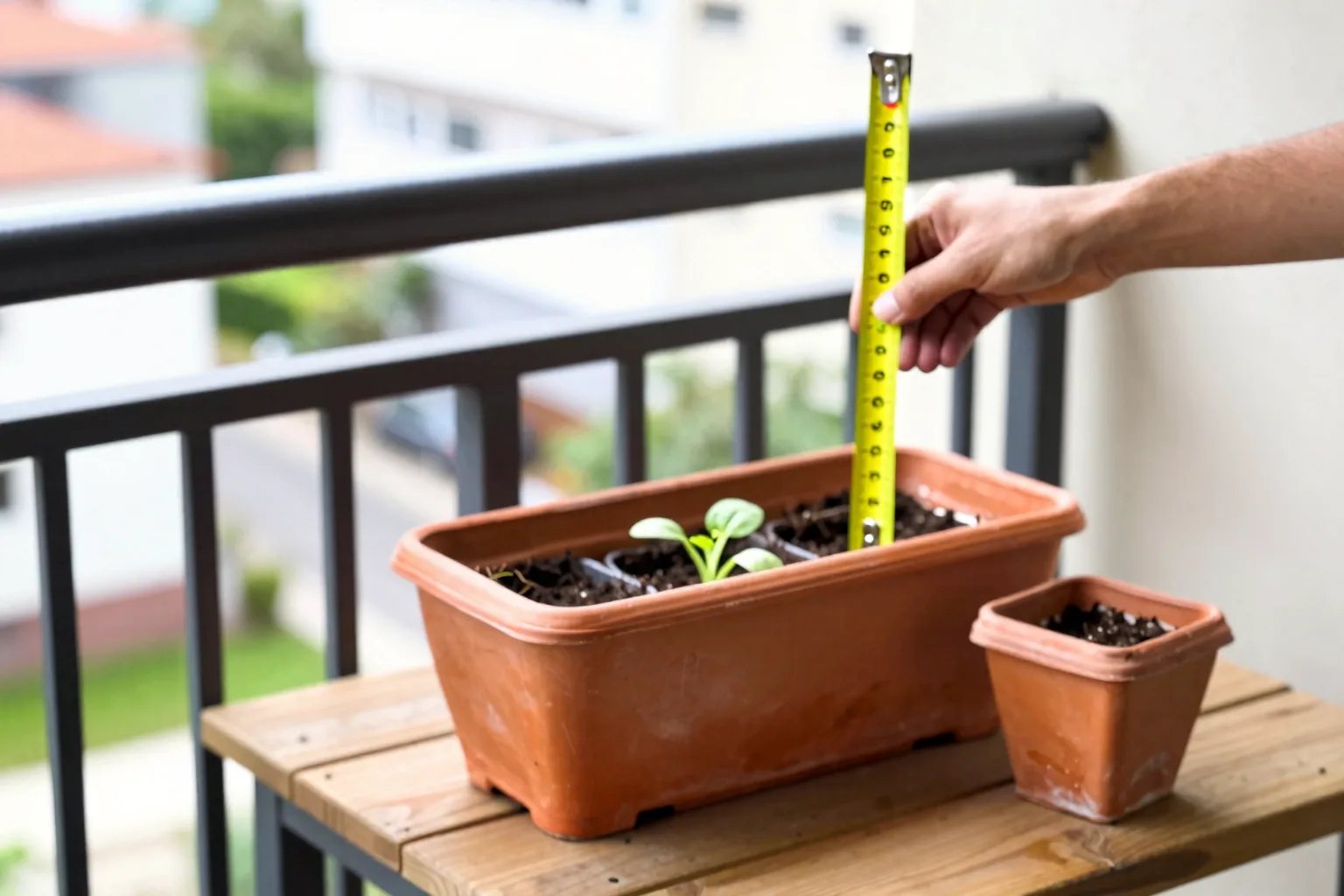
The short answer: 12 inches covers most mixed vegetable boxes
If you are buying one rectangular box for several crops, I use 12 inches (30 cm) of usable mix as the sensible default. That depth suits many greens, herbs, bush beans, peas, kale, chard, beets and compact root vegetables. It gives more moisture reserve than a shallow salad box without committing you to the weight and cost of a very deep container.
That is not a universal minimum. Leafy crops and radishes can produce in about 6 inches (15 cm), provided the mix stays evenly damp. Peppers, cucumbers and broccoli are more comfortable with 12–18 inches (30–45 cm), while tomatoes, eggplants and zucchini need a deeper root zone and stronger anchoring. For those, plan on roughly 18–24 inches (45–60 cm), especially on an exposed balcony.
Think of depth as solving one problem at a time. Shallow roots need less vertical space. Large fruiting plants need room for roots, a heavier plant canopy and the water reserve that keeps fruit production from being interrupted. A deeper box cannot compensate for a footprint that crowds the plants, but a wide box with only 6 inches of mix still limits the crops you can grow.
Quick depth chart: from 6-inch salad boxes to 24-inch tomato boxes
Use the first depth in the table as a practical starting point, not a promise of performance. The minimum assumes a compact variety, open drainage, a container mix and regular moisture checks. The more forgiving depth gives roots more room and gives you a wider margin when wind, heat or a missed watering changes the conditions.
| Crop or group | Minimum usable depth | More forgiving depth | What can change the choice |
|---|---|---|---|
| Lettuce | 6 in (15 cm) | 8–10 in (20–25 cm) | Heat makes shallow mix dry quickly; loose-leaf types are easier than large heads. |
| Spinach | 6 in (15 cm) | 8–10 in (20–25 cm) | Cool-season growth is straightforward, but shallow boxes need moisture checks. |
| Radishes | 6 in (15 cm) | 8–10 in (20–25 cm) | Choose short or round varieties if the root zone is shallow and free of stones. |
| Green onions | 6 in (15 cm) | 8 in (20 cm) | They need little anchoring space; a wider box is more useful than extra depth. |
| Small herbs | 6 in (15 cm) | 8–10 in (20–25 cm) | Woody perennial herbs such as rosemary are better with 10–12 inches (25–30 cm). |
| Bush beans | 8 in (20 cm) | 10–12 in (25–30 cm) | Loaded foliage can make plants top-heavy, particularly in a windy position. |
| Peas | 8 in (20 cm) | 10–12 in (25–30 cm) | The trellis and wind load may dictate box width and weight more than roots do. |
| Kale | 8 in (20 cm) | 12 in (30 cm) | Large plants stay productive longer with room for a substantial root mass. |
| Chard | 8 in (20 cm) | 12 in (30 cm) | Full-size plants benefit from the extra moisture buffer. |
| Beets | 8 in (20 cm) | 10–12 in (25–30 cm) | The swollen root needs loose mix below the seedling, not compacted soil. |
| Short carrots | 8–10 in (20–25 cm) | 12 in (30 cm) | Use the mature root length of the chosen variety, not the average carrot. |
| Full-length carrots | 12 in (30 cm) | 15–18 in (38–45 cm) | A shallow box can force short, forked or crowded roots. |
| Cucumbers | 12 in (30 cm) | 18 in (45 cm) | Vines require horizontal room, a support and steady water as well as root depth. |
| Broccoli | 12 in (30 cm) | 18 in (45 cm) | Large leaves and a heavy head make a broad, stable footprint useful. |
| Peppers | 12 in (30 cm) | 15–18 in (38–45 cm) | Compact varieties are easier; fruit-loaded plants may need a stake. |
| Eggplant | 12 in (30 cm) | 18–24 in (45–60 cm) | Tall varieties need a stable box and support, not just a deep root zone. |
| Potatoes | 12 in (30 cm) | 18–24 in (45–60 cm) | Extra mix allows hilling: adding mix around growing stems as the plant rises. |
| Tomatoes | 18 in (45 cm) | 20–24 in (50–60 cm) | Determinate patio types can reduce the requirement, but support and watering still matter. |
| Zucchini | 18 in (45 cm) | 24 in (60 cm) | The plant sprawls widely, so the box footprint and surrounding floor space are limiting. |
The crop group is only half the decision. A compact pepper and a vigorous pepper do not occupy the same space; a short carrot and a full-length carrot do not use the same root depth. For an unusual variety, university extension guidance on container vegetable root depth, mature spacing and crop-specific container requirements can provide a useful cross-check.
Measure the soil the roots actually get—not the outside of the box
The useful measurement is the internal distance from the lowest place mix can sit to the planned soil surface. Measure inside the box with a ruler. Do not count an enclosed cavity below a false bottom, a thick decorative base, or a liner that holds the mix several inches above the drainage outlets.
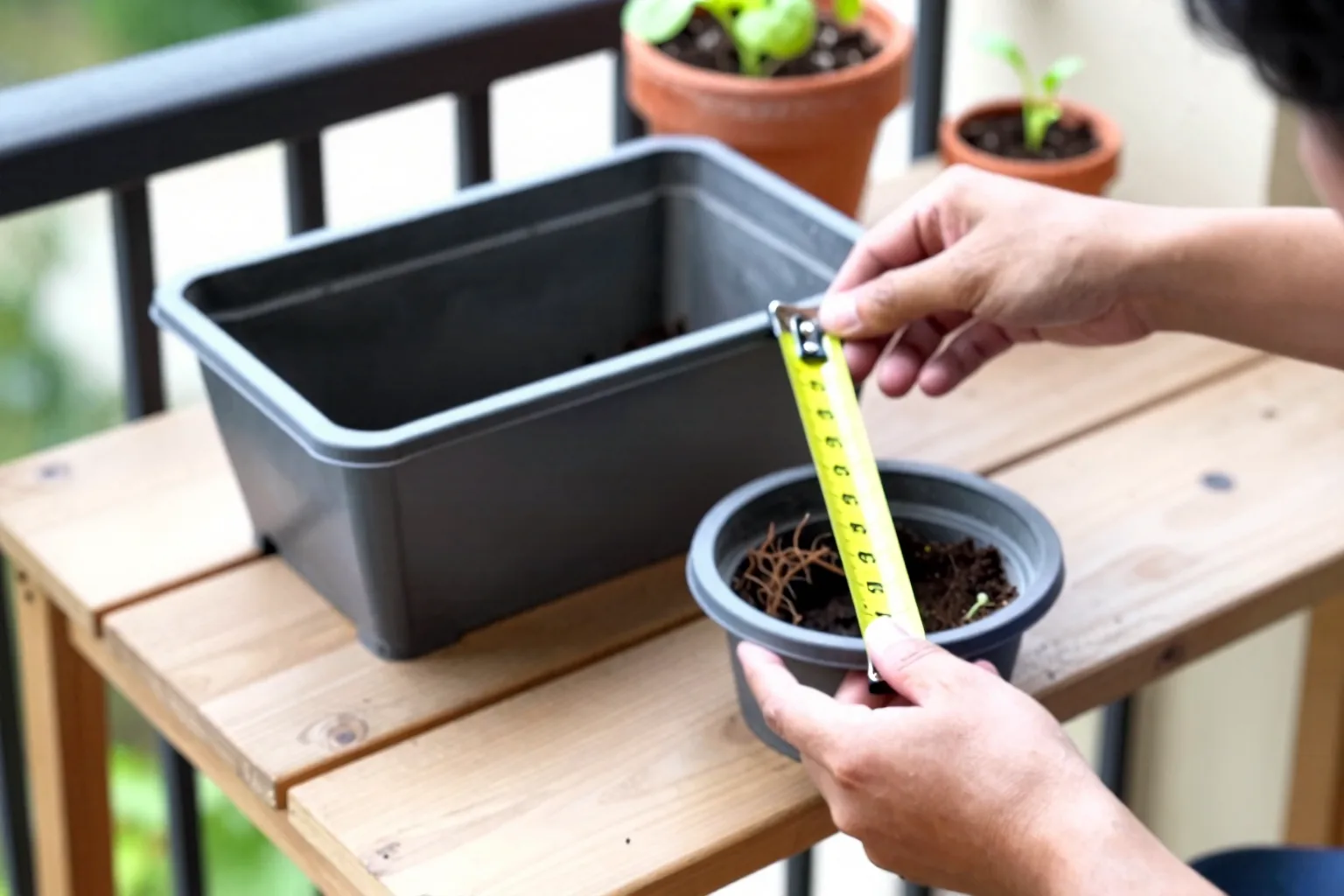
- Measure the internal length and width. Use the space where the mix will sit, not the rim overhang. If the box tapers, use the narrower lower measurement for a cautious estimate.
- Find the lowest usable floor. If an insert or raised drainage tray occupies the bottom, subtract its height from the outside measurement.
- Mark a fill line below the rim. Leaving about 2 inches (5 cm) of headspace keeps water from spilling over the edge and gives you room to water slowly.
- Calculate the volume. Multiply length × width × usable depth in centimetres, then divide by 1,000 to get litres. Divide litres by 3.785 for approximate US gallons.
For example, an internal mix space measuring 36 × 12 × 12 inches converts to about 91.4 × 30.5 × 30.5 cm. That is roughly 85 litres, or 22 US gallons, if filled to that depth. If the box is 14 inches tall and you leave 2 inches empty at the top, the 12-inch fill line is still the correct depth; the unused headspace is not wasted root volume.
Dry potting mix is also loose. Watering collapses some air pockets and moves fine particles into gaps, so the surface can drop after the first thorough soak. Fill to the planned line, water slowly until it drains, wait for the mix to settle, then top up before planting. Doing this in the reverse order leaves the roots higher than the depth you calculated.
Drainage holes do not make the bottom of a box instantly dry. The perched water table is the wetter layer that can remain at the base of a mix-filled container above the drainage openings, held there by the mix's small pores. Adding gravel below the mix changes the level at which that wet layer sits; it does not create more root space. The mechanism is explained in Planter Box Drainage Holes: How Many You Need and Why Gravel Backfires.
Length and width decide plant count after depth is right
Once the root depth is adequate, the footprint controls crowding. Plants need room for mature leaves, stems and access for watering. A broad box also spreads the weight and is less likely to tip when a crop or trellis rises above the rim. A narrow deep box can suit one tomato or a row of herbs; it is a poor place for several large plants sharing the same root zone.
Treat spacing on a seed packet as the distance between plants after thinning, not the distance at which you should leave every seed. The seedling stage is temporary. A box planned around tiny seedlings can look generous for three weeks and then become a damp, tangled canopy.
Here are conservative starting counts for two common footprints:
- 24 × 12 inches (61 × 30 cm): about 4–6 lettuce plants at 6–8 inches (15–20 cm) apart, 12–20 radishes at 3–4 inches (8–10 cm), 3 bush beans at 6–8 inches, or 1 pepper. Use it for one compact tomato only if the box is also deep enough; do not add a second large plant beside it.
- 36 × 18 inches (91 × 46 cm): about 8–10 lettuce plants at around 8 inches apart, 25–35 radishes at 3–4 inches, 5–6 bush beans, or 2 peppers with roughly 18 inches between centres. A tomato still deserves its own root space unless it is a genuinely compact variety.
These are planting layouts, not quotas. If the balcony is humid, shaded or difficult to water, use the lower end. Trailing cucumbers and zucchini need room to spill over the edge or climb a support, so their horizontal demand can exceed their root-depth demand.
Three box plans I’d choose for a balcony or patio
The three plans below turn the chart into shopping decisions. Their volumes are approximate and assume the stated usable depth, not the outside height. A box that is too heavy or awkward to move is not a good bargain, even if its dimensions are horticulturally ideal.
| Plan | Approximate size and mix | Good choices | Leave out | Support and maintenance |
|---|---|---|---|---|
| Salad and herb box | 24 × 12 × 8 in (61 × 30 × 20 cm) outside; about 6 in usable; roughly 28 L (7.4 US gal) | Lettuce, spinach, radishes, green onions, parsley and chives | Tomatoes, zucchini and full-length carrots | Little structural support; shallow mix needs closer moisture checks in sun or wind. |
| Mixed vegetable box | 36 × 12 × 14 in (91 × 30 × 36 cm) outside; about 12 in usable; roughly 85 L (22 US gal) | Kale, chard, bush beans, peas, beets, short carrots and herbs | Full-size tomatoes, zucchini and full-length carrots | Allow room for a modest pea support. The long narrow shape is easy to position but can be less stable with a tall trellis. |
| Deep crop box | 24 × 18 × 20 in (61 × 46 × 51 cm) outside; about 18 in usable; roughly 127 L (34 US gal) | One tomato, one eggplant, two peppers, full carrots or a compact potato planting | A crowded mixture of all those crops, plus sprawling zucchini in a tight balcony corner | Plan for a cage or stake. It is heavy when wet, so position it before filling. |
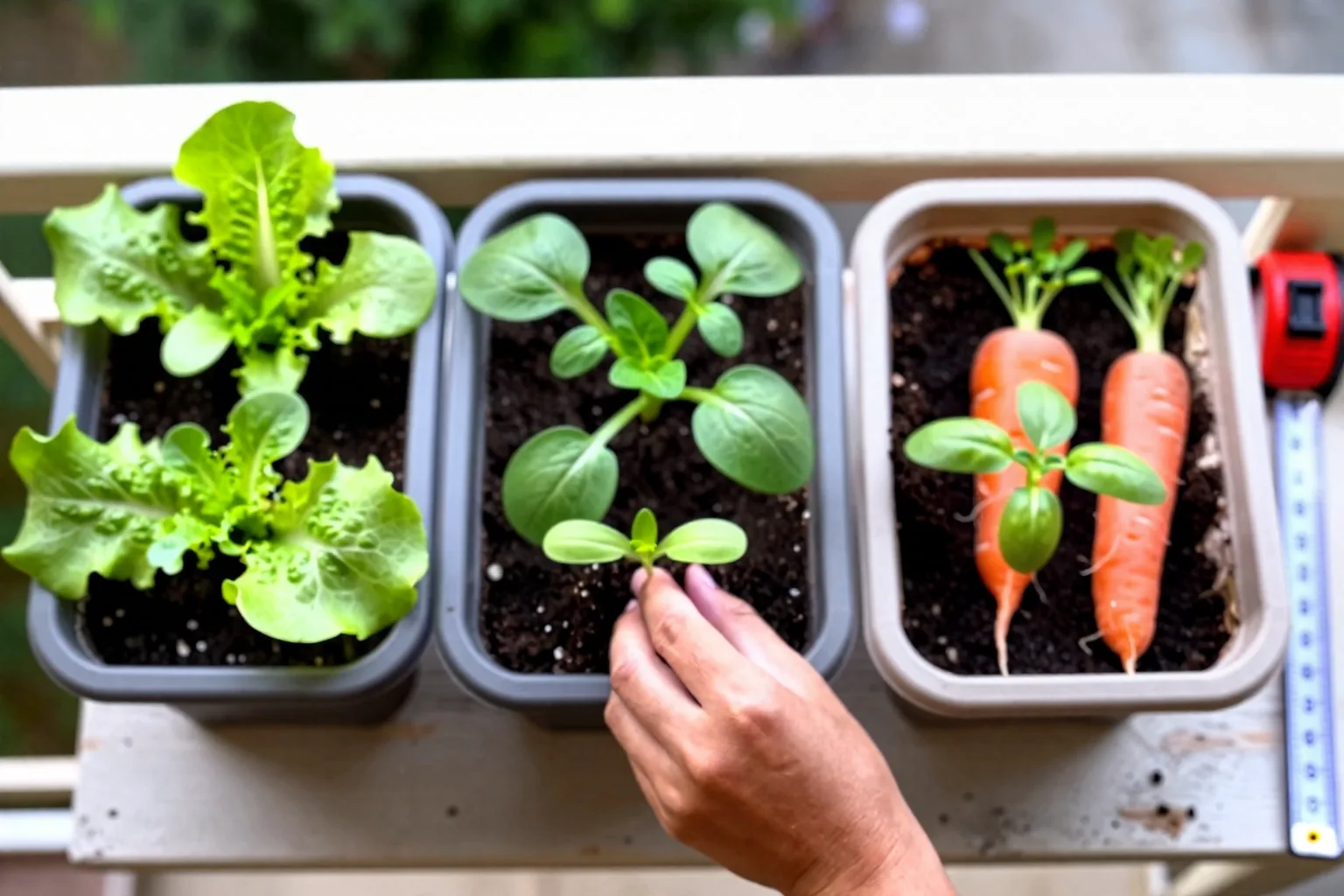
There is a useful trade-off here: one deep box devoted to a high-value crop can make better use of balcony space than a shallow box packed with incompatible vegetables. A tomato beside lettuce may look efficient on planting day, but the tomato eventually claims the light, support and water supply. Separate boxes let you move the salad crop into cooler light and water each root zone according to its demand.
Support changes the engineering. A tall tomato cage or pea trellis catches wind above the box like a small sail. The force is transferred down through the stems and support into the container, so a narrow, light box becomes easier to rock or tip. Use a wider footprint, place the box against a sheltered wall where permitted, or secure the support without blocking drainage.
A pre-purchase check for drainage, weight, and hot-weather drying
Before paying for a box, run through this short check:
- Inspect the drainage. Several open holes spread across the base are more useful than one hole at an edge. The box should drain onto a saucer or surface that can tolerate runoff, rather than onto a neighbour's balcony or a painted wall.
- Buy container mix, not garden soil. Garden soil can compact in a confined box, leaving fewer air spaces for roots and slowing water movement. A purpose-made container mix is designed to balance water retention with air-filled pores; it still needs checking because mixes vary by ingredients.
- Keep the 2-inch headspace. Filling right to the rim makes slow, deep watering harder and encourages runoff before the mix is evenly wet.
- Estimate the wet load. A deep box contains a large volume of mix, and retained water adds substantial mass. Check the box's base, the route it must travel when full, and your building's rules before placing it on an elevated space. I’d check local building, strata or municipal guidance on balcony and rooftop planter loads rather than assume a balcony can carry any container sold for outdoor use.
- Match the material to the exposure. Plastic is usually lighter and holds moisture longer. Porous terracotta can lose moisture through its walls as well as from the surface. In direct sun, a dark container can absorb more radiant heat than a pale one and warm the root zone. These are useful trade-offs, not fixed watering schedules.
- Check food-contact suitability. Do not assume that salvaged treated timber, an unknown coating or a decorative glazed pot is suitable around edible plants. Treatment, glaze and manufacturing details vary; check the maker's information or government food-safety guidance on treated timber, coatings and glazed materials used around edible plants.
Exposure can overturn the chart. A 6-inch salad box in a sheltered, bright patio corner may be manageable, while the same box on a windy rooftop can lose moisture quickly. For a schedule built around pot material, sun and weather, use How Often to Water Vegetables in Planters and Raised Boxes. If the balcony receives only two to four hours of sun, choose crops from Best Vegetables for a Small Balcony With Only Two to Four Hours of Sun instead of forcing a deep tomato box into a dim position.
Before the weekend: measure the intended box inside, mark the fill line, calculate litres, and write the crops that fit beside the measurement. Then check the drainage holes and the proposed location while the box is still empty. That five-minute check is what turns a plausible planter box into one you can actually manage.