Growing Blackberries in Containers: Pot Size, Supports & Pruning
A blackberry in a pot isn’t a miniature hedgerow: for many cultivars, a 10–20 gallon (38–76 L) container is a more workable starting point than the 5-gallon (19 L) pot that looks convenient in the shop. The other decision that can make or break your pruning is whether the label says primocane- or floricane-fruiting; check before you buy, because those names describe which canes carry the crop.
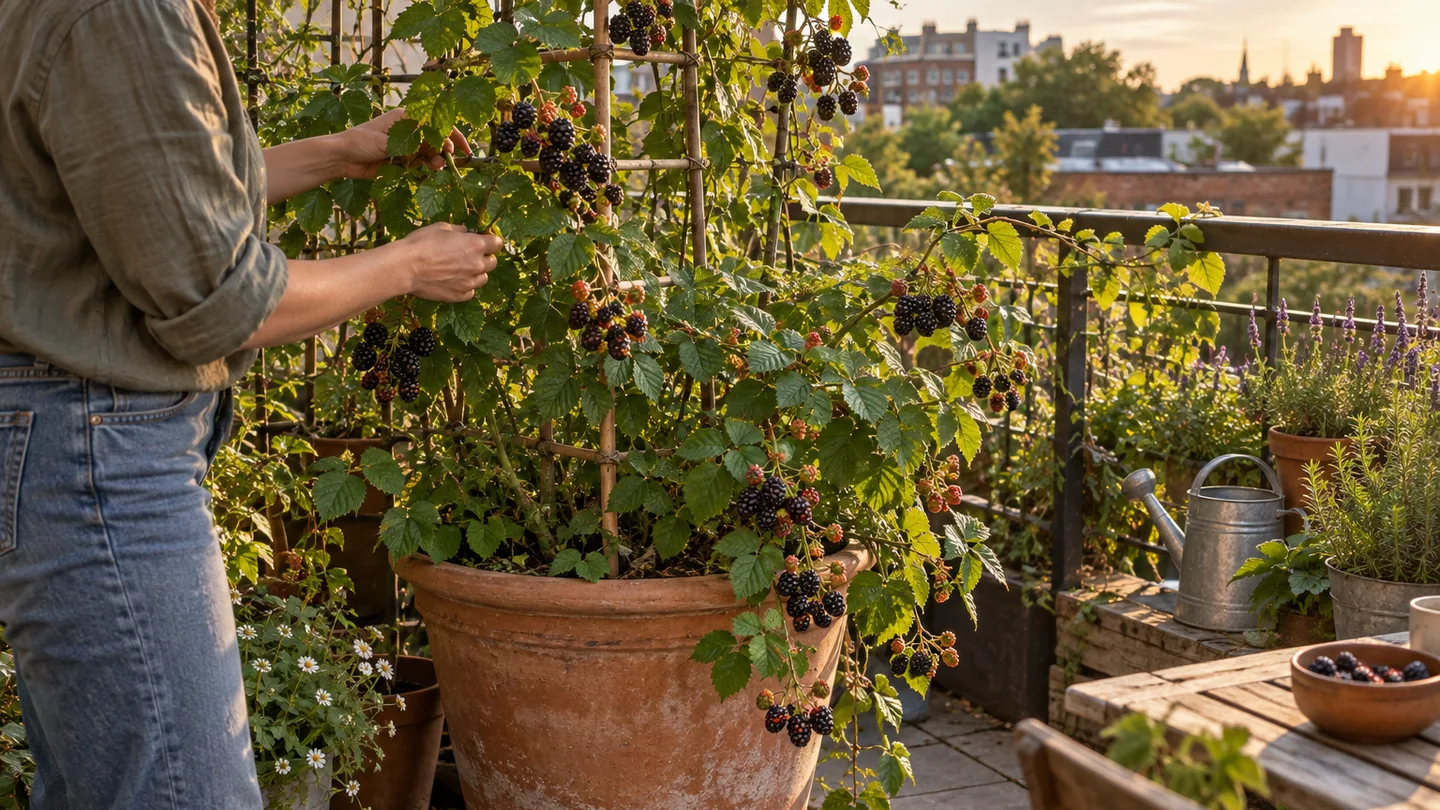
Here’s how I’d set one up: match the cane type to the space, give it a stable support, then prune by cane age rather than by guesswork. If your balcony gets only an hour or two of direct sun, be realistic about fruit: the plant may grow, but a shadier position is a poor bet for a dependable crop.
Start with the right cane type—and enough sun to ripen fruit
Blackberries make long-lived roots and fresh canes that rise from the crown, the point where the roots meet the stems. A primocane is a first-year cane. A floricane is a cane in its second year. The names matter because many traditional blackberries produce fruit on floricanes, while primocane-fruiting types can flower and fruit on the upper parts of first-year growth.
That difference changes what you keep at pruning time. A floricane that has fruited is finished; the replacement canes are next year’s fruiting wood. A primocane type gives you a choice: cut all canes back for a single crop on new growth, or retain suitable canes for a different, potentially two-season approach. The label should identify the fruiting habit. If it doesn’t, ask the nursery before taking the plant home rather than trying to solve the mystery with shears later.
Give the plant the brightest spot you can. Around six or more hours of direct sun is a useful target for better flowering and fruiting; one or two hours is a very different proposition. On a partly shaded balcony, the container can still support foliage and cane growth, but don’t choose a large, thorny plant on the assumption that shade will produce the same harvest as sun. A movable pot helps you follow the brightest seasonal spot, but it won’t make a deeply shaded balcony sunny.
When choosing a variety, put compact growth and a manageable cane habit ahead of a promise of large berries. “Compact” doesn’t mean no support or no pruning; it means you’re less likely to spend the summer redirecting a cane that has outgrown the space. For a first fruiting shrub in a small outdoor space, I’d rather have a less vigorous plant that fits the balcony than a famously productive type whose canes need more room than I can give them. If you’re comparing other edible crops for the same corner, Easy fruits and vegetables to grow in pots is a useful companion guide.
Pot, mix and drainage: use 10–20 gallons as the practical range
A 5-gallon (19 L) pot can hold a young blackberry, but it leaves less room for roots and dries faster than a larger container. I’d use it only when space is genuinely tight and I can check moisture often. For many container-grown plants, 10–20 gallons (38–76 L) is a more workable range. Choose the lower end for a naturally restrained cultivar or a balcony where weight and footprint are limiting; move toward the upper end when you have room and can safely support the filled pot.
| Container choice | What it means in practice | Best fit |
|---|---|---|
| 5 gallons (19 L) | Restrictive root space; expect to monitor moisture closely. | A temporary or space-limited setup, with regular checking. |
| 10 gallons (38 L) | A more useful starting size for one plant. | A compact type or a small balcony with room for one pot. |
| 15–20 gallons (57–76 L) | More mix around the roots and a larger moisture buffer. | A vigorous plant, if the footprint and supported load are acceptable. |
As a rough shopping guide, many pots in the useful range are about 18–24 inches (45–60 cm) across and deep. Shape matters: a tall narrow pot and a wide shallow pot with the same advertised volume don’t give roots the same arrangement, and nominal volume varies by manufacturer. Check the actual inside dimensions and capacity rather than assuming that a pot’s label tells the whole story. Use one blackberry per pot; crowding two crowns into one container makes watering and cane management harder without creating more root room.
Fill with a free-draining container mix, not garden soil packed into a tub. Use a pot with open drainage holes so excess water can leave. Gravel at the bottom doesn’t fix a slow-draining mix: it takes up space, and the change between fine mix and coarse stones can leave water held above the gravel rather than making it drain sooner. If water sits on the surface or the pot stays saturated, inspect the mix and holes instead of adding a layer of stones.
A slightly acidic mix is commonly recommended for blackberries; a practical target often given is about pH 5.5–6.5. If your mix is far outside that range, changing it with guessed amounts of amendments is a poor first move. Start with a suitable container mix, and check the plant label or local growing guidance before adding material that shifts pH.
One trade-off deserves a pause: the larger pot is not automatically the better balcony pot. Wet mix is heavy, and the plant plus support catches wind. Check your building or property rules and the balcony’s load guidance before placing a filled container near an edge or grouping several large pots. For that decision, look up local building guidance on balcony load limits; don’t infer a safe load from how sturdy the railing looks.
A concrete setup to plan around: one 15-gallon (57 L) pot, one labeled blackberry, and four strong canes trained into a support within the pot’s footprint. That is a manageable starting layout, not a promised harvest. The expected practical result is four stems to tie and track instead of a tangle of uncounted growth; if the chosen cultivar is much more vigorous, thin or redirect canes as they grow rather than forcing them into an undersized frame. The outcome to watch is whether the canes stay separated and the mix remains evenly moist, not a fixed number of berries.
Install support before the canes sprawl across the balcony
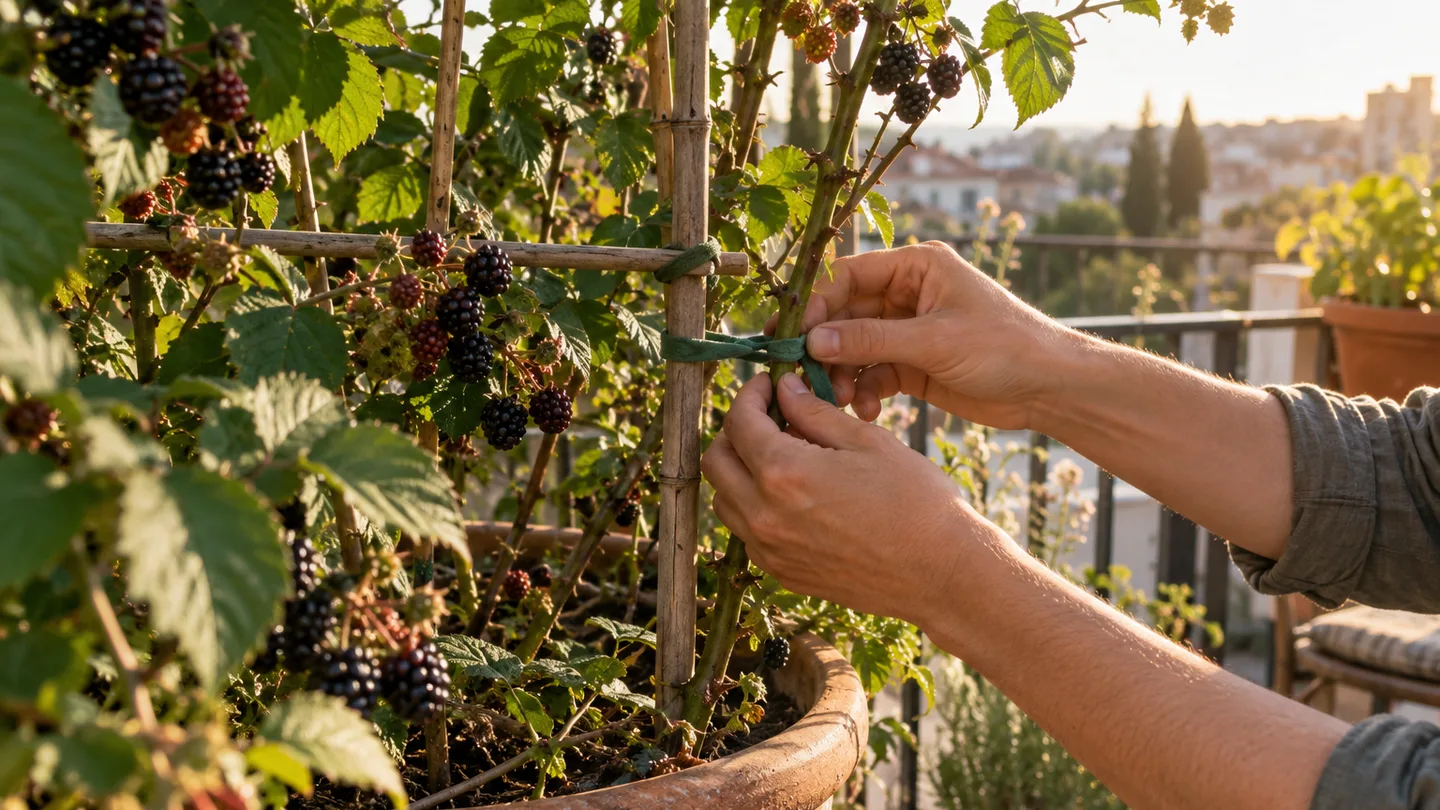
Blackberry canes can arch, trail, or stand more upright depending on cultivar. A sturdy stake or compact cage may suit a naturally upright plant; longer, flexible canes are easier to guide along a simple trellis. Many container setups need a support roughly 4–6 feet (1.2–1.8 m) high, but let the cultivar and available space set the final height. A short frame that holds canes neatly is more useful than a tall one that acts like a sail in the wind.
Fit the support before planting, or while the canes are still small. Pushing a stake into a mature root ball risks cutting through roots you want to keep. For a trellis, secure the frame to a stable structure where permitted, or use a design that has its own broad, stable base. Don’t count on a loose pot alone to keep a tall, leafy support upright in a gust. If you can’t anchor the frame safely, choose a lower support and keep the canes within it.
Tie canes loosely with soft garden ties. Leave room for the stem to thicken; a tight loop can pinch it. I’d guide new canes to one side of the support and keep older, fruiting canes separate where the layout allows. That small bit of sorting makes post-harvest pruning simpler: you can identify which canes have finished without cutting into the replacements by mistake. Keep ties easy to reach, since you may need to reposition a growing cane rather than bend it sharply all at once.
Wind exposure changes the support decision. A sheltered patio may suit a light frame, while an exposed rooftop needs more attention to anchoring and the combined load of pot, wet mix, plant, and support. Don’t improvise a tie to a railing unless the property permits it and the attachment is designed for that use. When in doubt, keep the whole arrangement low and close to a secure wall, away from a walkway.
Keep the root ball evenly moist from planting through fruit set
Plant a dormant bare-root blackberry with its roots spread out and covered, following the nursery’s planting-depth directions. For a potted nursery plant, set the root ball so the soil surface sits at the same level it did in its original pot; avoid burying the crown. Water after planting to settle mix around the roots, then let excess drain freely.
Don’t water by a fixed weekday schedule. Check the top inch (about 2.5 cm) of mix with a finger, then water thoroughly when it feels dry. Pour slowly enough for the mix to absorb water, and continue until excess drains from the holes. Check more often during hot, windy weather and in a smaller, sun-warmed pot; a larger container usually gives you more buffer, but it can still dry out in exposed conditions.
Wilting doesn’t tell you by itself whether the plant needs water. A dry root ball can leave leaves limp; so can roots sitting in saturated mix with too little air. Before watering again, feel the mix below the surface and look at the drainage holes. Dry mix points toward a thorough watering. Wet, heavy mix suggests checking blocked holes, a saucer holding standing water, or a mix that stays saturated. Adding more water to the second situation can prolong the stress rather than relieve it.
Feed conservatively, using a fertilizer labeled for edible plants and following its directions. Too much nitrogen can push leafy cane growth at the expense of the balance you want from a fruiting plant. Don’t stack fertilizer doses because growth looks slow: first check sun, moisture, drainage, and whether the plant is still establishing. A container loses some nutrients as water drains through it, but that does not mean every watering should carry fertilizer.
In my judgment, moisture checks are a better use of attention than buying a complicated watering gadget for one pot. A simple check tells you what the root zone is doing today; the calendar can’t account for a windy afternoon, a shaded corner, or a pot that warmed in full sun. If you’re also tending smaller fruit containers, the article on growing blueberries in containers covers the separate acidity and watering decisions that crop needs.
Prune by fruiting habit: remove spent canes, keep the ones that matter
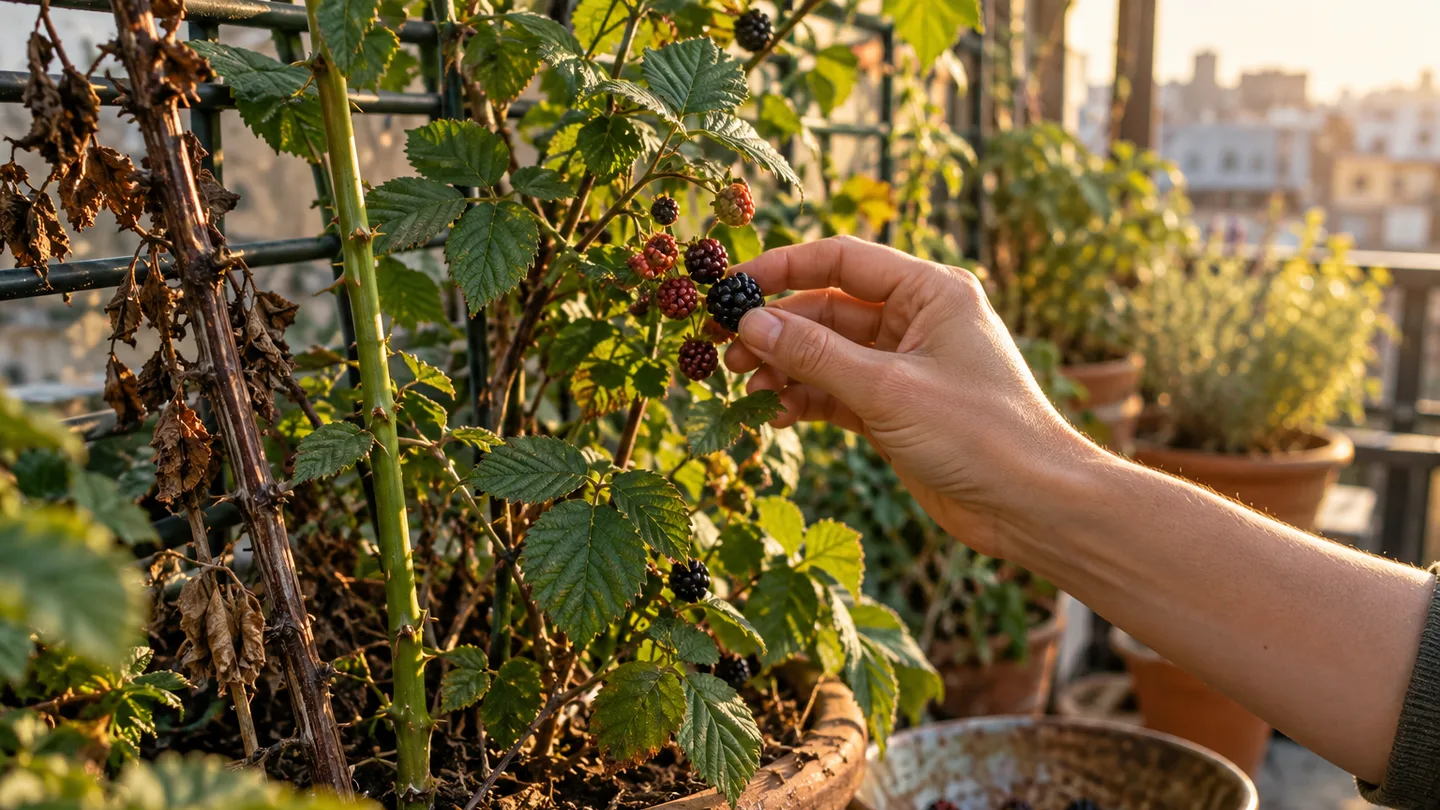
Pruning is where the label earns its place. For a floricane-fruiting blackberry, the cane grows in its first year, fruits in its second, and then dies back. After harvest, cut the spent floricanes near the base and remove them. Keep healthy new canes that will become next year’s fruiting wood. If you remove every cane because the plant looks crowded, you can remove the crop you were waiting for.
For a primocane-fruiting type, decide whether you want one crop or to manage canes across two seasons. For a single fall crop, growers commonly cut all canes down during late winter dormancy; the new season’s growth then carries the crop. If you want to retain canes for a later crop as well, don’t automatically cut the whole plant back. Remove the portions that fruited according to the cultivar’s instructions and keep suitable lower cane growth for the next season. In a short or cool season, the later crop may not have time to ripen, so the simpler single-crop system can be the more sensible choice.
For one container plant, a starting point of about 3–5 strong canes is easier to support and inspect than a mass of thin, crossing growth. Treat that as a working range, not a rule: a compact cultivar in a small pot may need fewer, while a larger container and vigorous plant may support more. Remove weak, damaged, or badly tangled canes at the base, and avoid stripping healthy replacements just to make the plant look sparse.
Use the support to keep the cane groups distinct. As the season goes on, mark or loosely tie new growth to one side and keep fruiting canes on another where possible. After the harvest, cut out the canes that have finished. This simple sorting system matters more than a fancy pruning pattern: it reduces the chance of confusing next year’s fruiting wood with the stems that are already done.
Pick berries when they are fully colored, plump, and release easily with a gentle lift. A berry that still resists may need more time; don’t tug hard enough to damage the cane. Harvest readiness can vary with cultivar and weather, so check the plant rather than treating a calendar date as a signal.
Roots in an exposed container experience more temperature swings than roots in the ground. Before winter, move the pot to a sheltered outdoor position if you can do so safely, and insulate around the container where local conditions call for it. Keep drainage open; wrapping a pot should not trap water around the roots. A heated room is not a substitute for the outdoor seasonal cycle for many blackberries. Check the cultivar’s winter needs and your local climate, especially if your balcony is exposed or your winters are severe.
Do I need two blackberry plants to get fruit?
Many commonly grown blackberry cultivars are self-fertile, so one plant can set fruit. Check the variety label for an exception and remember that fruit set still depends on suitable growing conditions and flowering.
Can I grow a blackberry from seeds in a store-bought berry?
You can try, but a seedling may not match the named variety and its growth and fruiting traits are less predictable than those of a labeled nursery plant. If your space is limited, starting with a named cultivar makes it easier to choose a cane habit that fits.
Can I keep a potted blackberry indoors all winter?
A heated room generally isn’t a good stand-in for the outdoor seasonal rest many blackberry cultivars need. Winter requirements differ, so check the cultivar and local conditions; a sheltered, unheated outdoor spot may be a better fit where the plant can tolerate the winter there.
This week, check the plant label for its fruiting habit, measure the spot where the pot will sit, and make sure you have a safe place to anchor its support before you buy.
Frequently Asked Questions
Do I need two blackberry plants to get fruit?
Most commonly grown blackberry cultivars are self-fertile, so one plant can set fruit; check the cultivar label for exceptions.
Can I grow a blackberry from seeds in a store-bought berry?
You can try, but seedlings may not match the named variety and are less predictable than starting with a labeled nursery plant.
Can I keep a potted blackberry indoors all winter?
A heated room is generally not a substitute for the plant’s outdoor seasonal dormancy; explain how needs vary by cultivar and local winter conditions.