Bitter Cucumbers: Why It Happens and How to Prevent It
A bitter cucumber has more of the natural bitter compounds called cucurbitacins than a mild one. Genetics set the baseline, but a cucumber plant that swings from a dry root ball to a flooded pot during hot, windy weather can produce fruit that tastes harsher.
In a container, prevention is less about finding a magic fertilizer and more about giving the roots enough mix to buffer weather, then keeping that mix evenly moist and harvesting at the size your variety expects.
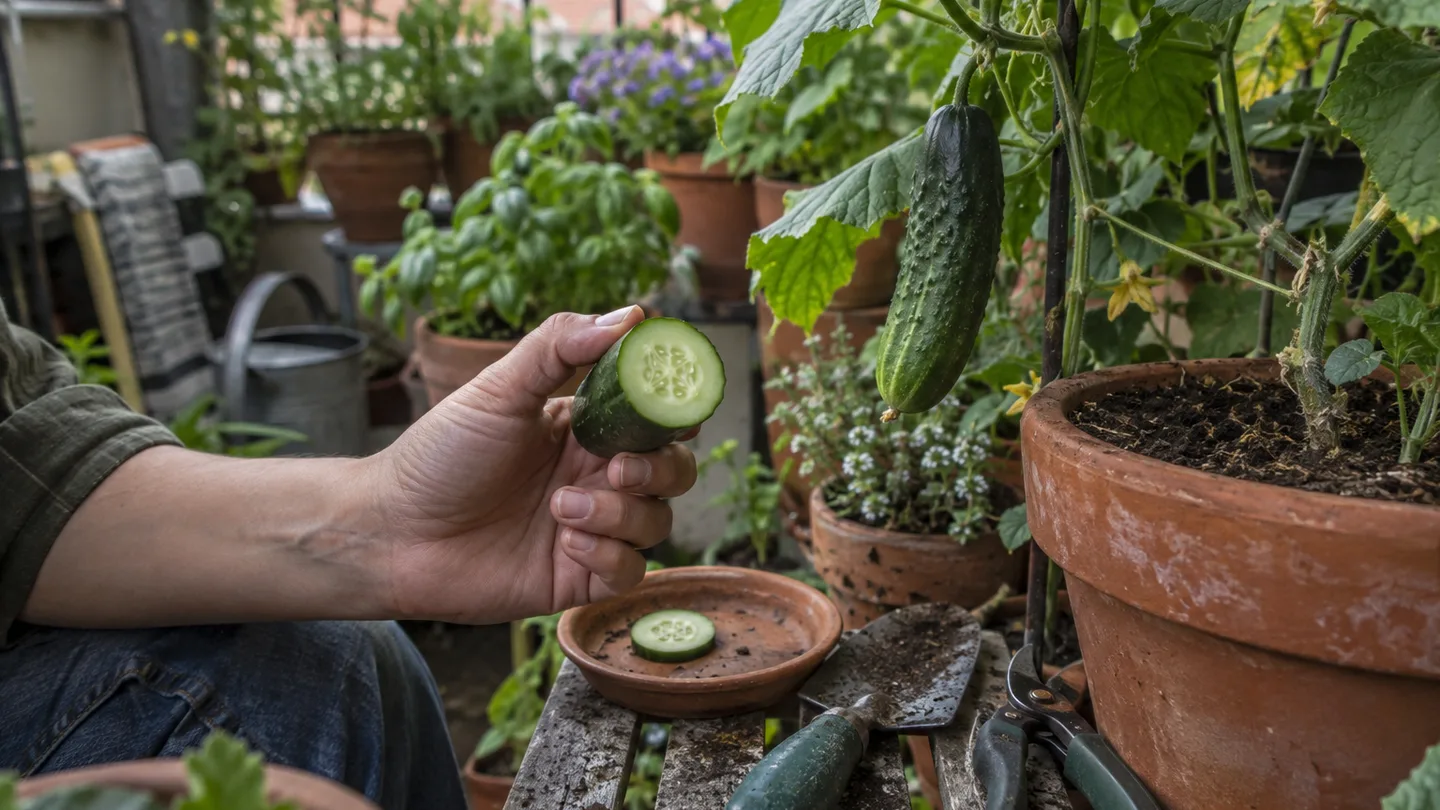
Cucurbitacins are the culprit: why the stem end tastes worse
Cucurbitacins are natural bitter compounds made by cucumber plants. They are not a sign that the fruit has developed a disease, and bitterness is not automatically caused by leaving a cucumber on the vine for too long. The plant’s genetics establish how readily a particular cucumber can become bitter; growing conditions can then push that tendency in one direction or the other.
That is why two plants grown in similar pots can behave differently. One cultivar may stay mild through a short dry spell, while another produces a fruit with a sharp, unpleasant edge after the same weather. A plant labelled burpless may be selected for lower bitterness, but burpless does not mean every cucumber from that plant will be guaranteed mild.
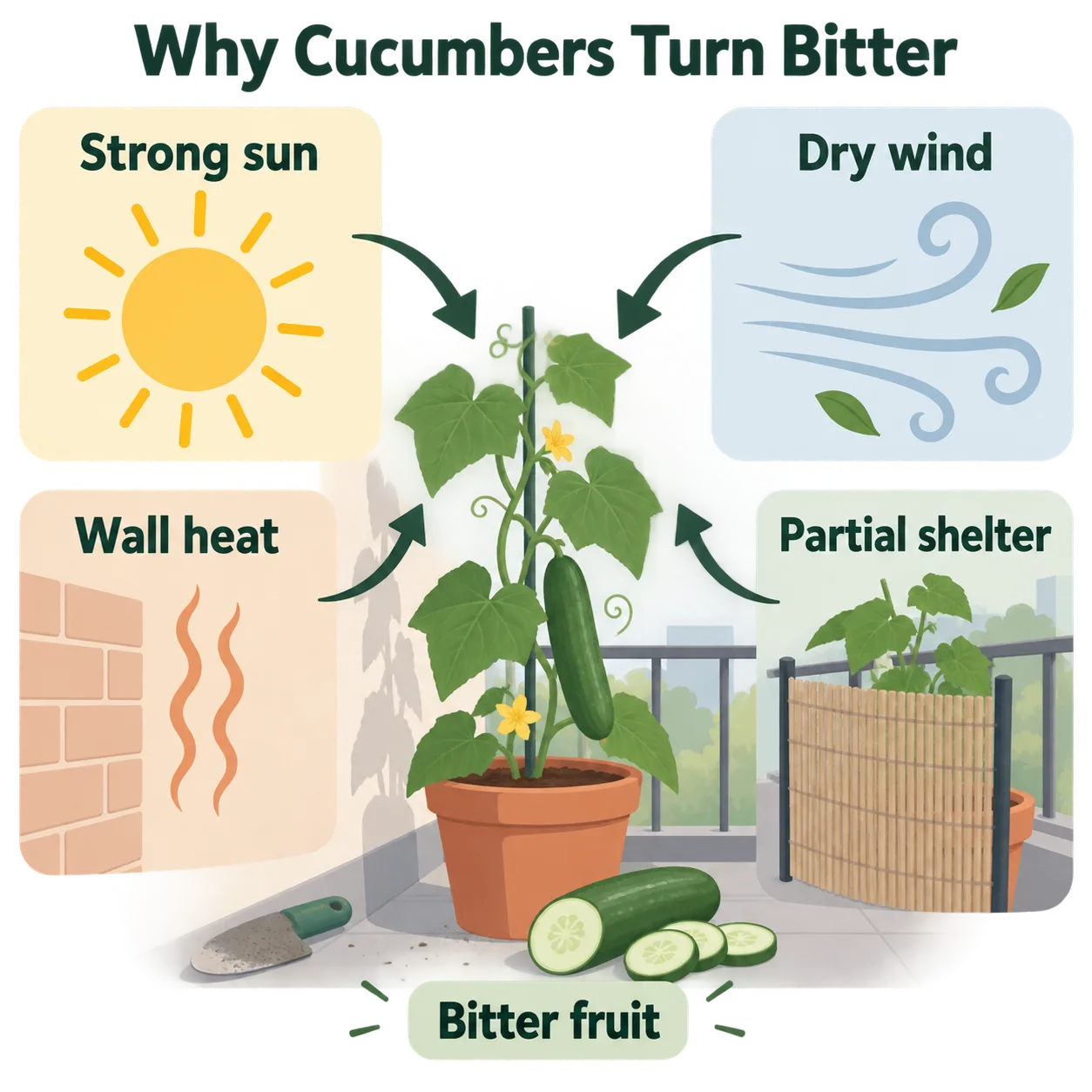
Stress can come from several directions. A small pot can dry quickly in full sun. A balcony can add wind, which pulls moisture from leaves and potting mix faster than a sheltered garden does. Root disturbance during transplanting, repeated missed waterings, or a pot that stays saturated after watering can also leave the plant struggling.
The common pattern is stronger bitterness in the skin and near the stem end, where the fruit attaches to the vine. The centre may taste fine while the outer layer is harsh. That pattern is useful, but it is not a rule for every fruit: bitterness can be spread through the flesh, and fruit from the same plant can vary.
For a second opinion, University extension guidance on cucumber bitterness, cucurbitacins and environmental stress is worth comparing with what you see in your own pot. The useful thread is the interaction between cultivar and growing conditions, not the idea that one missed watering explains every bitter cucumber.
The one-fruit versus whole-plant test: genetics, weather or root-zone stress?
Before repotting, feeding or flooding the plant, I would first decide whether the problem is isolated or repeating. One bitter cucumber on an otherwise vigorous plant is a different diagnostic situation from four bitter fruits appearing after a week of hot weather.
Use the previous seven days as your evidence. I would check these points in order:
- How many fruits are affected? One fruit may reflect cultivar tendency, maturity, or ordinary fruit-to-fruit variation. Several bitter fruits in sequence deserve a closer look at the root zone.
- Did the pot dry hard? Look past the surface. If the top is dusty but the deeper mix is still damp, you may have a watering problem in either direction rather than a simple lack of water.
- Was the plant exposed to heat or wind? A cucumber in a dark plastic pot against a hot wall can lose moisture much faster than one in a glazed pot in part shade.
- Were the roots disturbed? Recent transplanting, a broken root ball, or a trellis pushed deep into the pot can all interfere with the root zone.
- Does water drain freely? If water sits in the saucer or the mix stays slick and heavy for days, adding more water is not a correction.
Leaf behaviour can add a clue, although it is not a diagnosis by itself. Leaves that droop only during the hottest part of the afternoon may be responding to demand from the weather. A plant that is still limp early in the morning, especially when the mix is wet, makes me inspect drainage and roots before I reach for the watering can.
If one fruit is bitter and the next few fruits look normal, I would not overhaul the whole plant. If bitterness starts after missed watering, a heatwave or root disturbance and continues across several fruits, I would stabilise care first. That sequence matters because changing three things at once makes it impossible to tell whether the original stress was involved.
Burpless is worth treating as a useful selection clue, not a warranty. The label may indicate a lower-bitter type, but the plant still has to grow in a suitable root zone. A burpless cucumber in a tiny, fast-drying pot can still disappoint, while a standard slicing type in a stable container may produce mild fruit.
The prevention routine that keeps a cucumber from swinging between drought and saturation
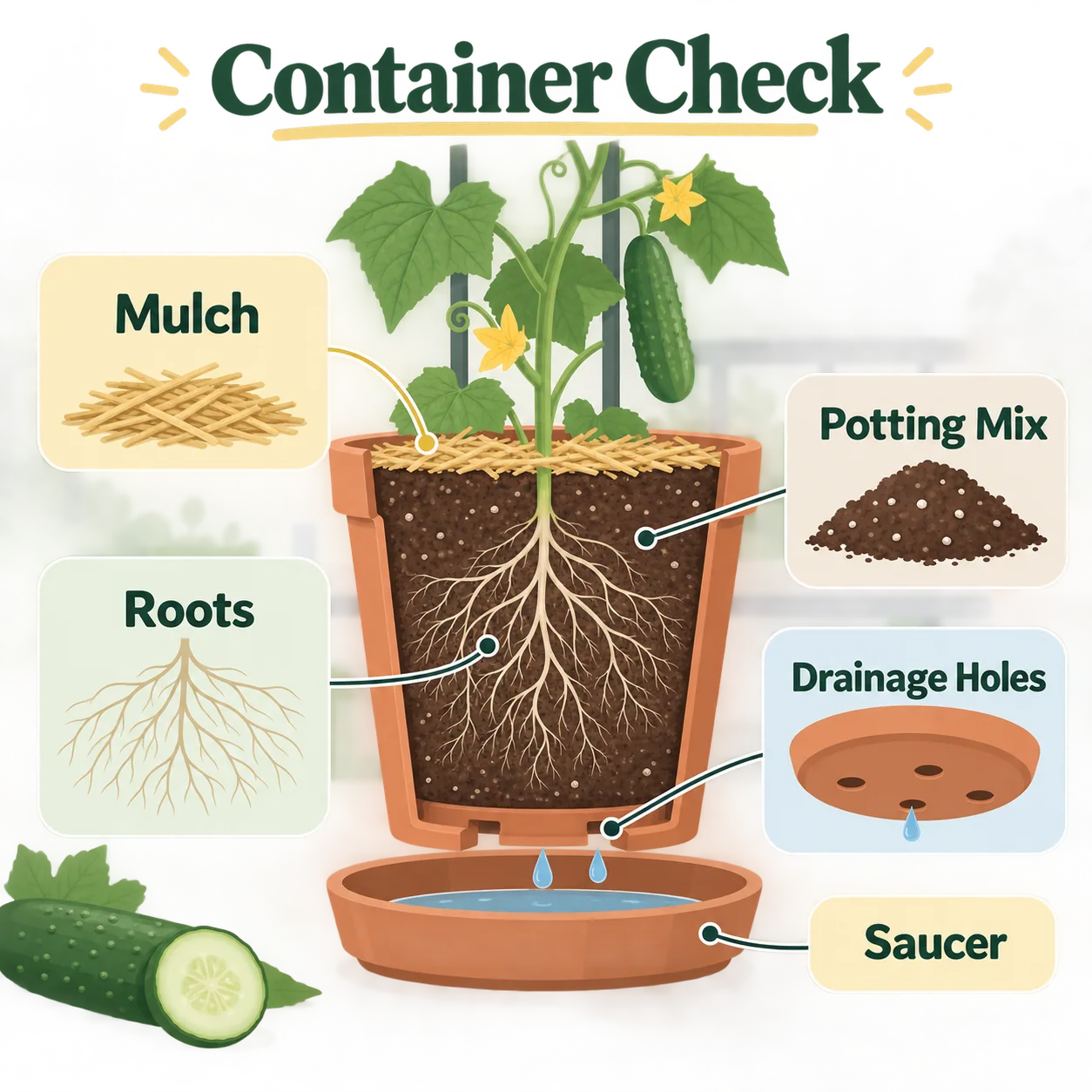
Root volume is your first buffer in a container. For one compact cucumber, I would allow about 20–30 litres of potting mix, or roughly 5–8 US gallons. A vigorous vining type gets a better margin from about 30–40 litres, or approximately 8–10 US gallons, if your balcony has room for the pot and a secure support.
Those figures are not a promise that every plant will perform identically. They are a practical point at which the pot holds enough mix to slow down rapid moisture changes without becoming unmanageably large. I prefer one cucumber plant per pot in this range rather than packing several plants into one small container. If you are still choosing crops for the same space, the guide to easy fruits and vegetables to grow in pots can help you compare cucumber with crops that need less support and water.
Start with a container potting mix, not soil dug from the ground. Garden soil can settle into a dense mass in a pot, leaving less air around the roots and making watering harder to judge. Fill the container to a few centimetres below the rim so water does not immediately run over the sides.
Keep every drainage hole unobstructed. If mix falls through a large hole, cover it with a piece of mesh or a thin pot shard that still lets water escape. Do not build a thick gravel layer at the bottom. A perched water table is a wet band that remains above the drainage point because the fine potting mix holds water against the change in texture; gravel does not create extra root room, and it can move that wet band higher into the container.
A 2–5 cm layer of loose mulch helps slow evaporation from the surface. Straw, fine bark or another container-suitable mulch can work, but leave a small gap around the stem so the crown stays dry and visible.
My own balcony routine is deliberately boring. I treat a 25-litre plastic pot in full sun as a daily-check pot, keep it on feet so the drainage hole is not pressed against the floor, and inspect the top few centimetres each morning. That is not a yield trial; it is simply a way to catch the dry-to-flood swing before I start guessing from the leaves.
Use this watering sequence:
- Push a finger 2.5–5 cm into the mix. In a large pot, use a wooden skewer or check farther down as well, because a dry surface does not prove that the entire root ball is dry.
- If the mix is dry where the active roots are, water slowly over the whole surface rather than pouring against the stem.
- Let the first pass soak in. If water runs straight down the sides or the surface repels it, pause for roughly half a minute and repeat with a slower second pass.
- Continue until a small amount begins to drain from the holes, then empty standing water from the saucer.
Small sips can wet only the top layer, leaving the centre of the root ball dry. The opposite mistake is keeping the mix permanently saturated. Water-filled pore spaces contain less air, so roots can lose function even while the leaves look wilted. That is how overwatering and underwatering end up producing similar symptoms: the plant cannot move water normally through a damaged or stressed root zone.
In hot, windy sun, check the pot every day and expect to water more often when the mix reaches your dry-point test. In cooler weather or part shade, the same container may need checking every few days instead. I would rather check and decide than follow a fixed calendar, because pot material, wind, plant size and humidity can change the drying rate quickly.
Do not use extra fertilizer as a rescue treatment for a bitter fruit that has already formed. Feed a growing plant according to the product directions if its leaves and growth indicate a nutrient need, but fertilizer cannot replace root volume, water or drainage. For a wider list of quick container crops, fast growing vegetables in pots for beginners is a useful comparison, especially if cucumber care is becoming more demanding than the space allows.
Harvest by the variety's ruler, not by waiting for a giant fruit
Many slicing cucumbers are harvested around 15–20 cm, or 6–8 inches, but that range is not a universal target. Pickling types are often taken much smaller, around 5–10 cm, or 2–4 inches. Miniature, Asian, lemon and specialty cucumbers can have completely different ideal sizes, so the seed packet or plant label is the best ruler for that particular cultivar.
Check a producing plant every one or two days. A fruit that looks modest in the morning can be noticeably larger after warm weather, and missing several harvests can leave you with tougher skin, larger seeds and a less pleasant texture. Use length alongside firmness and colour: a cucumber that is soft, yellowing when it should be green, or visibly swollen with mature seeds has gone past the texture most people want for fresh eating.
Pick with scissors or a knife rather than twisting hard against the vine. That reduces the chance of tearing the stem or disturbing the support. If you find one oversized fruit, remove it and continue checking the plant; an overgrown cucumber is not proof that every later fruit will be bitter.
Late harvest can make a cucumber seedy and coarse, but it is not the only possible cause of bitterness. A small, freshly picked cucumber can still taste harsh if the cultivar has a strong bitter tendency or the plant has been under root-zone stress.
When one fruit is bitter: salvage limits and the next decision
If the bitterness is mild and limited to the skin or the stem end, peeling and trimming may improve the flavour. Treat that as a salvage option, not a reliable cure. I would cut away the stem end, remove a strip of skin, and taste only a small piece if the remaining flesh seems normal.
If the flesh remains strongly bitter, stop tasting it. I treat intense bitterness as a food-safety question rather than a recipe problem. Salt, cooking and pickling may change texture or mask some flavours, but I would not rely on them to make a strongly bitter cucumber suitable for eating. Food-safety or poison-control guidance on unusually bitter cucurbits is the right place to check if the taste is extreme or someone feels unwell after eating it.
For the plant itself, use this decision path:
- One bitter fruit, healthy plant: remove it, note its size and where the bitterness was strongest, then inspect the next two or three fruits before changing the setup.
- Several bitter fruits after a dry spell or hot, windy week: correct the watering pattern and check drainage. Do not flood the pot to compensate for earlier dryness.
- Several bitter fruits despite steady moisture, good drainage and appropriate harvest size: treat the cultivar as the likely weak point and choose a variety labelled low-bitter or bitter-free next season.
Removing a bitter fruit does not reset the plant’s genetics, but it does make the next harvest easier to judge. If stress was the main driver, I would expect the next fruits to improve after the root zone becomes steady. If the next two or three fruits remain intensely bitter under stable care, that expectation has failed and changing varieties becomes the sensible move.
The cure for a bitter cucumber is usually fewer swings, not more water. Before the weekend, check the pot size, clear the drainage holes, buy mulch if the surface dries quickly, and make a note of the variety’s recommended harvest length. Over the next week, check the mix at the same depth each morning and record whether the next fruit is mild at the skin, stem end and centre. That small log will tell you more than guessing from one disappointing cucumber.