Growing Parsley in Pots: Choose a Pot at Least 8 Inches Deep
For growing parsley in pots, choose at least 8 inches (20 cm) of usable soil depth; a 10–12-inch (25–30 cm) opening is a practical starting point for one plant. That depth is measured from the inside bottom to the soil line—not from the outside of a pot that leaves an inch of empty space above the mix.
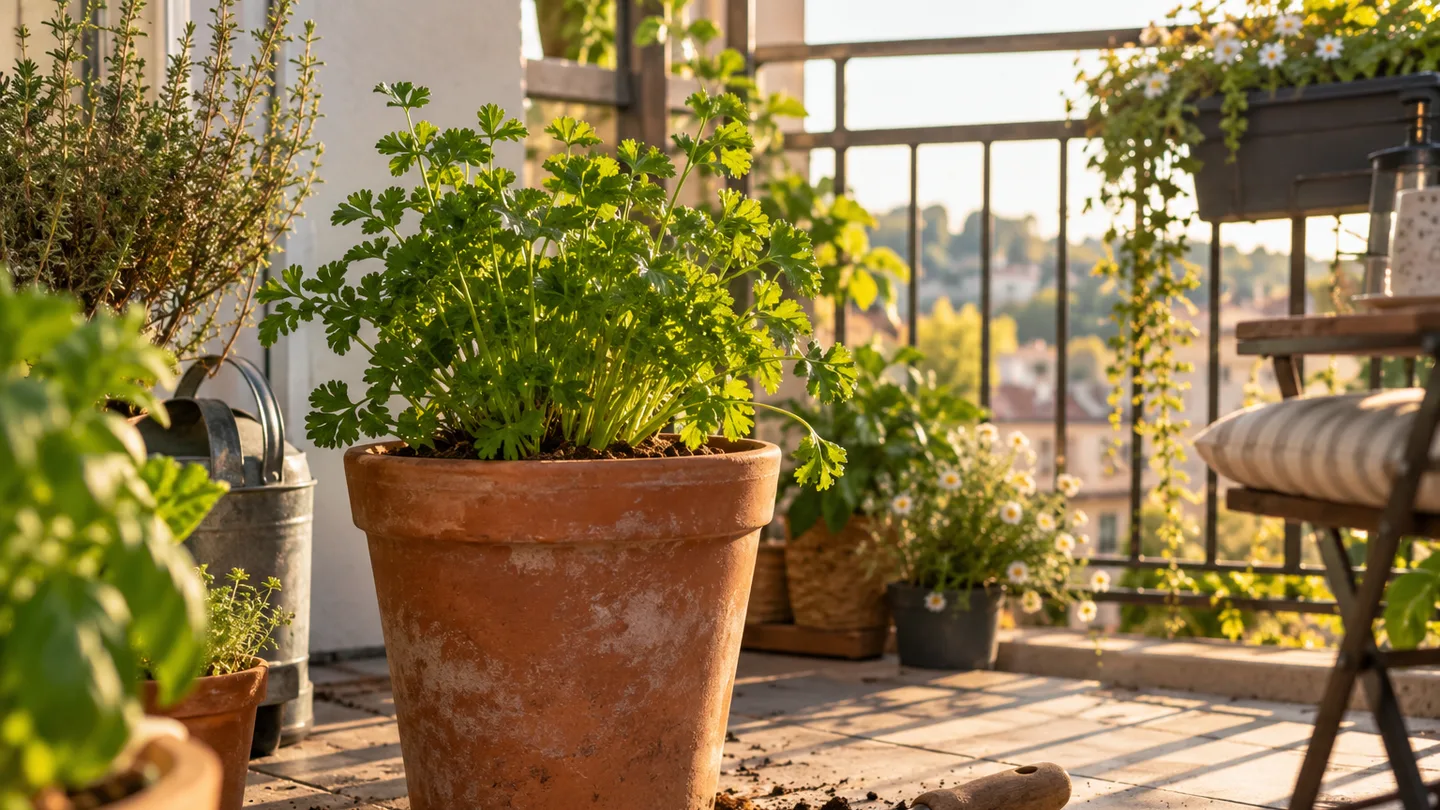
That distinction saves a common bit of disappointment: a pot can look substantial, yet leave parsley with less root room than its label suggests. Here’s how I’d size the pot, start the plant, and adjust care for the light your balcony actually gets.
An 8-inch internal depth is the floor—not the whole pot specification
Think of the 8-inch (20 cm) depth as the amount of mix parsley can use, not necessarily the pot’s outside height. Leave roughly 1–2 inches (2.5–5 cm) below the rim so water can soak in without washing soil over the edge. A pot whose inside height is only 8 inches may therefore come up short once you allow for that watering space. Check the inside measurement and the intended fill line before buying.
For one parsley plant, a pot with an inside opening about 10–12 inches (25–30 cm) across gives a useful balance of root room and manageable footprint. Wider containers can hold more than one plant, but don’t assume the printed diameter tells you how much mix to buy: nursery pots taper, and decorative pots can have thick walls or a narrow base.
For a straight-sided round pot, estimate the volume in litres with this simple formula: 3.14 × (inside diameter ÷ 2)² × fill depth ÷ 61. Use inches for the measurements. As an example, a 10-inch-wide pot filled to 8 inches has an approximate volume of 10.3 litres (about 0.36 cubic feet). A tapered pot holds less than that cylinder estimate. If you’re between bag sizes, buy for the pot’s actual shape and leave a little mix for settling rather than packing the container tight.
Choose a pot with open drainage holes. Water needs a route out; a pot with no outlet can leave the bottom of the mix saturated even while the surface looks dry. Skip the gravel layer. It doesn’t create a better drain through the soil; it takes up root space and can leave the saturated zone higher in the pot. Use potting mix made for containers rather than dense garden soil, which can compact in a pot and make air and water movement less predictable.
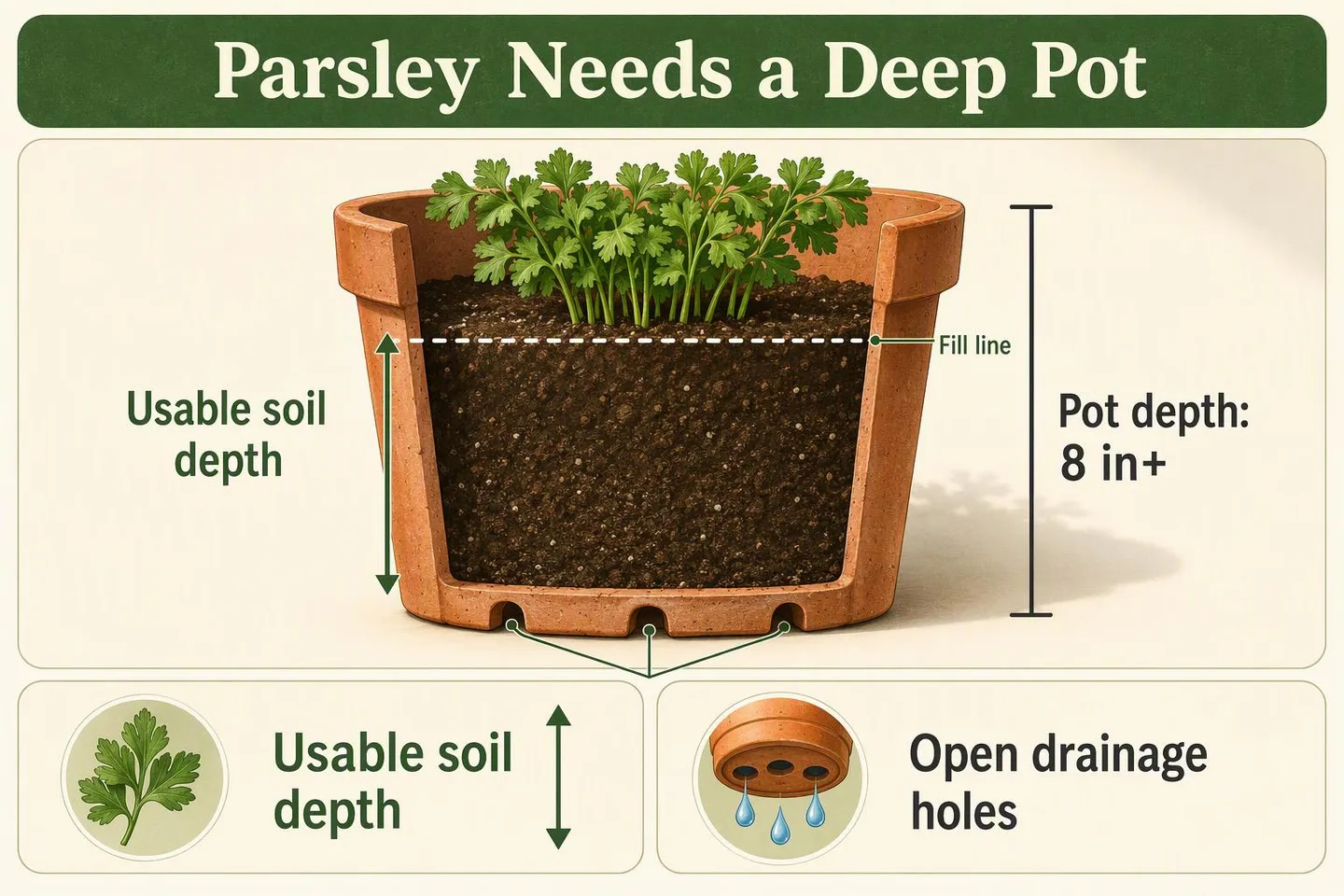
When I’m choosing between a deeper, narrower pot and a shallow, broad one, I’d take the deeper option if both fit the space. The extra usable mix gives you a larger buffer between watering, while a broad opening is useful for spacing plants. For one parsley plant, you don’t need to sacrifice depth just to buy an oversized planter.
Sow parsley ¼ inch deep and expect a patient 2–4-week wait
Flat-leaf and curly parsley can both grow in pots. Pick the leaves you prefer to cook with; the pot and care decisions are much the same. Flat-leaf types are easy to snip into a meal, while curly leaves make a compact-looking edging plant. I’d choose by intended use, not by the assumption that one type will fix a cramped or dim setup.
Starting from seed avoids the shock of moving an established root system. Scatter seeds over pre-moistened mix, cover them about ¼ inch (6 mm) deep, and water gently so they don’t wash into a clump. Keep the mix evenly moist while you wait. Parsley germination commonly takes around 2–4 weeks, so a bare-looking pot after several days is not a reason to dig the seeds up or sow again immediately. If the surface dries repeatedly, the emerging seed can fail before you see it.
That wait is the part I’d plan around: mark the sowing date on the pot or a note on your phone, then check moisture rather than disturbing the seedbed to see whether anything is happening. A loose cover can slow surface drying, but remove it once seedlings appear and keep the pot out of harsh, hot sun while it is covered. If you prefer to buy a rooted seedling, move it gently and keep the root ball intact as much as you can. Parsley has a long main root, and rough teasing or breaking of that root can set a young transplant back.
Once seedlings have several true leaves—the leaves that look more like adult parsley than the first simple pair—thin them so the strongest plants have room. In a 10–12-inch (25–30 cm) pot, keep one plant as a straightforward default. In a trough, leave roughly 6–8 inches (15–20 cm) between plants. Crowded seedlings may stay alive, but their leaves have less room to spread and air moves less freely around the foliage.
If you want a broader herb setup, compare the spacing and water needs before combining crops. Our guide to growing herbs in containers covers the shared-pot question across several kitchen herbs; growing basil in pots and growing cilantro in pots are useful comparisons, but don’t let a matching container size tempt you to crowd every herb into one pot.
Compare 4–6 hours of sun with a 1–2-hour balcony
Aim for about 4–6 hours of direct light for steady leafy growth. Parsley may persist with only 1–2 hours of direct sun, especially in a bright spot, but expect slower, thinner growth rather than a full cutting pot. Bright shade can help in a hot location; a cool, dim corner is a different proposition. If you have a movable container, use that advantage and shift it toward the brightest usable patch as the season changes.
Before you settle on a spot, watch where the light falls at different times of day for several days. A bright wall can make a balcony feel sunny while the pot itself gets little direct light. On a very hot, exposed balcony, harsh afternoon sun can dry a small container quickly; a position with morning sun and some later shade may be easier to manage. The useful answer depends on both light and heat, not just the number of sunny hours.
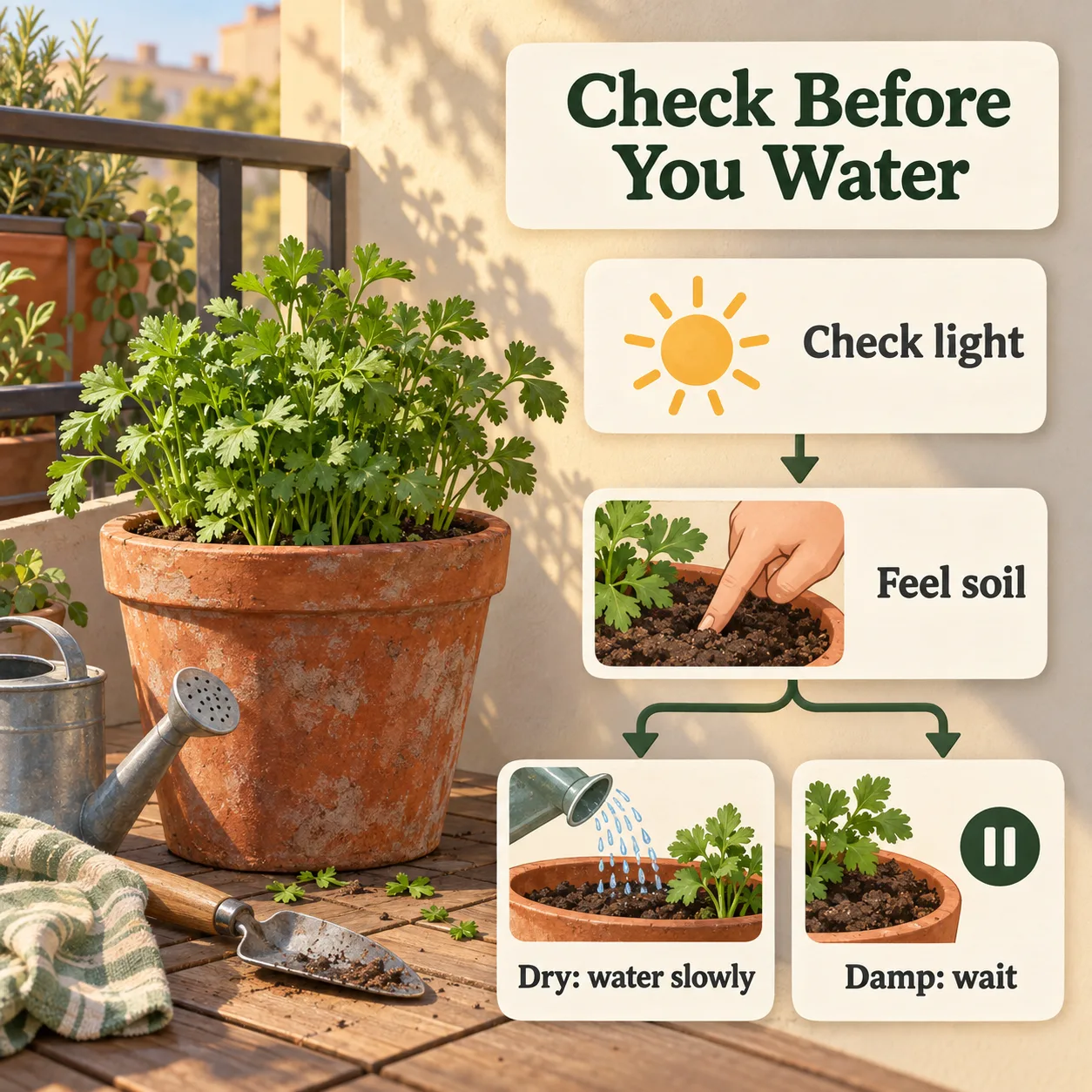
Water by checking the mix, not by keeping a fixed calendar. Push a finger about 1 inch (2.5 cm) into the surface. If that layer feels dry, water slowly until some drains from the holes; if it still feels damp, check again later. Don’t let water sit in a saucer for long. In hot weather or wind, a small plastic pot may dry quickly; a larger pot or a glazed container in a more sheltered position may hold moisture longer. Use the check to decide, because the same schedule won’t suit every balcony.
Dryness and excess water can both leave parsley looking limp. Check the mix before adding more: if it is dry below the surface, water thoroughly and see whether the leaves recover; if it is already wet and the pot feels heavy, pause watering and make sure the holes are clear. Persistently wet mix can deprive roots of air, while repeated severe drying stresses the plant. Yellowing alone doesn’t diagnose either problem, so look at the soil and drainage before changing several things at once.
Feed modestly, following the label directions on a fertilizer intended for edible plants rather than guessing at a stronger dose. Frequent watering carries dissolved nutrients out through the drainage holes, but adding extra fertilizer to compensate can damage roots. If growth slows, check light, moisture and crowding first; a small plant in shade won’t be fixed by feeding it more.
For another low-sun container, compare the conditions with our guide to growing herbs in containers before buying more pots. A useful outside reference is your local extension’s parsley seed-starting guidance; local advice can account for regional timing and climate. The practical rule on a balcony is simpler: when the mix dries faster than you can comfortably check it, move the pot out of the strongest wind or hottest sun before reaching for a more complicated watering routine.
Harvest from the outside, then decide whether to keep the plant for year two
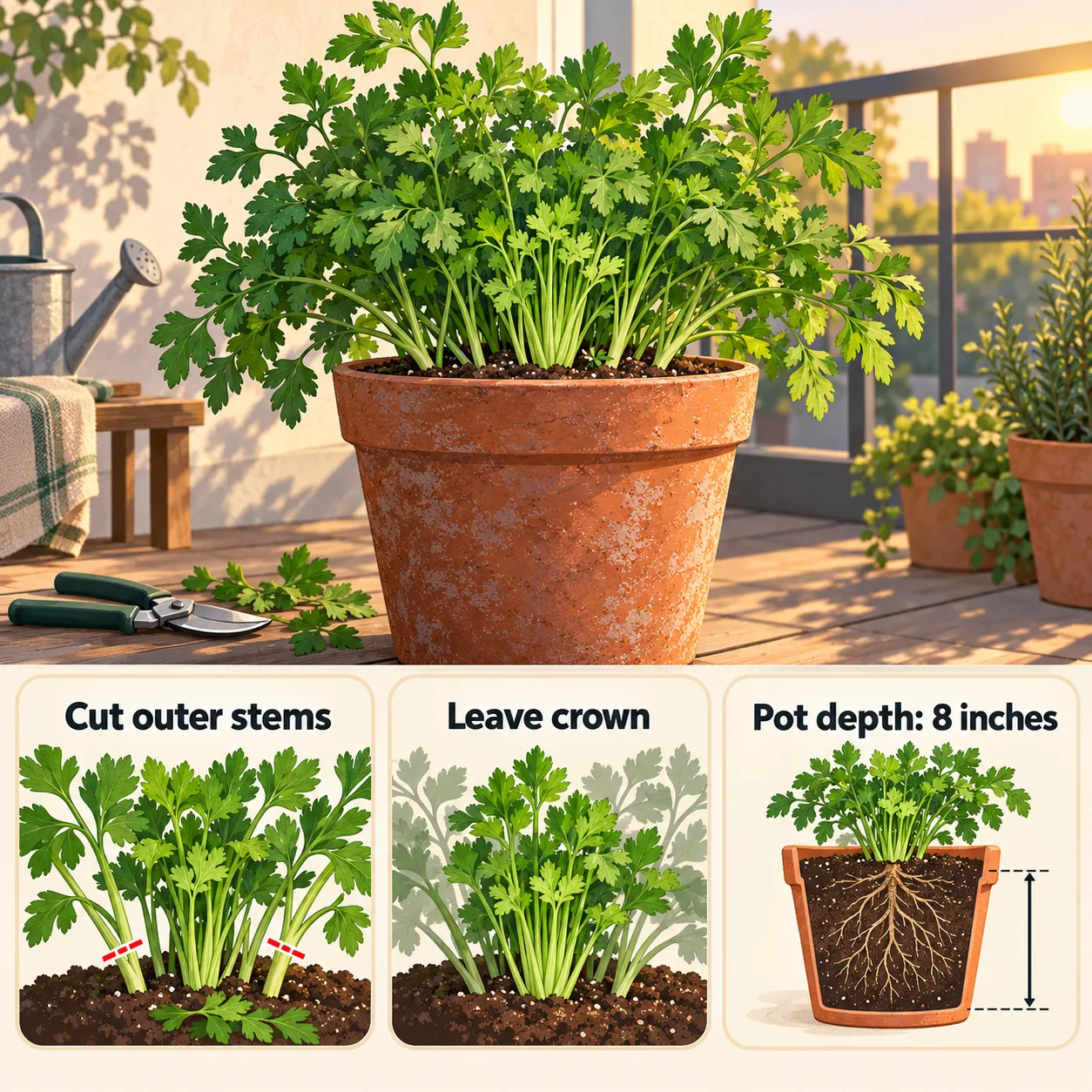
Start picking once the plant has a handful of sturdy stems. Cut the oldest outer stems close to the base, and leave the centre—the crown, where fresh growth emerges—undisturbed. Taking a few outside stems gives the middle room to keep producing. As a cautious working limit, avoid removing more than about one-third of the foliage in one go; a small or slow-growing plant needs more leaf area left behind to keep growing.
Use clean scissors and take whole stems rather than trimming every leaf from the centre. If you need only a garnish, snip a small outer stem. For a larger handful, spread the harvest across the plant instead of stripping one side bare. Regular picking can keep a healthy plant useful, but it can’t make a shaded, crowded or under-watered pot produce indefinitely.
Parsley usually follows a two-year pattern: it grows leaves in its first season, then may send up a flower stalk and set seed in its second. Once it starts flowering, leaf production and flavour can change, so treat a second-year plant as a bonus rather than a permanent supply. You can let it flower if you want to collect seed, or replace it when the leaves no longer suit your cooking.
Whether a potted plant makes it through winter depends on your local cold, the pot’s exposure and how protected its roots are. A container is more exposed than garden soil, so a plant that survives outdoors in a sheltered bed may be less reliable in a small pot on a windy balcony. Move it to a protected spot when conditions turn cold, avoid letting the container stand in water, and check regional advice rather than relying on a single universal frost date. Your regional frost guidance for potted herbs is a better timing reference than a calendar date borrowed from somewhere with a different climate.
By the end of its first week in the final spot, an established parsley plant should still look upright, with no steadily worsening wilt and no mix that stays soggy for days. New leaves are a welcome sign, but don’t judge a transplant by one quiet afternoon. This is also a good moment to check that the drainage holes are open and the pot hasn’t shifted into deeper shade.
Three quick side questions
Can parsley grow indoors in a pot?
Yes, if you can give it a bright position with several hours of direct light. A dim windowsill may keep a plant going without producing much to harvest. Rotate the pot if growth leans toward the window, and check moisture more often if the container sits near a heater.
Can parsley and basil share one pot?
They can share a roomy container if each has enough space and you can keep the mix evenly moist. The usual practical limit is crowding: a pot that comfortably fits one parsley plant may not have room for a second full-sized herb. Leave space for airflow and for your fingers to reach the soil when checking it.
Can supermarket parsley stems start a plant?
Detached cooking stems are not a dependable starting point. Begin with seed or a rooted plant instead. If you buy a living parsley plant from a shop, move it gently into a deeper container and water it in; don’t pull apart the roots just to separate several crowded stems.
Before the weekend, measure the inside depth of the pot you already own and check where its soil line will sit. If it leaves less than 8 inches (20 cm) of usable depth, choose a deeper container; if it passes, clear the drainage holes and get the mix ready.
Frequently Asked Questions
Can parsley grow indoors in a pot?
Yes, if it gets a bright position with several hours of direct light; growth may be slower on a dim windowsill, so set expectations or consider supplemental light.
Can parsley and basil share one pot?
They can share a roomy pot if each has enough space and the mix stays evenly moist, but explain that crowding—not compatibility—is usually the limiting factor.
Can I grow parsley from supermarket cut stems?
Detached culinary stems generally are not a reliable way to start a plant; use seed or a rooted plant, and handle a rooted supermarket plant gently when moving it.