Growing Vegetables in Pots for Beginners: Pot Sizes That Work
A 12-inch (30 cm) pot can hold about 13 litres (3.4 US gallons) if it is only 20 cm (8 in) deep and filled below the rim; the same width at 30 cm deep holds about 20 litres (5.3 US gallons). For growing vegetables in pots for beginners, shop by usable internal litres and root depth, not the outside diameter printed on a label: shallow greens can start in 5–10 litres, while a tomato or cucumber deserves about 20 litres and gets a better buffer at 30–40 litres.
That difference is easy to miss in a garden-centre aisle. Two planters with the same 12-inch label can have very different depths, tapers and internal capacities.
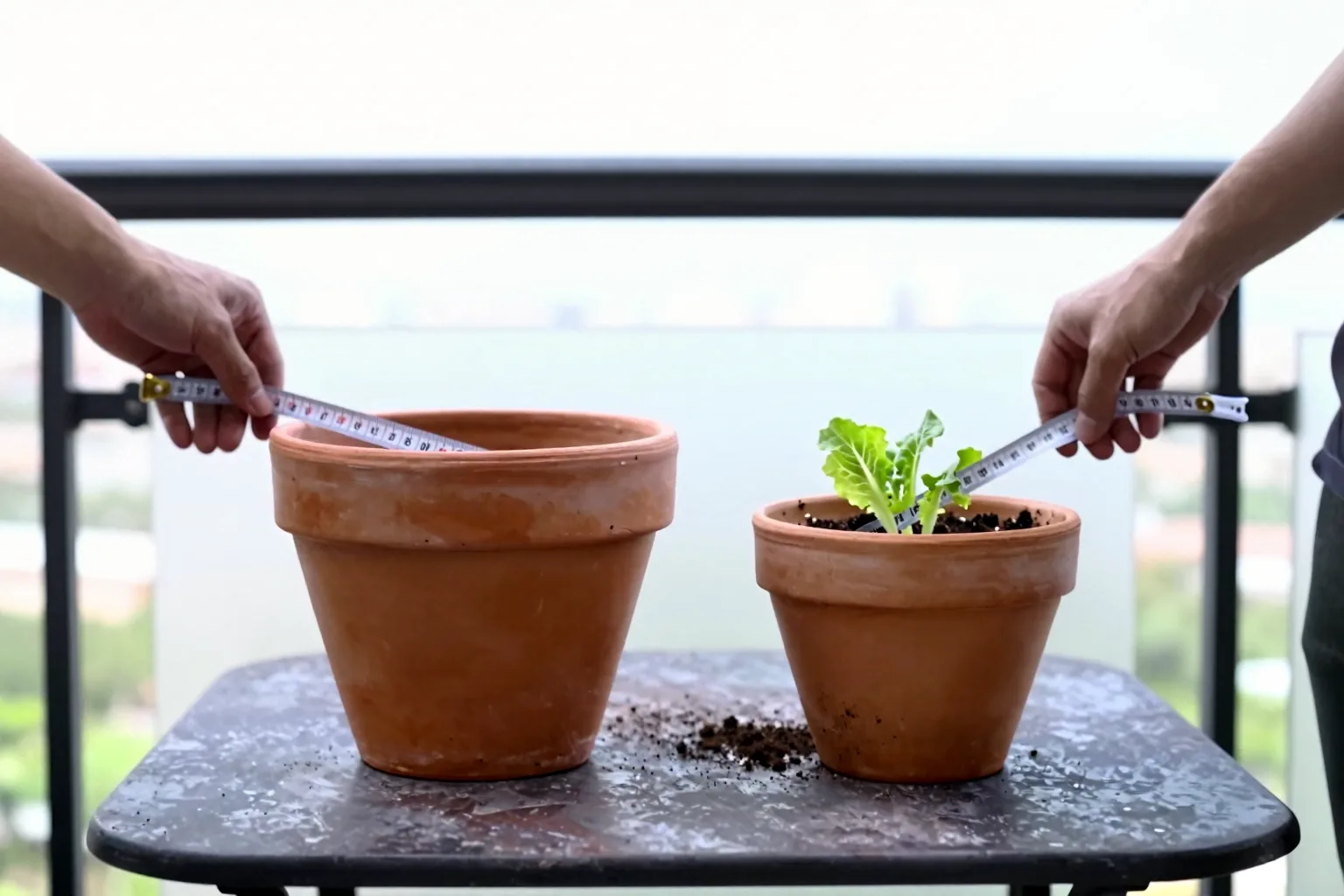
The number to shop by is litres of mix
The useful number on a pot is the amount of container mix its roots can occupy after you leave headspace at the top. Headspace is the empty band below the rim that lets you water without washing mix over the side. I treat the printed diameter as a clue, then check the internal depth and the stated litre capacity.
For a straight-sided pot, the quick calculation is:
radius × radius × height × 3.14 = cubic centimetres
Divide the result by 1,000 to get litres. Measure inside the pot, not across its outer lip. A pot with an internal diameter of 30 cm has a radius of 15 cm. At 20 cm of usable depth, the calculation is 15 × 15 × 20 × 3.14, or about 14.1 litres to the brim. If you leave 2 cm for watering, the working volume is closer to 12.7 litres.
Make that same pot 30 cm deep and the brim volume rises to about 21.2 litres; with 2 cm of headspace, it is roughly 19.8 litres. That is why a deep 12-inch pot may be suitable for a compact tomato while a shallow 12-inch bowl is not.
Tapered pots hold less than the cylinder calculation because the base is narrower. A rolled rim, thick wall or false decorative base reduces it again. If the seller gives a litre figure, use that. If not, calculate from the narrowest useful planting area and then allow some room for the shape to reduce the result.
More mix does not make a plant independent of watering. It simply gives the roots a larger reservoir of water and dissolved nutrients before the pot becomes dry, and a larger volume changes more slowly when the weather turns hot. Repeated watering can also carry soluble nutrients out through the drainage holes, so a larger starting volume gives you more room to manage that loss.
If you want to redo this calculation for an oddly shaped container, see How Much Potting Mix Do I Need? Litres for Common Container Sizes.
A crop-by-crop pot-size table for a first balcony
The figures below are practical starting specifications, not guarantees. The minimum depth assumes a container mix that drains properly, a reasonable plant count and enough attention to watering. On a hot, windy balcony, I would use the upper end of the volume range or grow fewer plants in the same pot.
| Crop | Minimum practical depth | Usable mix | Suggested container width | Planting load |
|---|---|---|---|---|
| Salad leaves | 15–20 cm (6–8 in) | 5–10 L (1.3–2.6 US gal) | 25–40 cm (10–16 in) | Several small plants |
| Radishes | 15–20 cm (6–8 in) | 5–8 L (1.3–2.1 US gal) | 20–30 cm (8–12 in) | Several, spaced apart |
| Short carrots | 25–30 cm (10–12 in) | 8–15 L (2.1–4 US gal) | 25–35 cm (10–14 in) | Several roots |
| Beets | 20–25 cm (8–10 in) | 8–12 L (2.1–3.2 US gal) | 25–35 cm (10–14 in) | Three to six plants |
| Bush beans | 25–30 cm (10–12 in) | 10–15 L (2.6–4 US gal) | 30–40 cm (12–16 in) | Four to six plants |
| Kale or chard | 25–30 cm (10–12 in) | 10–15 L (2.6–4 US gal) | 30–40 cm (12–16 in) | One or two plants |
| Peppers | 25–30 cm (10–12 in) | 15–20 L (4–5.3 US gal) | 30–40 cm (12–16 in) | One plant |
| Eggplant | 30–40 cm (12–16 in) | 20–30 L (5.3–8 US gal) | 35–45 cm (14–18 in) | One plant |
| Compact or determinate tomato | 30–40 cm (12–16 in) | 20–25 L (5.3–6.6 US gal) | 30–45 cm (12–18 in) | One plant |
| Vigorous indeterminate tomato | 40–45 cm (16–18 in) | 30–40 L (8–10.5 US gal) | 40–50 cm (16–20 in) | One plant |
| Cucumber | 30–40 cm (12–16 in) | 20–30 L (5.3–8 US gal) | 35–45 cm (14–18 in) | One plant with support |
| Potatoes | 30–40 cm (12–16 in) | 20–30 L (5.3–8 US gal) | 35–45 cm (14–18 in) | One plant equivalent |
| Compact zucchini | 40–45 cm (16–18 in) | 30–40 L (8–10.5 US gal) | 45–60 cm (18–24 in) | One plant |
“Several” does not mean pack the surface solidly. Salad leaves and radishes have a small individual root footprint, so a broad shallow container can carry a group. A pepper, tomato or zucchini has a larger canopy making demands on the same finite root zone, so the table gives one plant per pot.
For roots, depth is the limiting measurement. A 20 cm (8 in) planter can suit radishes but will force a long carrot to bend, fork or stop short. Short carrot varieties are the sensible beginner choice in a shallow container; full-length varieties need the deeper end of the range. The companion guide How Deep Does a Vegetable Pot Need to Be? is useful if depth is the measurement you are missing.
Think of the table as a floor under moderate conditions. The upper end is the better target if the container is dark plastic in full sun, exposed to wind, or likely to go unwatered for a day.
Change the minimum when variety, plant count or support changes
Tomatoes: variety changes the pot
A compact or determinate tomato generally makes a shorter, more limited plant than a vigorous indeterminate type. That difference changes both the root-volume target and the risk of the plant pulling the pot over. I would start a compact tomato at 20 litres (5.3 US gallons), but choose 30–40 litres (8–10.5 US gallons) for an indeterminate variety that keeps extending upward and needs a substantial stake or cage.
The word “dwarf” still needs checking. It describes a growth habit, not a universal pot specification. Read the label for mature height, spread and support needs. A dwarf plant in a very sunny, windy position may be easier to manage in a wider pot than the nominal minimum suggests.
Support and plant count are separate calculations
Root volume and stability are not the same requirement. A narrow 30-litre pot may hold enough mix for a tomato, yet a tall plant, wet foliage and a gust can put force high above the soil line. A broad, heavy container or a support that carries its own load solves a different problem from adding litres.
My practical rule is this: if the mature height on the label is more than roughly twice the container’s width, treat the pot as top-heavy until you have planned a support. Choose a wider, heavier container, use a free-standing trellis, or select a shorter variety. The two-times figure is a shopping rule, not a botanical law; its purpose is to stop root capacity being mistaken for stability.
Bush beans can share a broad pot because their plants stay relatively compact. Climbing beans may use a similar root volume, but their trellis adds leverage. Cucumbers need one plant per 20–30-litre container for a straightforward start, and zucchini needs room for its broad leaves as well as roots. Crowding a second large plant into the same pot saves floor area on paper but removes the moisture buffer each plant was meant to have.
I’d treat a support fixed to a wall or railing as a permission-and-load question, not an automatic solution. Check first, since it may count as an attachment under some landlord or strata rules, and the railing itself may not be designed for the extra force of a moving plant.
What an 8-, 12- and 18-inch pot can actually grow
A shop label such as 8, 12 or 18 inches describes a dimension, not a guaranteed volume. Here is how I translate those familiar sizes before putting a plant in the trolley.
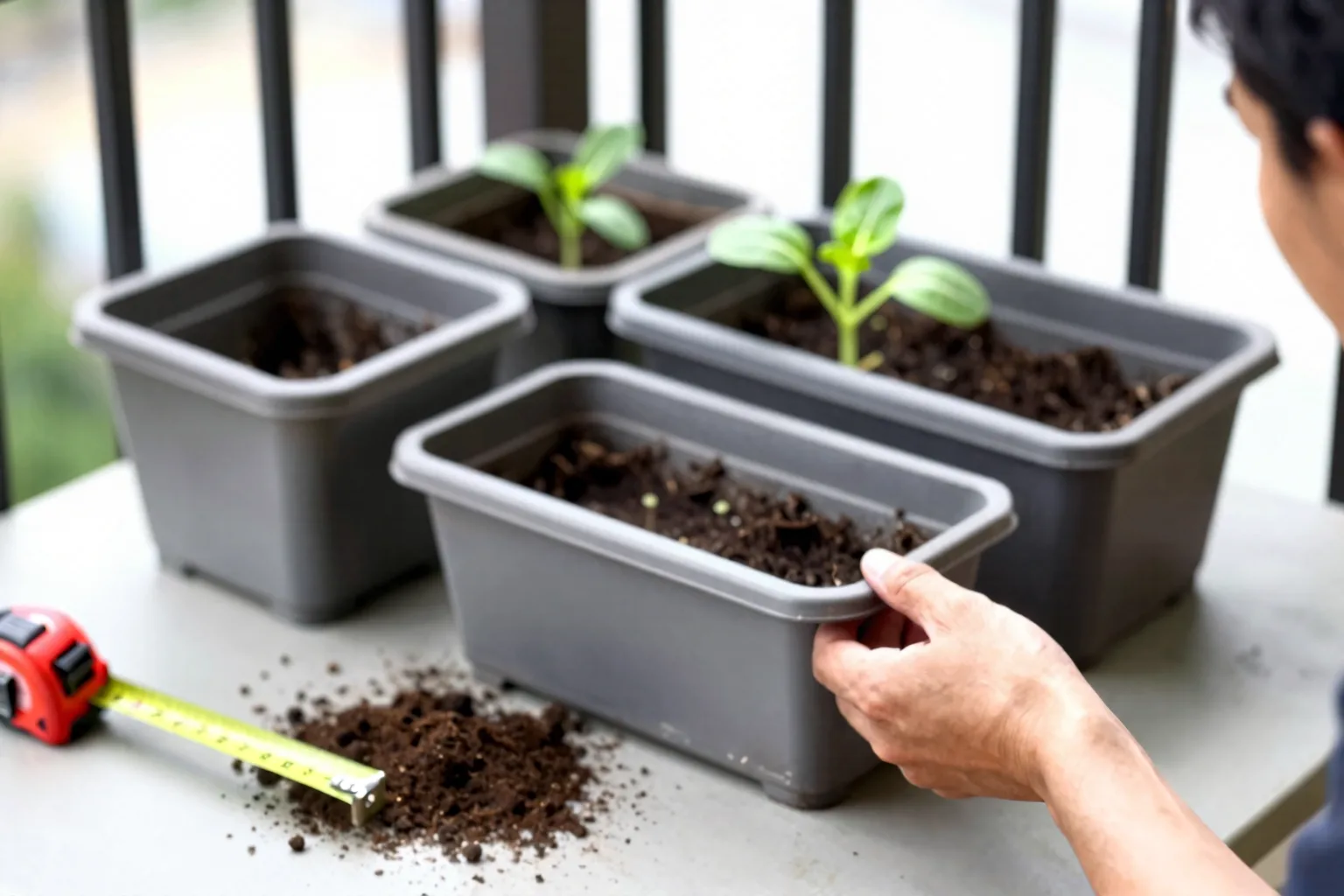
An 8-inch (20 cm) pot: A straight-sided container 20 cm wide and 20 cm deep holds about 6.3 litres to the brim. A tapered version filled below the rim may offer only 4–6 litres. That is useful for salad leaves, radishes, a small herb or one compact leafy plant. It is not a sensible starting size for a full-size tomato, cucumber or zucchini.
A 12-inch (30 cm) pot: If it is only 20 cm deep, it gives roughly 14.1 litres before headspace and taper, often about 12–13 litres in use. If it is 30 cm deep, it can approach 20 litres usable. The first version is a good compact-crop container; the second can be a workable starting point for one pepper or determinate tomato, provided the plant is supported and watering is accessible.
An 18-inch (45 cm) pot: A straight-sided pot 45 cm wide and 35 cm deep calculates to about 56 litres at the brim. A real tapered planter with headspace may provide closer to 35–50 litres. That is a more reliable starting scale for one tomato, cucumber, eggplant or compact zucchini, although the mature canopy and support still need room.
These examples explain why diameter alone misleads. Before buying, look for the capacity in litres. If it is missing, measure the internal width and depth, calculate conservatively, and assume the taper will reduce the result.
Fill and set up the container so its advertised size stays usable
Set the container up in this order. The order matters because a large pot becomes awkward after it is full, and a support is harder to install without damaging established roots.
- Confirm the drainage holes. Turn the empty pot over and clear blocked holes. A saucer can catch runoff, but it should not seal the holes or hold the container sitting in a permanent puddle.
- Put the pot in its final position. Check sun, access to a hose or watering can, clearance from the balcony edge and the surface underneath. A filled pot is heavier and less convenient to shift than an empty one.
- Use container mix. Garden soil is made for open ground and can compact in a pot, leaving fewer air spaces for roots. Use a loose mix that holds some moisture but still lets excess water leave through the holes. You do not need the most expensive bag; you do need a medium that is sold for containers rather than excavated from a bed.
- Fill to about two fingers below the rim. Do not mound mix above the lip. That shallow empty band is what lets you apply a thorough watering without losing soil.
- Install the support before planting. Put in a stake, cage or free-standing trellis while the root zone is empty. Push it in gently and keep it clear of the drainage path.
- Wet the mix before the seedling goes in. Add water slowly until a little runs from the holes, wait for the mix to settle, then top up if its level drops. Some very dry, peat-rich mixes initially repel water; wetting before planting reduces the chance that water runs down the sides while the centre stays dry.
The gravel layer is not a drainage system
Skip the gravel at the bottom. A layer of stones does not create more room for water to drain from the mix above it. Water moving through fine potting mix can pause at the abrupt boundary before the coarse layer; this saturated band is called a perched water table, meaning water remains held above the bottom layer instead of leaving immediately. The gravel also takes away root volume and raises the wet zone within the container.
For the mechanism and a simple test you can do with an empty pot, see Why Gravel in the Bottom of a Pot Does Not Improve Drainage. The useful drainage improvements are open holes, an appropriate container mix and a pot that is not standing in collected runoff.
Keep food crops away from unknown materials
For edible plants, do not assume a reused bucket is suitable if it previously held fuel, solvents, pesticides or another chemical. Treated timber can contain preservatives, and an unknown decorative glaze may not be intended for food contact. A purpose-made food container or a pot with a clearly known material history is the less ambiguous choice. This is a material-history decision, not a reason to panic about every second-hand pot.
If you want a separate general reference, compare extension guidance on container vegetable depth and spacing and horticultural guidance on potting media and drainage. Local recommendations can differ by crop and climate, so use them to refine the starting figures rather than to replace the volume check.
Let sun, wind and watering gaps decide whether to size up
The same pot can behave reasonably on a sheltered patio and fail on an exposed balcony. Full sun adds heat to the leaves and mix. Wind pulls moisture from the plant and can dry the exposed surface faster. Porous terracotta can lose moisture through its walls, while a dark plastic pot can become warmer than the surrounding air. Small containers have less stored water to draw on, but a large container in cool shade can stay wet for longer than its roots can use.
Sunlight changes the crop choice as well as the watering demand. If a balcony audit finds only one or two hours of direct sun, shallow salad crops, radishes and some leafy greens are a more realistic first use of the space than a tomato chosen for a heavy fruiting crop. Fruiting plants need enough light to build both leaves and fruit; a large pot cannot compensate for a position that does not provide it.
Use symptoms to adjust the setup rather than following a calendar. Midday wilting that recovers by evening suggests that leaf demand is exceeding the pot’s available water buffer, although heat stress can contribute too. Check the moisture several centimetres below the surface and lift the pot slightly to compare its weight with the weight just after watering.
Persistent wilt in the morning, sour-smelling mix, or yellowing lower leaves while the pot remains wet is commonly read as a sign of low oxygen around the roots, poor drainage or watering too often. The reasoning is straightforward: saturated mix fills air spaces with water, limiting root gas exchange; stressed roots then take up water and nutrients poorly, so a plant can wilt while the pot is wet. Prolonged low-oxygen conditions and microbial activity can also produce a sour odour, while impaired nutrient uptake can appear as yellowing, or chlorosis, in older lower leaves.
In that combination, watering again is the wrong first move. Check the holes, the saucer, the actual mix depth and whether the container is too large for a cool shaded position. In the opposite situation, where the pot is light and dry below the surface, size up, reduce the number of plants or move the container where watering is easier. The detailed checking sequence is in How Often to Water Vegetables in Containers.
Buy a workable first batch instead of seven undersized pots
A beginner balcony does not need a collection of identical containers. I would start with three jobs:
- One shallow container: 5–10 litres (1.3–2.6 US gallons) for salad leaves, radishes or a small run of herbs.
- One medium container: 10–15 litres (2.6–4 US gallons) for bush beans, beets, chard, kale or short carrots, depending on depth.
- One fruiting-crop container: 20–40 litres (5.3–10.5 US gallons) for one tomato, pepper, cucumber or similar crop, chosen according to the variety and available support.
Before paying, run five checks: measure the internal depth, find the litre capacity or calculate it, inspect the drainage holes, compare the mature height with the container’s width, and confirm that the position gets enough direct sun. On a balcony, also check the building’s guidance on load limits and placement rather than guessing from the pot’s empty weight. Wet mix, the container and a mature plant all contribute to the load, and the allowable limit belongs to the building or landlord, not to a general gardening rule.
My strongest beginner recommendation is to buy fewer litres of mix in the right shapes rather than more small pots. A big pot cannot create sunlight, but a small pot can turn an otherwise suitable vegetable into a daily watering obligation.
Before the weekend, place each empty pot on paper, measure its internal width and depth, calculate a conservative litre target and write that number on your shopping list. After the first week, check that water exits the holes, the mix is damp below the surface without smelling sour, and the plant has not wilted before evening. If any of those checks fail, change the pot position or plant count before buying another plant.