Tomatoes Cracking After Rain? Why It Happens and What to Do
Tomatoes cracking after rain is usually a moisture-swing problem, not rain punching holes in the skin. If a pot or bed has dried down and then takes in a large drink, the fruit can swell faster than its outer skin can stretch.
That is why I look at the root zone before I blame the storm. A clean split in otherwise firm fruit calls for quick harvesting; a split that has turned soft, slimy or moldy is a different problem altogether.
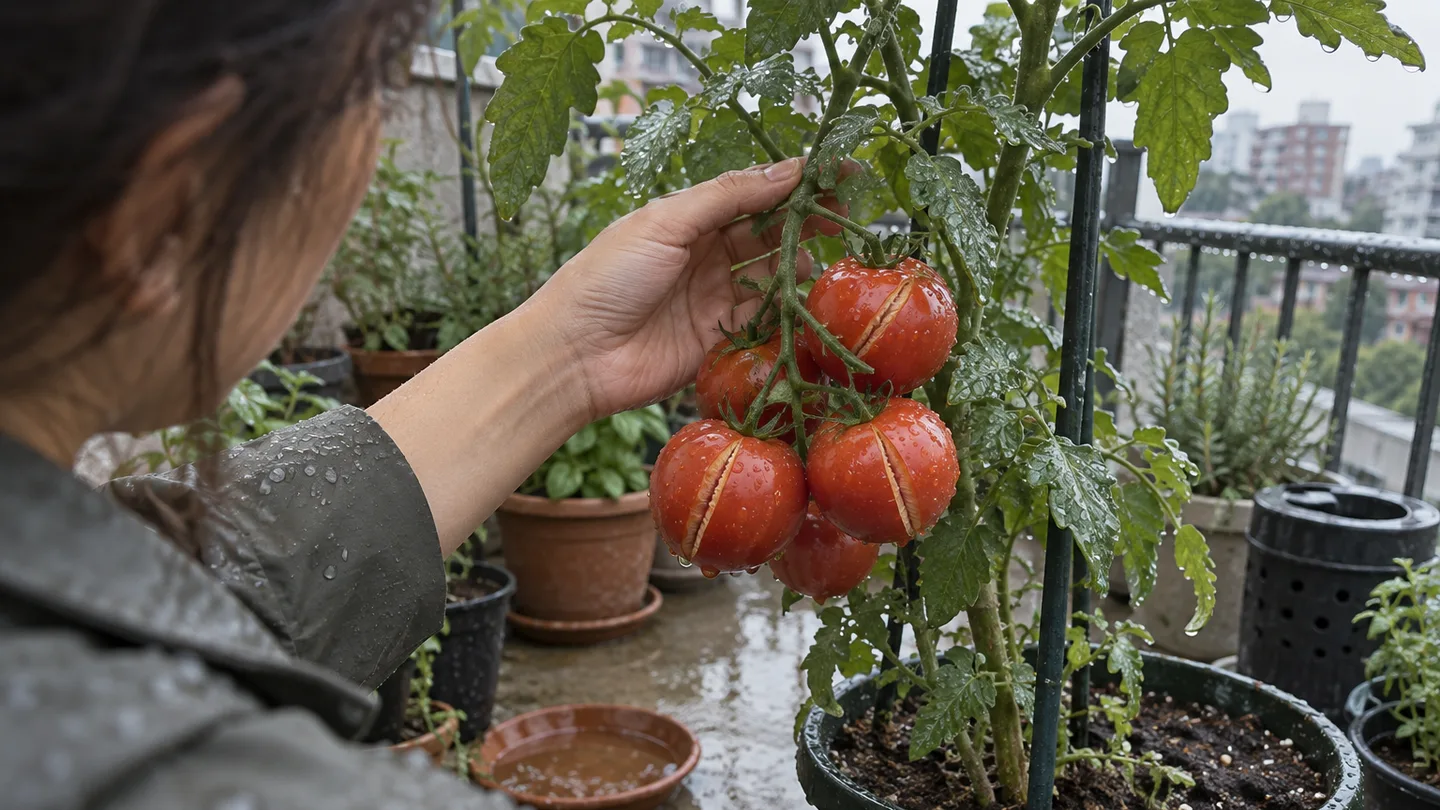
Rain is the trigger; uneven root-zone moisture is the cause
The useful distinction is between rainfall and the change rainfall causes below the surface. Tomato roots absorb water, that water moves into the plant and fruit, and the cells inside the tomato expand. The skin and its thin protective outer layer, called the cuticle, may not stretch at the same speed.
If the soil was already evenly moist, a storm may pass without much cracking. If the plant was thirsty first, then receives heavy rain or a large irrigation, the sudden uptake creates more pressure inside the fruit. The same pattern can happen under a roof if a dry pot is watered heavily all at once.
Soil moisture is the first thing I check. Tomatoes cracking after rain does not, by itself, prove that the plant has a disease or needs a calcium product. It tells me to investigate the size and speed of the moisture change before adding anything.
Start with the shape of the split
The first clue is the direction of the opening. Crack shape can suggest what happened, but it is not a perfect diagnosis. Weather, cultivar, fruit maturity and damage from insects can overlap.
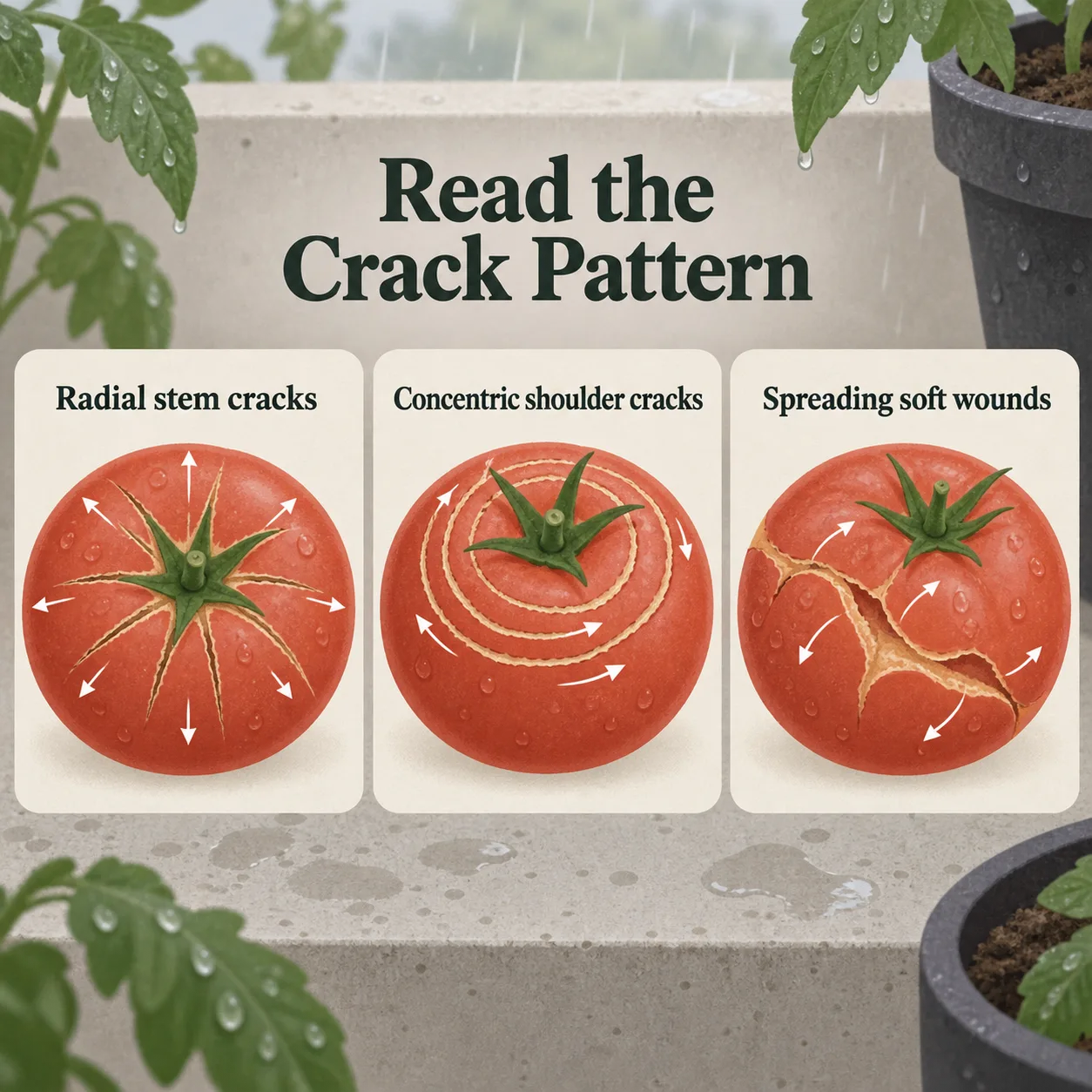
Radial cracks run outward from the stem, like spokes from a wheel. They are commonly associated with rapid swelling around the shoulder after the fruit has taken up water. Concentric cracks form rings around the shoulder, usually close to the stem. Both can begin as narrow, clean fissures.
A long opening down the side or toward the blossom end can also be a pressure split, especially after a dry spell. The important next question is not simply which pattern you see, but what the edges look and smell like.
A fresh crack usually has firm surrounding flesh and a clean, pale or slightly wet edge. A spreading wound becomes darker, softer or translucent. Fuzzy growth, slime, a sour or fermented smell, insect tunnels, or a soft patch that is widening beyond the original split points toward decay rather than a harmless skin opening.
Do not use the crack pattern as a promise that the tomato is safe or unsafe. Use it as a reason to inspect the whole fruit.
The dry-to-wet swing happens below the skin
Tomato plants do not need the surface of the soil to look dry before the root zone has started drying out. In a container, the upper mix can dry quickly while the centre remains damp, or the sides can become hydrophobic and let water run down the pot wall instead of soaking the root ball evenly.
A useful balcony example is a tomato growing in a 40-litre container, roughly 10.5 US gallons. After two hot, windy days, the top 2–3 cm, or about 1–1¼ inches, may be dry. A heavy storm then wets the exposed surface and the plant suddenly has access to more water. If the fruit is already close to full size, its internal tissues can expand before the skin catches up.
The practical inspection window is the first 24–48 hours after a heavy rain or a large watering following dry soil. A crack may be visible immediately, but a small opening can widen as the fruit continues to take up water. On a hot balcony, the pot may swing from dry to wet quickly. On a windy rooftop, evaporation can be even faster. In a sheltered bed, the surface may look soaked while the root zone below a dense canopy is still uneven.
On a balcony, my working rule is to inspect the pot, not the forecast, before I decide to water. A weather app can tell me rain is coming; it cannot tell me whether a thick tomato canopy kept the root ball dry underneath.
A same-day triage for fruit already open
When I find a cracked tomato, I sort it by firmness and smell before I think about ripeness. The order matters because a fresh split is easier to use promptly than a wound that has been sitting wet for several days.
- Firm fruit with a fresh, clean split: harvest it the same day if practical. Keep it separate from unblemished fruit and use it first. A clean opening is still an entry point for moisture and microbes, so I do not put it at the back of the fruit bowl.
- Firm fruit with a shallow surface crack: my cautious kitchen practice is to cut generously around the damaged area and use the rest immediately. This is a judgement call, not a guarantee of safety. If the crack is deep, the fruit has been warm and wet, or you are unsure, discarding it is the safer choice.
- Fruit with mold, slime, a foul or fermented smell, insect tunnelling, or soft spreading rot: discard the whole tomato. Those signs mean the damage is no longer just a dry skin fissure.
- Green or pink fruit with a clean opening: pick it rather than leaving it through another storm. Pink fruit is closer to the breaker stage, meaning the first blush of colour, and is more likely to finish colouring indoors. A fully green tomato may or may not ripen well, so I use it quickly if it remains firm.
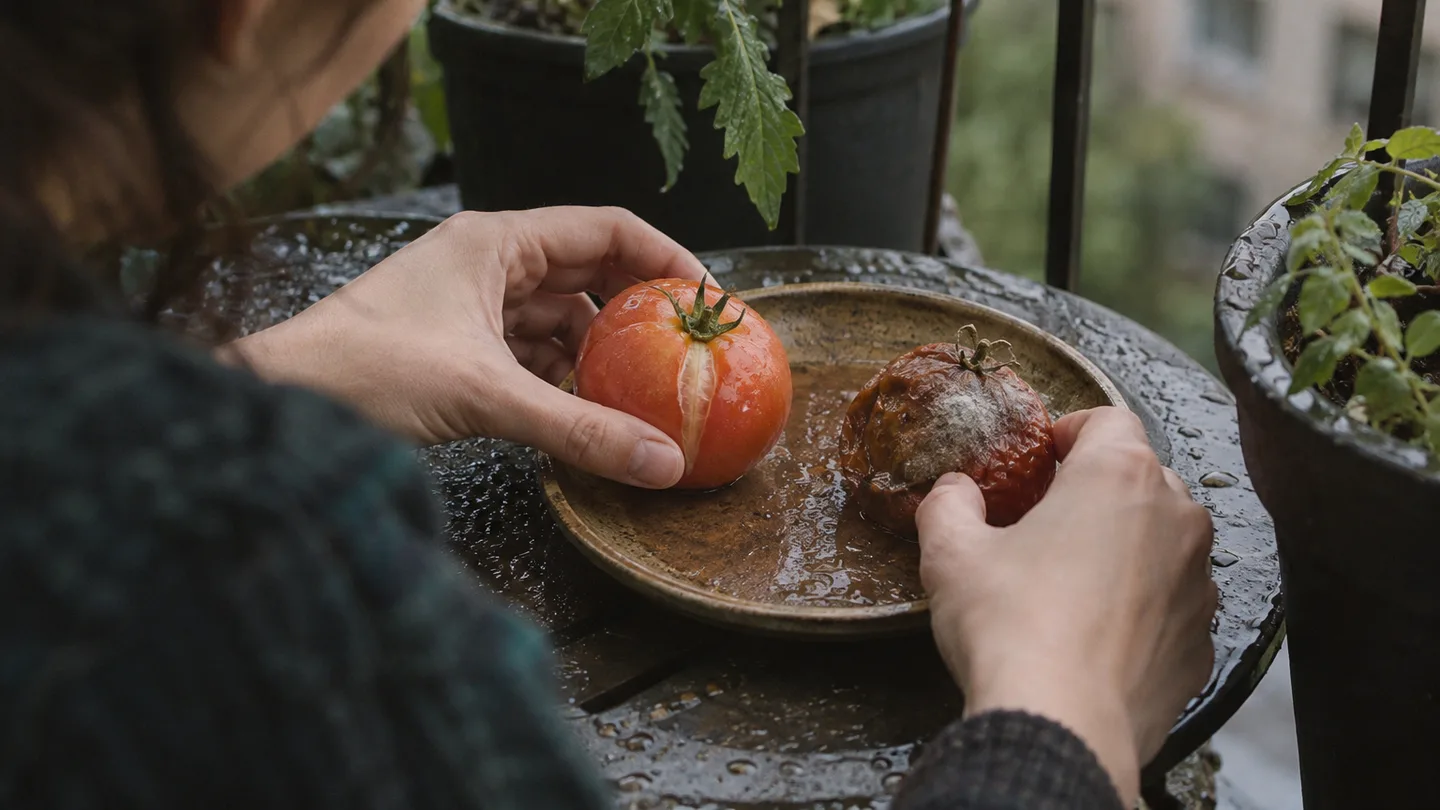
Do not rinse a visibly rotten tomato and return it to the kitchen. For a picture-based second opinion, look for official food-safety guidance on moldy or damaged produce, then choose the conservative option when the fruit is soft or smells wrong.
The 2–3 cm moisture test beats a watering calendar
A calendar cannot account for pot material, wind, plant size, mulch, canopy cover or a sudden change in temperature. I use 2–3 cm, or 1–1¼ inches, as a repeatable starting check: push a finger into the mix or soil a few centimetres away from the stem. If that layer is dry and the plant is actively growing, water the root zone slowly.
| Growing situation | What can mislead you | My starting check |
|---|---|---|
| Plastic pot in full sun | The dark pot and exposed sides warm the mix; wind can speed drying. | Check the upper 2–3 cm daily during hot or windy spells, then adjust from what you find. |
| Glazed pot in part shade | The surface may stay damp while the lower mix remains wetter for longer. | Check after a weather change rather than watering by habit. |
| Open rooftop or exposed balcony | Rain can be blown past the pot, while wind dries the foliage and mix quickly. | Inspect the mix after rain instead of assuming the container was soaked. |
| Sheltered patio or bed | A thick canopy can divert rain away from the soil near the stem. | Push below the mulch and check the root zone, not just the surface. |
When the mix is dry at that depth, apply water at the base in a slow pass. In a container, continue until a little excess exits the drainage holes. That tells me water has travelled through the full root zone rather than wetting only the top crust.
If a very dry mix immediately repels water, I wet it lightly first, pause for several minutes, then water again more slowly. A single fast pour can run down the sides of a shrunken root ball and leave the centre dry. If the mix is already wet below the surface, skip the extra irrigation even if the top looks dusty.
After rain, repeat the finger check. Rain may wet the upper layer without replacing moisture evenly throughout a container, particularly when the foliage is dense or the pot is tucked under an overhang.
Rain-ready pots and beds: mulch, drainage and shelter
Mulch is one of the simplest ways to reduce the dry-to-wet swing. Apply roughly 5–8 cm, or 2–3 inches, of suitable garden mulch over the soil surface, but leave about 5 cm, or 2 inches, clear around the stem. The open ring keeps wet material from sitting against the stem while the rest of the mulch slows evaporation and softens the impact of heavy rain.
Mulch helps stabilise moisture; it does not repair a blocked drainage hole. Check the holes before the next storm, make sure the container is raised slightly if its base sits flat against a surface, and do not leave it standing in a saucer of water after the rain has stopped.
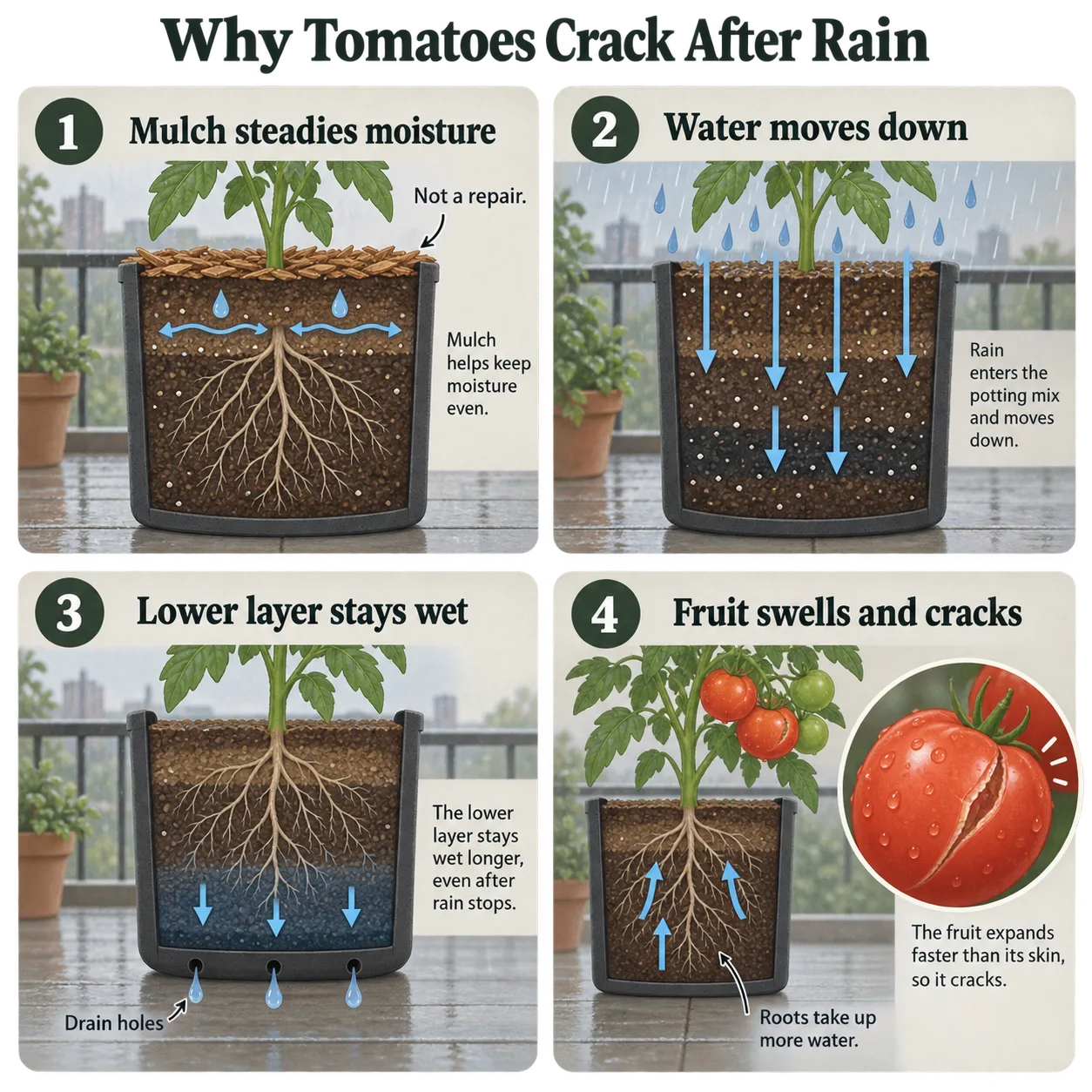
A perched water table is a saturated layer that remains above the drainage point because water is held in the fine potting mix before it can move out. This is why the gravel-in-the-bottom trick is unreliable. A coarse layer does not automatically pull water from fine mix above it; under some potting mixes, it can leave the wet zone sitting higher than you expected.
For a rain cover, think roof rather than sealed tent. Keep the cover from touching the foliage, leave the sides open where possible, and preserve usable light. A tightly wrapped plastic shelter may keep rain off the fruit while also trapping still, humid air around wet leaves. If the root zone is genuinely dry before a forecast storm, water gradually ahead of it rather than waiting and dumping a large volume on already stressed roots.
If you use wood-based mulch around edible plants, choose material sold for garden use rather than painted, treated or construction timber offcuts. The container is part of the food-growing system, not just decoration.
When the cultivar is the weak link
Moisture control can reduce cracking, but it cannot turn every tomato into a crack-proof tomato. Some thin-skinned, large-fruited, heavily ribbed or otherwise crack-prone cultivars split more readily when the weather changes quickly. Fruit shape and skin flexibility influence how much swelling the skin can accommodate.
Excess nitrogen can add another complication. A heavy nitrogen feed may push soft, lush growth, but it is not a standalone explanation for every split. If the plant already has dark, overly vigorous foliage and few fruiting trusses, I would stop adding nitrogen and return to a balanced feeding routine rather than trying to correct the crack with more supplements.
Before a forecast downpour, harvest fruit at the breaker stage, the point when the first blush of colour appears. It can continue colouring off the plant, and removing it before the heaviest moisture pulse gives the skin less time to split on the vine. This is a loss-reduction tactic, not a promise of identical flavour or a guarantee against damage.
My judgement is to grow one variety I love and one variety chosen for steadier performance, especially in a small garden where one pot represents a large share of the crop. The guide to determinate vs indeterminate tomatoes can help with plant size and season length, but neither growth habit makes a tomato immune to cracking.
Cracking is not blossom-end rot
These problems can appear after the same spell of unsettled weather, which is why they are easy to confuse.
Cracking: the skin opens, often near the stem or shoulder, while the surrounding fruit may remain firm. Start by checking for a dry-to-wet swing.
Blossom-end rot: the damaged area is at the end opposite the stem. It begins as a dark, sunken or leathery patch rather than a clean skin fissure. Water inconsistency can interfere with calcium movement inside the plant, so the presence of blossom-end rot does not automatically mean the mix contains no calcium.
Disease or decay: the lesion may be dull, sunken, water-soaked, fuzzy or rapidly expanding. A bad smell and soft tissue make it a discard problem rather than a watering adjustment. If you need to compare photographs, use university extension guidance on tomato fruit cracking and irrigation consistency alongside a diagnostic guide for disease lesions.
Adding calcium blindly is not my response to a rain-triggered split. Calcium is more directly discussed in relation to blossom-end rot, while the immediate mechanism in a clean rain split is rapid swelling. Fix the moisture pattern first, and test the soil or growing mix before adding an amendment for a different symptom.
Three side questions that come up after a storm
Can tomatoes crack in a greenhouse or under a rain cover?
Yes. A cover blocks rainfall, but it does not block a large irrigation, dry pockets in the mix or a sharp change from thirsty roots to saturated roots. Keep the root zone consistent and ventilate the shelter so humid air does not remain trapped around wet foliage and fruit.
Do cherry tomatoes crack more easily than large tomatoes?
Not automatically. Some thin-skinned cherry and grape cultivars crack readily, while some larger tomatoes cope better than expected. Fruit size alone is a poor decision rule; cultivar traits and moisture fluctuation matter more than the label cherry or beefsteak.
Does adding calcium prevent tomatoes from cracking?
Usually not. A clean rain-triggered split is primarily a water-uptake and skin-expansion problem. Calcium may be relevant to blossom-end rot, but adding it without checking the actual symptom and growing medium is unlikely to solve this particular failure.
Your next seven days: one prevention loop
Use the next week to make the moisture swing smaller, not to chase every crack after it appears.
- Today: harvest fruit with fresh clean splits, separate it from sound fruit, and discard anything moldy, slimy, foul-smelling or softening around the wound.
- At the next watering: push a finger 2–3 cm into the mix or soil. If it is dry at that depth, water slowly at the root zone. If it is wet, do not add water simply because the calendar says it is watering day.
- Before the weekend: add a 5–8 cm mulch layer if the surface is bare, leaving about 5 cm around the stem. Check that drainage holes are open and that the pot cannot sit in runoff.
- Before the next storm: pick fruit showing its first colour. Move a container only if the new position still gives it useful light and airflow; a dark, sealed corner trades one problem for another.
- Within 24 hours after rain: inspect the fruit and check below the surface of the mix. Adjust the next watering from that observation rather than from the amount of rain predicted.
This loop should reduce the size of the moisture swings, but it cannot remove the effects of cultivar, fruit maturity or unusually wet weather. If one tomato variety keeps punishing a small space, the guide to Easy fruits and vegetables to grow in pots can help you choose a crop that fits your light and attention better.
Before you put the phone away, push a finger 2–3 cm into the mix of the nearest tomato pot. That physical check will tell you more about the next risk of cracking than the rain forecast alone.
Frequently Asked Questions
Can tomatoes crack in a greenhouse or under a rain cover?
Yes. A cover blocks rainfall but not irrigation swings, dry pockets or sudden heavy watering; keep the root zone evenly moist and ventilate so humidity does not stay trapped around wet foliage and fruit.
Do cherry tomatoes crack more easily than large tomatoes?
Some thin-skinned cherry and grape cultivars crack readily, but fruit size alone is not a reliable predictor. Cultivar traits and moisture fluctuations matter more than the label 'cherry' or 'beefsteak'.
Does adding calcium prevent tomatoes from cracking?
Usually not. Cracking is primarily linked to rapid water uptake and skin growth limits, while calcium is more directly associated with blossom-end rot; test the soil or mix before adding an amendment.