Cold Hardy Vegetables for Pots: 9 Crops That Take the Chill
An in-ground label that says “cold hardy” doesn’t promise the same result in a pot: a container’s limited mix can cool more quickly than garden soil, putting roots closer to freezing air. Still, nine crops can make a useful cool-season balcony garden: kale, spinach, leaf lettuce, arugula, Swiss chard, radishes, carrots, scallions and beets. The practical starting point is about 6–8 inches (15–20 cm) of mix for many leafy greens, with deeper pots for crops that make substantial roots.
A light frost is a brief dip around 28°F (-2°C); a harder or longer freeze puts plants and root balls under more stress. Neither number is a guarantee of survival. Variety, how gradually a plant has met cool weather, wind, pot material and pot size all change what happens. For a balcony, I treat the frost rating as a clue about the leaves, not a promise about the roots.
Use pots with drainage holes, and measure the usable depth from the mix surface to the pot bottom. A wide container can hold plenty of mix while still being too shallow for a carrot. The advice below is a starting specification, not a substitute for the seed packet’s mature size or your local forecast.
When I’m choosing what belongs in a small balcony pot, I’d rather give one plant enough root room than squeeze in several and hope the weather stays gentle. That’s a practical rule, not a frost-survival record: no one should read it as a claim that I’ve tested these crops through a particular freeze.
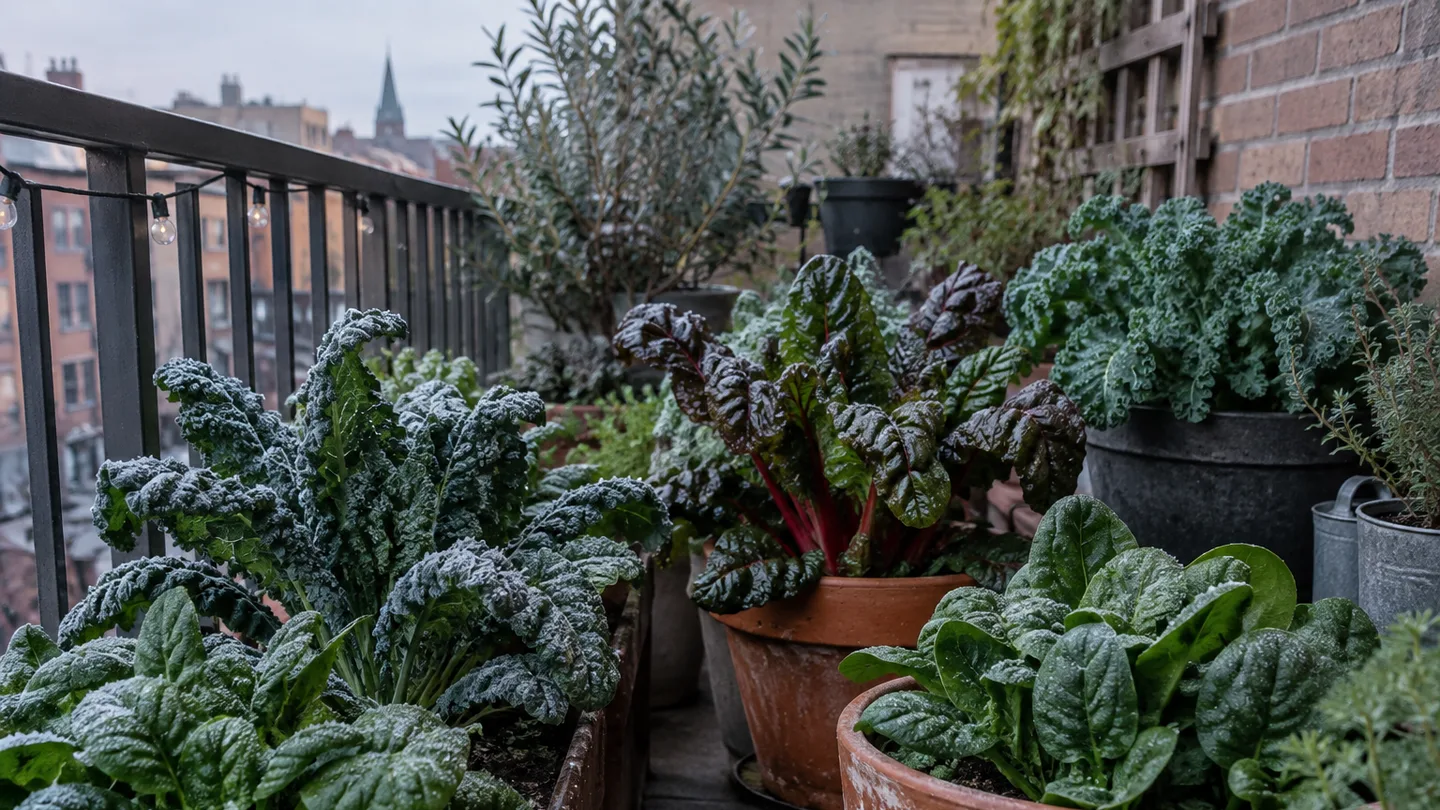
Cold-hardy in a bed is not the same as cold-hardy in a pot
Roots in open ground have more surrounding soil than roots in a container. A pot has less thermal mass—the amount of material that takes time to warm or cool—so its mix can track air temperature more quickly. Wind can add stress, and an exposed pot may chill from its sides as well as from the top. A larger container usually gives roots more room and more mix around them, but no size makes a prolonged freeze harmless.
Start with a sunny, sheltered spot if you have one, and check that water can leave the pot. Soggy mix is not a useful cold-weather buffer: it leaves roots short of air, while a dry pot can be exposed to both chilling and dehydration. For more on moisture checks, see how much to water container plants. If you have room, a cold frame can add shelter, but it still needs ventilation when the day warms.
Kale holds the longest season in a roomy pot
Kale is my first choice when the aim is a long picking window rather than the fastest salad. Give one full-size plant a pot around 5 gallons (19 L) and roughly 12 inches (30 cm) deep; a compact or dwarf type can be a better fit in less space, provided its mature size suits the container. Check the variety label rather than assuming every kale stays small.
Plant early enough for the plant to establish before the first expected frost. Gradual exposure to falling temperatures gives the leaves time to adjust; a plant shifted directly from a warm indoor spot to a cold, windy balcony faces a sharper change. My working expectation—not a guarantee—is that established kale in a sheltered 19 L (5-gallon) pot, gradually acclimated, will show limited tip damage after a brief frost near -2°C (28°F). Widespread collapse by the next morning would prove that call wrong for those conditions.
Pick the lower outer leaves when they are large enough for your use, leaving the central growing point intact. Repeated cool nights can be tolerated by many varieties, but a hard freeze, wind exposure or a small pot can still damage the plant.
Spinach rewards repeat sowings, not one crowded pot
Give spinach a planter about 6–8 inches (15–20 cm) deep. For leaf picking, thin seedlings to roughly 3–4 inches (8–10 cm) apart; tight clusters compete for light and make it harder to harvest individual leaves cleanly. Sow a short row or patch every 2–3 weeks while the season and your space allow, rather than filling the entire planter in one go.
Cool conditions slow new growth, so later sowings may take longer to replace what you cut. Harvest outer leaves and leave the centre growing. If the plant sends up a central stalk and starts forming flowers, it is bolting: leaf quality and shape change as it shifts toward seed production. That’s a cue to take the remaining usable leaves and decide whether to sow again, not to keep waiting for the same tender crop.
A planter with several small sowings also gives you a useful fallback. If one patch is damaged or runs to seed, the younger plants may still be coming along.
Leaf lettuce handles a nip; a full head needs steadier conditions
For a small balcony, loose-leaf lettuce is the more flexible choice. It can be harvested a few outer leaves at a time, while a heading type needs longer to form a head and gives you less room to adjust the harvest. Most compact lettuce types can start in about 6–8 inches (15–20 cm) of mix, but follow the packet spacing for the variety you buy.
Take outer leaves and leave the inner rosette to keep growing. A brief nip may leave some leaf varieties usable, but repeated cold, wet weather can mark leaves or stall growth; heading lettuce is not interchangeable with loose-leaf just because both are called lettuce. A breathable cover is worth considering when a frost is forecast, especially for small or recently planted seedlings. Keep the cover off the leaves where possible and uncover or vent it when conditions warm.
Arugula fits a shallow trough and a short harvest window
Arugula makes sense when a balcony has room for a narrow trough but not a large tub. Use about 6–8 inches (15–20 cm) of mix, sow seeds about ¼ inch (6 mm) deep and thin plants to roughly 4–6 inches (10–15 cm) apart if you want larger leaves. For baby leaves, you can harvest younger and more closely spaced plants, but don’t expect each one to grow into a full-sized rosette.
Cool weather can keep the useful leaf stage going longer; warmer conditions and lengthening days can push plants toward flowering. Sow another small batch after about 2–3 weeks if the season still gives it time to grow. Cut or pinch leaves from the outside and check the centre for a flower stalk. Once flowering starts, the flavor and texture may no longer suit the salad harvest you wanted.
It’s a good crop for using the awkward end of a planter. Just leave enough space to reach in and pick without crushing the next sowing.
Swiss chard is colorful, but not the toughest freeze pick
Chard can keep producing through cool weather, but I wouldn’t choose it ahead of kale if the pot will face a hard freeze. For a full-size plant, aim for a stable container about 10–12 inches (25–30 cm) deep, with roughly 3–5 gallons (11–19 L) of mix. A small or young plant may be easier to shelter than a mature one with a broad canopy and a large, exposed root ball.
Harvest the outer stalks and leaves while leaving the central growth point in place. A wide pot can be top-heavy once the foliage fills out, so put it where wind is less direct and where the container cannot be knocked over. If you have only one deep pot, my preference is to give it to the crop whose roots need it most; chard is a rewarding colour choice, but it isn’t the strongest reason to spend your only large container.
Radishes turn a 6-inch planter into a quick root crop
The usual radish disappointment is a forest of leaves with tiny roots underneath. Crowded seedlings are a common place to check first: their roots compete for space, and they can swell unevenly. Thin to about 1–2 inches (2.5–5 cm) apart, then keep the mix evenly moist rather than letting it swing from dry to soaked.
Round radishes can use about 6–8 inches (15–20 cm) of mix; longer-rooted varieties need more depth. Read the variety’s stated mature size and harvest when the roots reach it. Leaving them in the pot beyond their useful size can produce pithy or woody roots, particularly as conditions warm. Sow small batches rather than using the whole trough at once, so you have a fresh patch coming along instead of a single harvest deadline.
Choose carrot depth by mature root length, not the seed packet photo
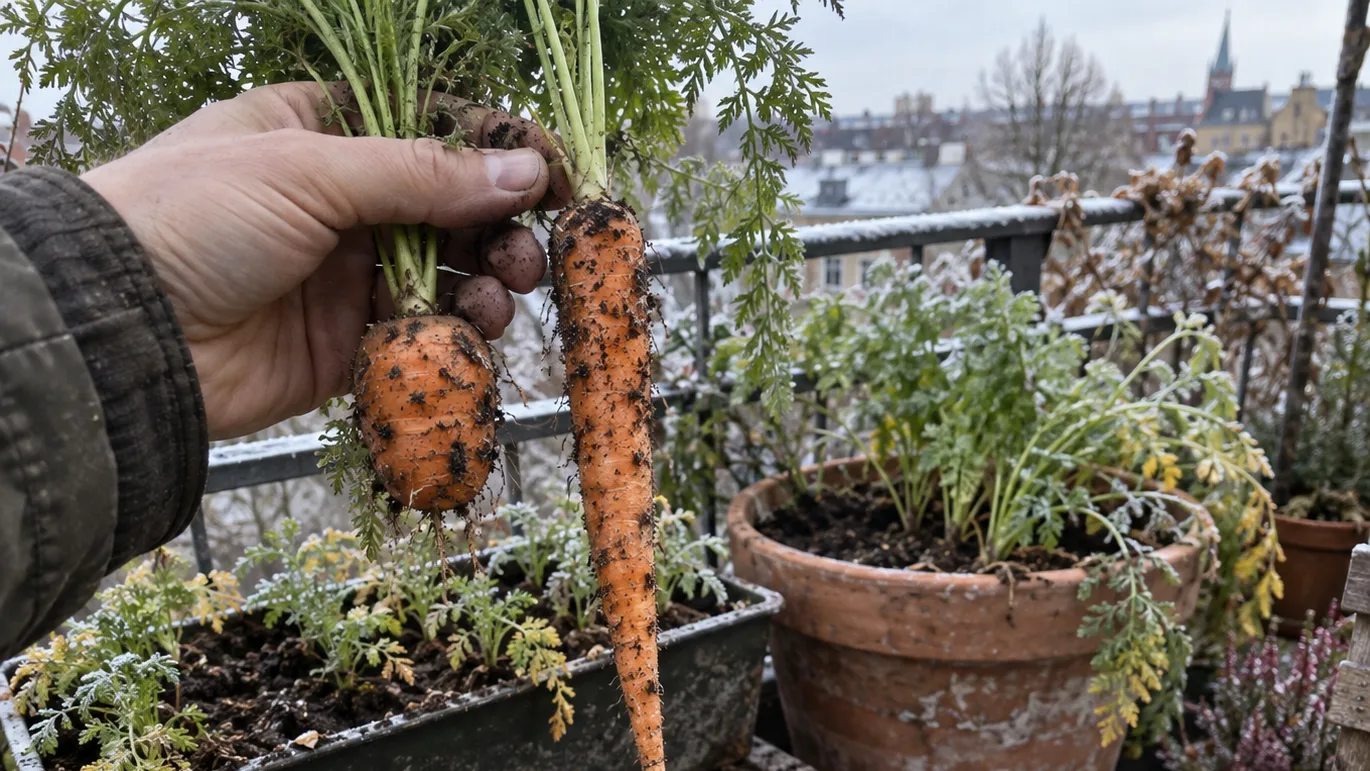
Measure the usable mix depth before you buy carrot seed. Short-rooted types can suit about 10–12 inches (25–30 cm), while long-rooted varieties may need roughly 14–18 inches (36–46 cm). A pot’s advertised capacity doesn’t tell you whether the root has a clear path downward: a broad but shallow container can hold a lot of mix and still be the wrong shape.
Use loose, stone-free potting mix so the roots don’t meet compacted lumps in their path. Once seedlings are large enough to handle, thin them to about 2–3 inches (5–8 cm) apart. If roots fork or twist, check for obstructions and crowded seedlings before blaming the seed. A quick depth test is to put a ruler inside the empty pot and mark the distance from the drainage area to where the mix surface will sit; subtract any space you plan to leave below the rim.
Scallions take little space, though winter growth still slows
A trough with about 6–8 inches (15–20 cm) of mix can hold a practical row of scallions. For slender onions, sow rows about 1–2 inches (2.5–5 cm) apart, then thin or harvest gradually as they fill out. Established plants generally cope with cool conditions better than seedlings, but that does not make a small trough safe through a prolonged freeze.
After cutting, expect regrowth to slow when the mix and air stay cold. Harvest when the stems are thick enough for your use, taking a few at a time rather than cutting every plant down to the base. In my balcony-scale planning, scallions are a useful space-filler because they don’t demand a deep tub; I still treat them as a crop to check, not as a winter-proof edging plant.
Beets give you edible leaves and roots—if the pot is deep enough
If your container is shallow or crowded, you can still take beet greens, but the roots may stay small or grow irregularly. For common beet varieties, start with about 8–12 inches (20–30 cm) of mix. Thin seedlings to roughly 3–4 inches (8–10 cm) apart when you want roots; spacing and final size vary with the variety.
Beet “seeds” often produce more than one seedling, so check each planting spot and thin the extra growth instead of assuming one seed equals one plant. You can pick a few outer leaves while the plant develops, but heavy leaf removal limits the foliage available to support root growth. If roots are not the priority, treat the planting as a greens crop and harvest accordingly.
A three-part frost plan: check the pot, group it, then cover it
Start with the forecast and the plant, not a promise that a particular temperature is safe. A brief light frost around 28°F (-2°C) is different from a harder or prolonged freeze, but neither threshold predicts what every cultivar and pot will tolerate. Local forecasts and local frost guidance help you judge the timing; the pot’s exposure still matters.
- Check the mix. If it is dry, water earlier in the day so the root area is not going into a cold night parched. Don’t leave the pot standing in a saucer of water.
- Group and shelter the containers. If their weight and your balcony layout allow, move pots together beside a sheltered wall. Keep them away from a railing edge where wind reaches them directly, and don’t block an exit or overload a balcony.
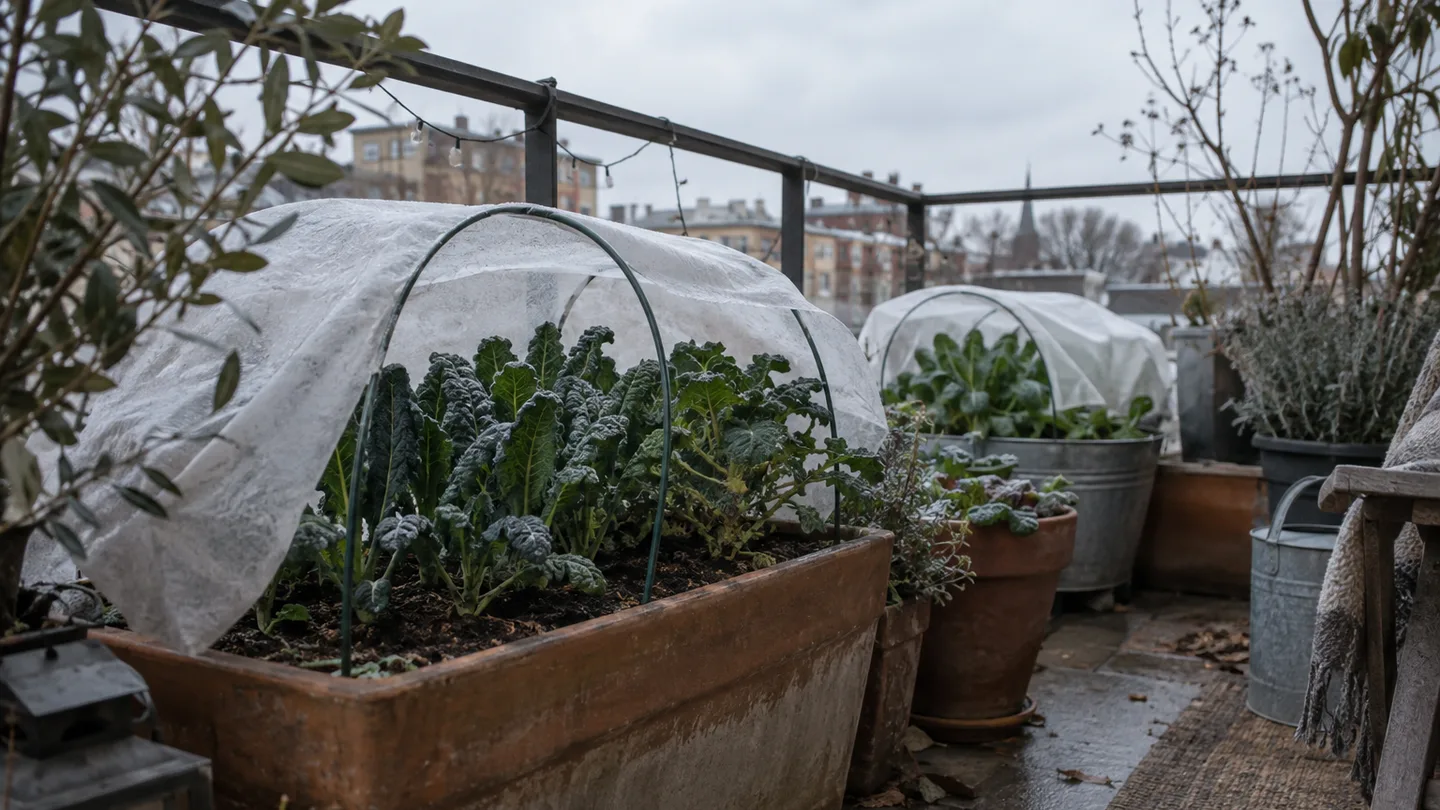
- Cover with breathable frost fabric. Support the fabric so it doesn’t press on leaves, and secure it against wind. A cover can buffer exposure, but it is not a heated shelter; check the forecast again and remove or vent it when conditions ease.
For a fuller step-by-step guide, use how to protect plants from frost. The judgement call I’d make is to shelter young plants and small pots first, rather than spending the evening trying to wrap every established crop equally. Smaller root volumes have less margin if the cold lasts.
Pick the crop that fits your light, pot depth and harvest deadline
These are planning ranges, not a promise of harvest dates. Cool weather slows growth, and variety, sowing conditions and light can shift the timing, so check the seed packet and use the table to shortlist crops rather than to schedule a meal.
| Crop | Useful mix depth | Container scale | Rough first picking from sowing | Cold-weather read |
|---|---|---|---|---|
| Kale | About 12 in (30 cm) | About 5 gal (19 L) for one full-size plant | Often 6–10 weeks for young leaves | Strong cool-season choice; hard-freeze risk remains |
| Spinach | 6–8 in (15–20 cm) | Planter with room for 3–4 in (8–10 cm) spacing | Often 4–7 weeks | Good cool-weather leaf crop; growth slows in cold |
| Leaf lettuce | 6–8 in (15–20 cm) | Compact planter; follow variety spacing | Often 4–7 weeks | Can take a nip; protect young plants in colder spells |
| Arugula | 6–8 in (15–20 cm) | Shallow trough works | Often 3–6 weeks | Useful in cool weather; warmth can trigger flowering |
| Swiss chard | 10–12 in (25–30 cm) | About 3–5 gal (11–19 L) for a full-size plant | Often 5–8 weeks for young leaves | Productive in cool weather; less dependable in hard freezes |
| Radish | 6–8 in (15–20 cm) for round types | Small planter, thinned to 1–2 in (2.5–5 cm) | Often 3–6 weeks | Quick crop; harvest at the variety’s stated size |
| Carrot | 10–12 in (25–30 cm) short-rooted; 14–18 in (36–46 cm) long-rooted | Choose by usable depth, not capacity alone | Often 7–12 weeks, depending on type | Cool-season option if root depth and mix suit it |
| Scallion | 6–8 in (15–20 cm) | Balcony trough or narrow planter | Often 8–12 weeks from seed for useful stems | Established plants handle cool better than seedlings; growth slows |
| Beet | 8–12 in (20–30 cm) | Thin to 3–4 in (8–10 cm) for roots | Often 7–10 weeks, variety dependent | Leaves can be harvested while roots develop |
For a quicker return, shortlist spinach, arugula or radishes. Choose kale or chard if you have a larger, stable pot and can give the plant time. Pick carrots or beets only when the depth matches the variety; otherwise, decide up front that greens matter more than full-sized roots. Those harvest windows are broad planning estimates, not source-checked specifications, so let the packet set the final expectation.
Before buying seed, measure the empty pot’s usable depth and check your local first-frost forecast. Then choose one crop that fits both, and leave the rest of the balcony’s space uncommitted until you know how that pot behaves.