Container Size Chart for Vegetables: Pot Depths That Work
A 30 cm (12 in) pot can be enough for lettuce and still be a poor tomato pot: diameter alone doesn’t tell you the root zone. As a working container size chart for vegetables, use 15–20 cm (6–8 in) of usable mix for shallow greens, 30–45 cm (12–18 in) for most fruiting or tuber crops, and check litres before you buy a seedling.
These are practical minimums rather than guarantees. I’m measuring the loose potting mix available to roots, not the pot’s outside height, rim diameter or printed capacity. A container with more room gives you a larger moisture and nutrient buffer, but it still has to suit the crop’s width, weight and top growth.
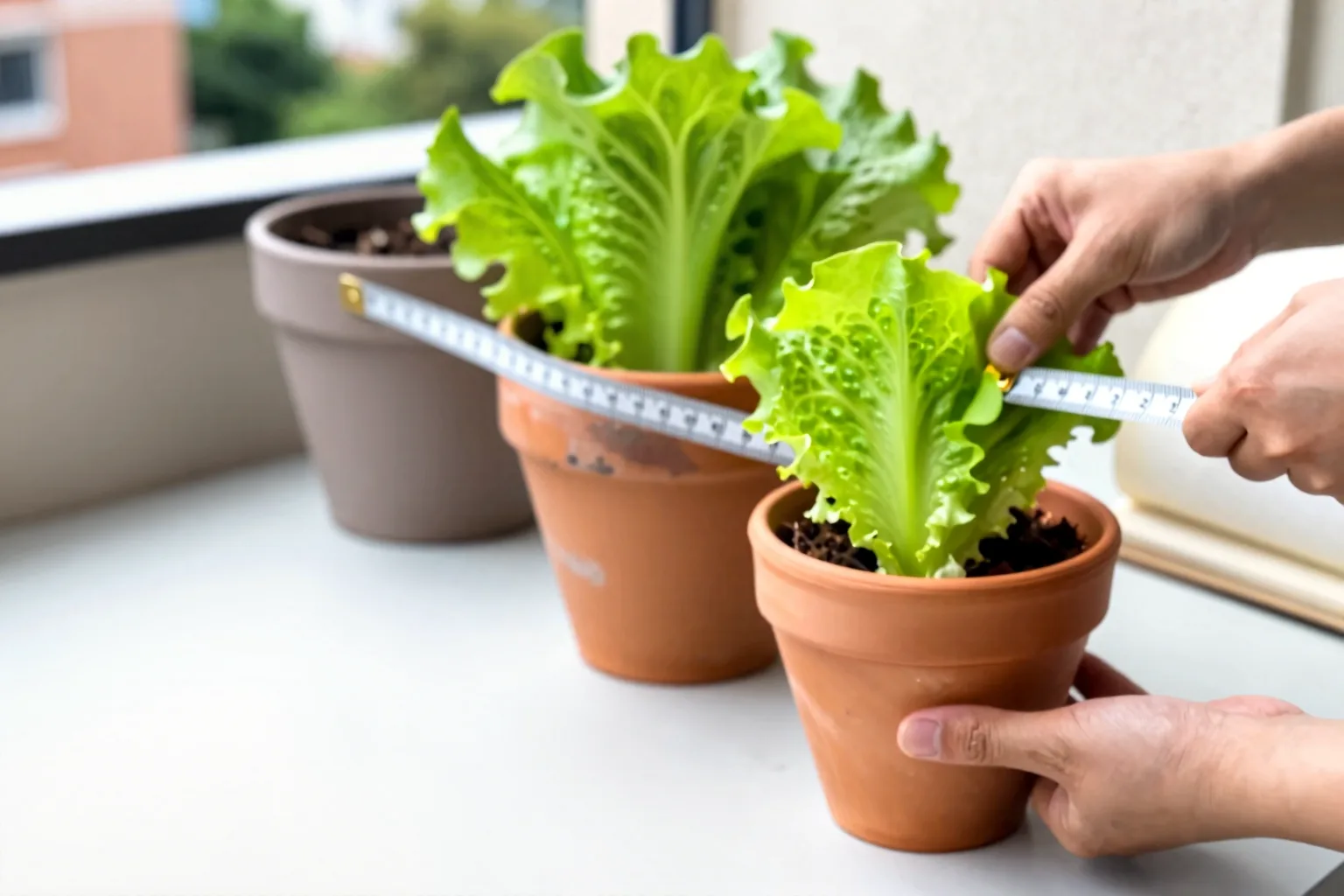
Start with the crop table: minimum workable depth and volume by vegetable
The table below is the quick answer to the question, how deep does the pot need to be? The volume is the approximate amount of mix in the whole container. Where several plants are listed, the count assumes ordinary harvest size and sensible spacing, not a dense baby-leaf crop.
| Vegetable or type | Usable mix depth | Approximate mix volume | Plants per container | What changes the recommendation |
|---|---|---|---|---|
| Lettuce | 15–20 cm (6–8 in) | 5–8 L (1.3–2.1 US gal) | 4–6 heads | Baby-leaf lettuce can share a wider, shallower trough; full heads need more spacing. |
| Radishes | 15–20 cm (6–8 in) | 5–8 L (1.3–2.1 US gal) | 16–24 | Round and short-rooted types fit this range; long daikon-style roots need a deeper column. |
| Spinach | 15–20 cm (6–8 in) | 5–8 L (1.3–2.1 US gal) | 4–6 plants | For repeated leaf harvests, width and steady moisture matter as much as depth. |
| Green onions | 15–20 cm (6–8 in) | 4–6 L (1.1–1.6 US gal) | 10–20 | Bunching onions fit; onions grown for large bulbs need more spacing and usually 20–25 cm (8–10 in). |
| Bush beans | 25–30 cm (10–12 in) | 10–15 L (2.6–4 US gal) | 4–6 | Climbing beans need similar root depth but a firm trellis and enough width to resist wind. |
| Beets | 20–25 cm (8–10 in) | 10–15 L (2.6–4 US gal) | 4–6 | Baby beets can be closer together; full roots need loose mix and more room between plants. |
| Kale | 25–30 cm (10–12 in) | 10–15 L (2.6–4 US gal) | 1–2 | Harvesting small leaves allows more plants than growing large, long-lived plants. |
| Bulb onions | 20–25 cm (8–10 in) | 10–15 L (2.6–4 US gal) | 4–6 | Small bulbs tolerate closer spacing than large storage onions. |
| Short carrots | 20–25 cm (8–10 in) | 10–15 L (2.6–4 US gal) | 12–20 | Choose a short-root cultivar; standard carrots need the deeper row below. |
| Standard carrots | 30–40 cm (12–16 in) | 15–25 L (4–6.6 US gal) | 10–16 | The mix must be stone-free and loose for the full root length. |
| Compact or dwarf tomato | 30–40 cm (12–16 in) | 20–30 L (5.3–7.9 US gal) | 1 | A patio, dwarf or compact determinate plant is the reason this smaller range works. |
| Indeterminate tomato | 40–45 cm (16–18 in) | 30–40 L (7.9–10.6 US gal) | 1 | The long vine and extended fruiting season call for more root volume, a heavy support and a wider base. |
| Peppers | 25–30 cm (10–12 in) | 10–20 L (2.6–5.3 US gal) | 1 | Compact plants can fit the lower end; a large plant carrying many fruits benefits from the upper end. |
| Cucumber | 30–40 cm (12–16 in) | 20–30 L (5.3–7.9 US gal) | 1 | A trellised compact plant uses less floor space, but its root volume does not disappear. |
| Potatoes | 30–45 cm (12–18 in) | 30–40 L (7.9–10.6 US gal) | 1–2 seed pieces | Part of the column is needed for adding mix over new stems, called hilling. |
| Compact zucchini | 30–45 cm (12–18 in) | 30–40 L (7.9–10.6 US gal) | 1 | A bush or compact cultivar is essential; the broad leaves can still make the pot wind-prone. |
Read depth as a floor, not a target. If your location is hot, windy or exposed to strong afternoon sun, choose the larger volume within the row. A small pot contains less water between checks, so the plant reaches dry mix sooner even if the stated depth is technically adequate.
The variety note is where the answer flips. A short carrot in a 20 cm (8 in) vessel is a reasonable match; a full-length carrot in that same vessel will bend, fork or stop against the base. A dwarf tomato can make a 20–30 L (5.3–7.9 US gal) pot useful, while an indeterminate vine turns that purchase into a frequent-watering and support problem.
What the chart is actually measuring
Measure from the surface of the mix down to the usable bottom, after allowing for the pot’s drainage structure. Leave roughly two fingers, or about 3–5 cm (1–2 in), below the rim so watering doesn’t wash mix over the edge. That unfilled strip is headspace; it isn’t root volume.
Also check whether the listed volume is per plant or per container. In this chart it is the whole vessel. Four lettuces may share a wide trough with 8 L (2.1 US gal) of mix, but one tomato should receive the full tomato volume rather than a quarter of it.
The 30 cm (12 in) diameter trap: convert labelled pot size into usable litres
Pot labels encourage a quick mistake: treating width as capacity. A 30 cm (12 in) diameter tells you one measurement at the rim. It says little about the internal height, taper, wall thickness or empty space that will remain above the mix.
For a straight-sided pot, measure the inside diameter and the depth you actually intend to fill. The simple calculation is:
litres of mix ≈ π × radius² × mix depth ÷ 1,000
Use centimetres for the measurements. Radius is half the internal diameter, and 1,000 cubic centimetres equals 1 litre. For example, a pot with an internal diameter of 30 cm (12 in) and 25 cm (10 in) of mix works out as π × 15 × 15 × 25, or about 17.7 L (4.7 US gal). If the same pot is only filled to 15 cm (6 in), it holds about 10.6 L (2.8 US gal).
| Internal shape | Mix dimensions | Approximate capacity | Why it matters |
|---|---|---|---|
| Straight-sided | 30 cm (12 in) wide × 15 cm (6 in) deep | 10.6 L (2.8 US gal) | A useful shallow container, but below the chart’s compact-tomato volume. |
| Straight-sided | 30 cm (12 in) wide × 25 cm (10 in) deep | 17.7 L (4.7 US gal) | More buffer for greens, beans or a pepper than the short version. |
| Straight-sided | 30 cm (12 in) wide × 35 cm (14 in) deep | 24.7 L (6.5 US gal) | Closer to a compact tomato or cucumber, though width and support still count. |
| Tapered | 30 cm (12 in) rim, 20 cm (8 in) base × 25 cm (10 in) deep | About 12.4 L (3.3 US gal) | The sloping sides remove capacity that the rim measurement suggests. |
These examples use internal measurements and a full column of mix. In a shop, a pot advertised as 30 cm wide may measure less inside because of thick walls, and you’ll usually leave headspace. That is why I treat a printed diameter as a clue and calculate the usable volume before committing a tomato or zucchini to it.
A tapered pot can be estimated by averaging its cross-sections, but a practical shortcut is to measure the inside at the rim and near the base, then assume its capacity is lower than a straight-sided cylinder of the same rim width. If the crop is close to the minimum, choose the next larger pot rather than relying on a flattering label.
Don’t put gravel, broken pottery or a layer of stones in the bottom to create a deeper root zone. Water moves through the small pores in potting mix differently from the larger gaps in gravel. At that boundary, the fine mix can remain saturated before water begins to cross into the coarse layer. The gravel has taken away space without removing the wet band.
That wet band is part of a perched water table: water held above the drainage holes after free drainage has stopped. It isn’t a separate underground tank; it is the portion of the mix whose pores remain full because capillary forces hold water there. In a shallow pot, that saturated portion occupies a larger share of the total root zone, which leaves less airy mix for roots.
pot rim
┌────────────────────────┐
│       headspace        │
│    usable mix          │
│  perched wet zone      │
│  drainage holes  • •   │
└────────────────────────┘
For the hole pattern and placement, see Container Drainage Holes: Size, Number and Placement. For irregular pots, How to Calculate Potting Mix Volume in Litres for Any Container gives you a better measuring route than trusting the outside dimensions.
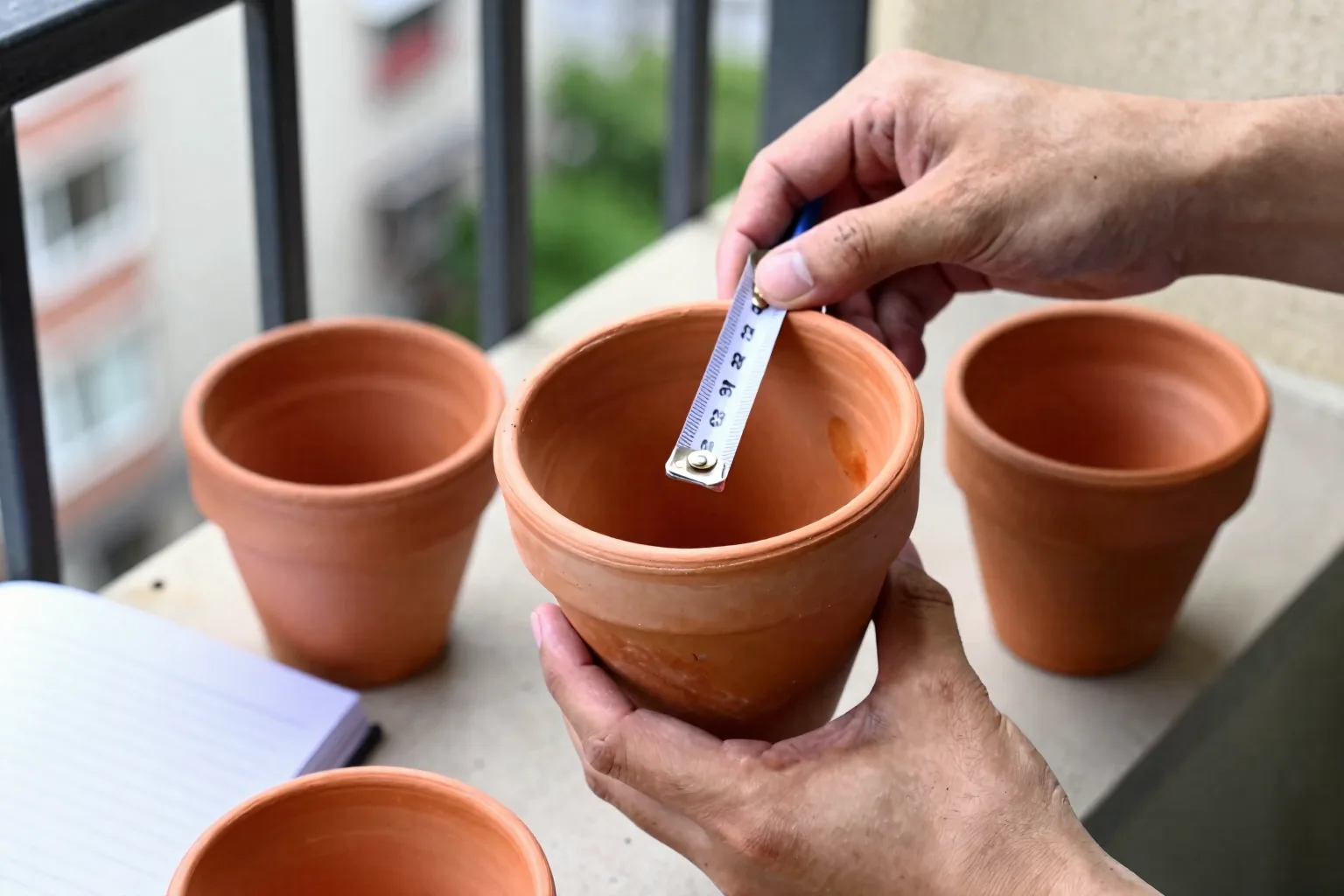
Depth is only half the decision—spacing, shape and support finish the match
Roots don’t occupy a pot as a neat cylinder. The crop’s architecture decides whether you need a broad shallow box, a narrow deep column or a heavy, stable vessel. Depth is the first filter, not the whole specification.
Match the pot to the way the crop grows
- Shallow, fibrous-rooted crops: lettuce, spinach and green onions can use a 15–20 cm (6–8 in) mix layer. Their practical limit is often width and moisture consistency. A broad trough gives several plants room to spread their leaves without forcing you to overfill a deep pot.
- Taproot crops: a taproot is one main root that grows down from the crown. Carrots and beets need a loose vertical column, so extra width does not compensate for a short vessel. Pick the cultivar to match the depth you own.
- Fruiting plants: tomatoes, peppers, cucumbers and zucchini keep producing foliage and fruit, which creates a longer demand for water and nutrients. A larger mix volume acts as a buffer between watering and feeding, but it doesn’t remove the need to check the pot.
- Tubers: potatoes use the container vertically. Hilling means adding mix around new stem growth as the plant rises, so the pot needs both initial depth and spare capacity for those additions.
Spacing is not just a root calculation. Leaves need room to dry after watering, and a crowded canopy can shade the lower leaves and make harvesting awkward. My practical judgment is to give up a few plants rather than squeeze the listed maximum into a sheltered, slow-drying corner. The extra plant rarely repays the smaller water reserve.
For a concrete comparison, a wide 20 L (5.3 US gal) trough can hold several lettuce plants because each plant is small and the crop is harvested quickly. The same volume is better treated as one pepper or a compact tomato. A single cucumber may use 20–30 L (5.3–7.9 US gal), whether its vine climbs a trellis or trails over the edge; the trellis changes the footprint, not the root demand.
Beans show a similar fork. Bush beans need a low, stable canopy and can share a 10–15 L (2.6–4 US gal) container within the chart’s spacing. Climbing beans can use a comparable root volume, but the support rises above the pot and catches wind. The root zone may be adequate while the whole arrangement becomes unstable.
Wind acts higher up the plant than the root ball. A trellis, long cucumber vine or broad zucchini leaf increases the leverage that can tip a light container, especially on a balcony or rooftop. If the pot feels easy to lift empty, plan where it will live before filling it. Once saturated, one litre of water adds roughly one kilogram of weight, before you count the mix, pot and plant.
Pot size also cannot solve a light shortage. If a fruiting crop receives only a brief patch of direct sun, moving the pot to a brighter position or choosing a leaf crop is a more useful change than adding another 10 L (2.6 US gal) of mix. A larger pot helps the root environment; it does not manufacture sunlight.
Fill and place the container in this order
The order matters because a container changes from easy to awkward as soon as it is filled. I use this sequence before buying the plant, not after a root ball is already sitting on the balcony.
- Audit the location. Mark where direct sun reaches the floor or railing, note the wind exposure, and check your building, landlord or strata rules about balcony weight and runoff. A rooftop or balcony may have its own load and water-management limits, and only the responsible building guidance can tell you what applies to your site.
- Choose the crop before the pot. Use the table to select one row, including its variety condition. If you own a 20 cm (8 in) deep pot, buy a short carrot rather than expecting a standard carrot to adapt to the container.
- Measure the empty pot inside. Record the narrowest internal width, internal height and the position of the drainage holes. Subtract the 3–5 cm (1–2 in) headspace you intend to leave. If those figures fall below the chart, change the pot or change the crop now.
- Confirm unobstructed drainage. Holes need an open path out of the container. A saucer can catch overflow, but it should not leave the pot standing in a pool after watering. Don’t rely on gravel to correct a pot with inadequate holes.
- Pick the mix and container material. I favour a lightweight container sold for food-growing and a purpose-made potting mix. Treated timber and decorative glazes of uncertain composition are edible-plant-adjacent materials with a food-safety question attached; check the product’s material guidance instead of assuming that an attractive finish is suitable for vegetables. I would not use excavated garden soil as the default in a pot: fine particles can settle, reduce air spaces and make the root zone harder to wet evenly.
- Install the support while everything is empty. Put a cage, trellis or stake in position before the plant becomes top-heavy. Anchor it to the pot or a secure structure without blocking drainage. Pushing a long stake through an established root ball can cut roots that were using the very volume you sized correctly.
- Fill in stages. Add mix to roughly halfway, tap the sides, and check that the container is sitting level. Continue to about two fingers below the rim. If the mix is bone dry, moisten it in a tub or add water in several passes; dry mix can shed water down the sides or leave a dry centre after the first rushed watering.
- Plant, water and settle the pot. Set the seedling at the depth suited to that crop, fill around the root ball without packing the mix hard, and water slowly until some water exits the holes. Let the container drain before its final placement, because moving wet mix is a lifting job rather than a gentle adjustment.
Then troubleshoot by inspecting the mix, not by guessing from the leaves. A wilted plant with a dry root zone points first toward too little volume, missed watering, strong wind or a root ball that has become water-repellent. A wilted or yellowing plant sitting in persistently wet mix points toward poor drainage, blocked holes or watering again before the root zone has used the available air and water.
If the surface is dry but the lower mix is wet, don’t automatically add water. Push a finger or a narrow wooden stick several centimetres into the root zone, or lift the container if it is small enough to do so safely. Surface dryness is not a complete moisture reading, particularly in a deep pot or after a cool night.
A container that becomes dry within hours deserves a sizing and placement check. The immediate options are a larger volume, shelter from drying wind, protection from the hottest afternoon exposure or a crop with lower demand. In a 20 L (5.3 US gal) black plastic pot exposed to hot wind, I’d expect daily moisture checks to become necessary during a heat spell. A glazed 30 L (7.9 US gal) pot in part shade may go longer, but the mix decides the schedule.
Use How Often to Water Vegetables in Pots on a Balcony for the inspection routine, and see Best Potting Mix for Vegetable Containers if the mix dries into a hard-sided plug or stays wet for days. University extension guidance on container vegetable root depth, spacing and minimum container volume can provide a useful second opinion, while RHS guidance on growing vegetables in containers is helpful for comparing crop choices. Neither replaces measuring your own pot and checking your own balcony conditions.
Your next physical action: take the empty pot, a ruler and a tape measure. Write down its internal diameter, narrowest width, usable depth and hole position, then match those measurements to one row in the chart before buying mix or seedlings this weekend.