Container Gardening Cucumbers: How Big a Pot Do You Need?
The pot most people carry home for a cucumber holds about 8 litres (2 US gallons). A single cucumber plant, once it has thrown out its third or fourth true leaf and started climbing, wants something closer to 19–24 litres (5–6 US gallons) by high summer. That gap is why so many balcony cucumbers grow a metre of vine, flower beautifully, and then hand over four bitter fruit and quit.
This is a sizing problem before it is a growing problem. Get the volume right and the plant forgives a lot. Get it wrong and no amount of feeding, misting or encouragement fixes it, because the failure happens underground in the middle of the afternoon while you are at work.
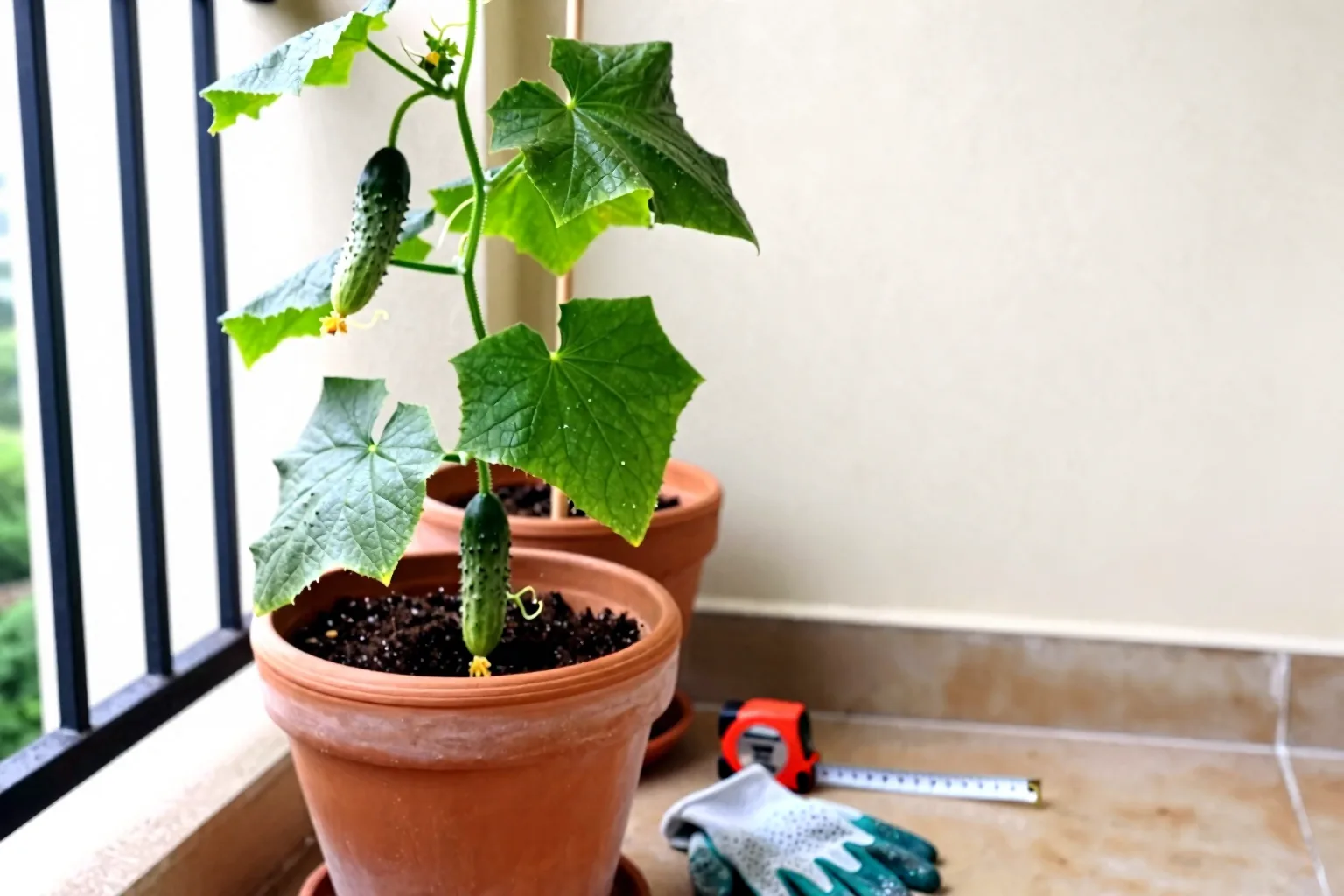
The Short Answer: Minimum Pot Size for Cucumbers
One cucumber plant, one pot, 19–24 litres (5–6 US gallons) of mix, at least 30 cm (12 in) deep. That is the size I would tell anyone standing in an aisle with no other information. Depth below 25 cm (10 in) is where I start expecting trouble regardless of how wide the pot is.
The number moves with the variety. A compact bush cucumber bred for patios can produce respectably in 15–18 litres (4–5 gallons), which is roughly what a drilled 5-gallon bucket actually holds once you allow for headspace. A full vining slicer in a hot, exposed spot is happier at 30–40 litres (8–10 gallons), not because the roots need every litre but because the extra mix is a water buffer, and water is the whole ballgame with this crop.
If you only remember one line: buy the pot for August, not for the seedling in your hand.
Bush vs Vining Cucumbers: Why the Variety Changes the Math
There is no single correct pot size for "cucumber" because the two habits you can buy are structurally different plants doing the same job.
Bush and compact types — the ones sold as patio, space-saver or bush varieties — have shortened internodes, so the stem stacks leaves close together instead of running. Total leaf area is smaller, so total daily water loss is smaller, so a smaller reservoir of mix can keep up. They tend to set most of their fruit over a concentrated few weeks and then decline, which also means they never reach the enormous late-season root mass that breaks small pots.
Vining types keep extending as long as conditions allow. Every new node adds a leaf, and every leaf adds transpiration — water pulled up through the plant and evaporated out of the leaf surface. A vining cucumber trained up a 1.8 m (6 ft) trellis in late July can be carrying three or four times the leaf area it had in June, from the same volume of mix. The pot did not shrink. The demand on it tripled.
So the honest way to size is: pick the variety first, read the packet for its habit and mature spread, then buy the container. Seed catalogue listings are where growth habit and days to maturity are actually stated for the specific cultivar in front of you, and they vary far more between varieties than most sizing guides admit.
Pot Dimensions Compared: Volume, Depth and Width
Volume on a label is nominal — it is the brim-full figure, and you never fill to the brim. Assume you lose 10–15% to the watering gap you leave below the rim.
| Pot (nominal) | Typical depth × width | Verdict for cucumbers |
|---|---|---|
| 8 L / 2 gal | 20 × 22 cm (8 × 9 in) | No. Fine for basil, not for a fruiting cucurbit. |
| 12 L / 3 gal | 25 × 26 cm (10 × 10 in) | Plant survives, sets a handful of small fruit, stalls in heat. |
| 15–18 L / 4–5 gal (a drilled bucket) | 30 × 28 cm (12 × 11 in) | Workable for one bush/compact variety if you can water daily. |
| 19–24 L / 5–6 gal | 30–35 × 35–40 cm (12–14 × 14–16 in) | The default. One plant of any type, trellised if vining. |
| 30–40 L / 8–10 gal | 35–40 × 45 cm (14–16 × 18 in) | Comfortable for a vining variety in full sun; best drought buffer. |
| 60 L+ trough or half barrel | 40 × 80 cm (16 × 32 in) | Two plants, 45 cm (18 in) apart, if the balcony can take the weight. |
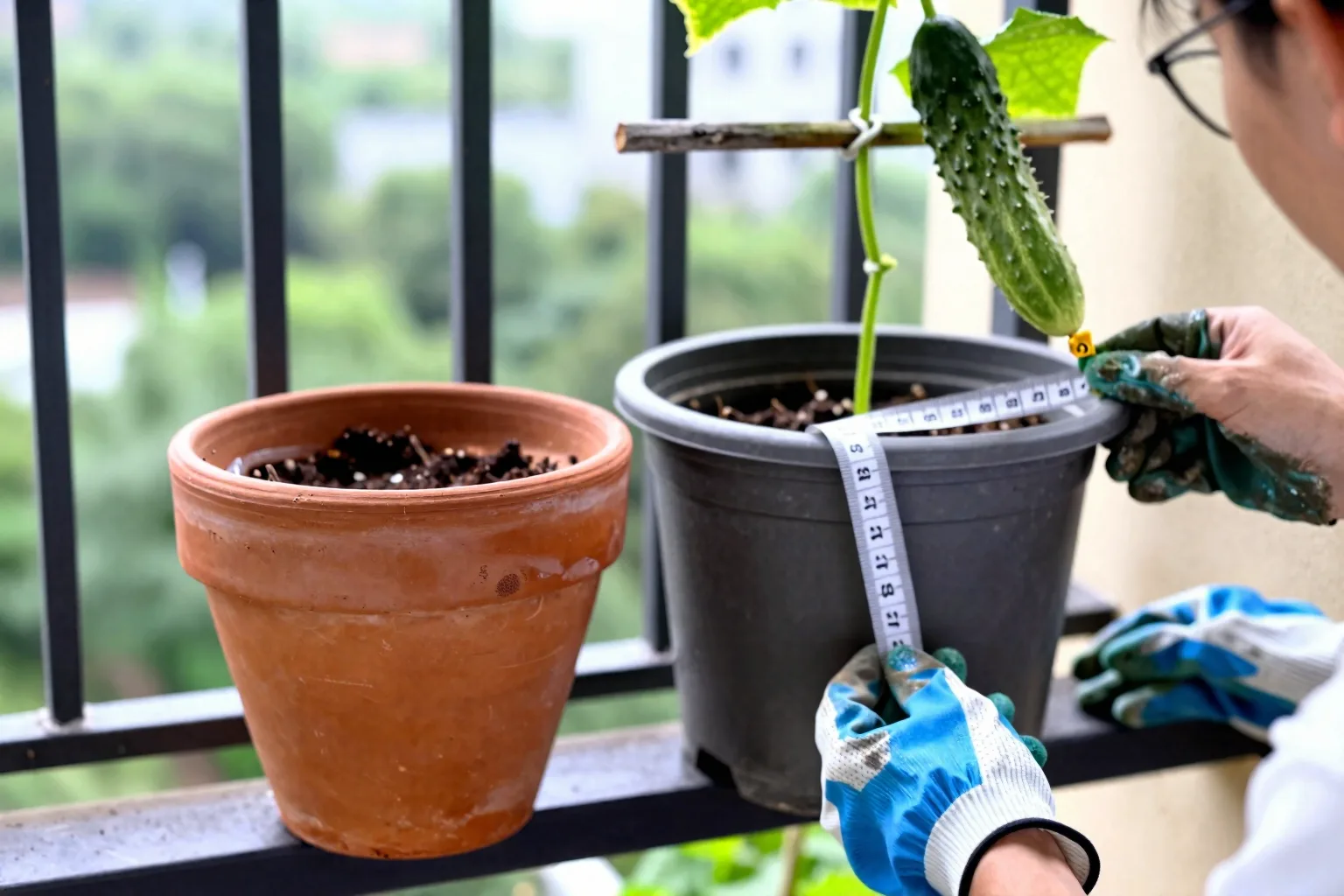
Run the arithmetic yourself rather than trusting the sticker. A round pot 30 cm across and 28 cm deep gives you π × 15² × 28 ≈ 19,800 cm³, which is 19.8 litres brim-full. Fill it to 25 cm and you are holding about 17.7 litres of mix. That pot is labelled "30 cm" and sold as generous. It sits at the very bottom of the range for a vining cucumber. It is worth learning to work out how much potting mix your pot actually holds before you commit to a plant, because the label and the reality diverge most on the shallow, wide, decorative shapes.
Why an 8-Litre Pot Fails a Cucumber
Not "produces less". Fails, in a specific and repeatable sequence.
A small pot in sun heats up and dries from the sides as well as the surface. By early afternoon the mix in the outer few centimetres is drier than the root hairs can draw from. The plant's response is immediate: it closes its stomata, the pores on the leaf underside, to stop losing water. Closed stomata also stop carbon dioxide coming in, so photosynthesis pauses. No sugar is being made, but the plant still has flowers and small fruit demanding sugar.
Cucumbers resolve that shortfall by triage. The developing fruit nearest the growing tip gets what there is; the rest of the flowers abort. You see it as flowers yellowing at the stem and dropping without swelling, or as fruit that starts, goes pale and narrow at the blossom end, and stops. Crucially, all of this happens before visible wilting. By the time the leaves flop, the plant has already spent several afternoons not growing.
The second half of the failure is root binding. In a small pot the roots hit the wall within weeks, circle, and thicken into a mat. That mat displaces mix, so the pot holds even less water than it did in June, right when demand peaks. The plant is fighting a reservoir that is shrinking as its thirst grows.
There is a related point worth flagging honestly, because it gets stated as fact too often: bitterness in cucumbers comes from compounds called cucurbitacins, and irregular water and heat stress are widely blamed for it by growers. Many modern varieties are specifically bred to be low in these compounds, so a stressed plant of a "burpless" hybrid may stay perfectly sweet while an heirloom in the next pot turns bitter. Treat bitterness as a variety-plus-stress interaction, not a guaranteed verdict on your watering.
Depth vs Width: Which Matters More for Cucumber Roots
Cucumbers grow a central taproot that heads down early, plus a dense fan of lateral roots that spread sideways in the upper layer of soil. In open ground that taproot can go well past a spade's depth. In a pot it reaches the base, stops, and the plant compensates by pushing more laterals.
That gives you a clean way to think about it. Depth buys you root architecture: enough vertical run that the taproot establishes properly before it turns, and a deeper column means the bottom third stays cooler and damper as a reserve the plant can reach on a hot day. Below about 25 cm (10 in) you lose that reserve entirely, and every watering has to carry the plant through to the next one with nothing in the bank.
Width buys you litres. Widening a pot adds volume by the square of the radius, so going from 30 cm to 40 cm across adds far more mix than adding 10 cm of depth does. Width also gives the lateral roots the horizontal space they naturally want.
If forced to choose between a tall narrow pot and a broad shallow one of the same volume, I would take the tall one for cucumbers, on the condition that it clears 30 cm deep. Shallow-and-wide has a second problem: the saturated zone that sits at the bottom of any container occupies a much larger fraction of a shallow pot's height, so proportionally less of the mix is usefully aerated. Depth is what dilutes that soggy layer, which is also why the gravel layer makes drainage worse rather than better.
Drainage and Watering in a Fast-Drying Pot
Drainage first, because it is cheap and permanent. For a 20-litre-class pot I want four to six holes of at least 10–12 mm (about half an inch), spaced around the base rather than one big one in the centre, plus feet or a couple of tile offcuts so the base is not sealed against the balcony floor by surface tension. If you are drilling a bucket, drill the sides too, 2 cm up from the base — that drains the very bottom layer without letting mix wash out.
Do not add gravel, crocks or polystyrene. Water does not cross from fine mix into a coarse layer until the mix above is fully saturated, so a gravel layer lifts the wet zone up into the root ball instead of removing it. You lose volume and gain sogginess.
Then stop watering on a schedule and start reading the pot. Two checks, both free:
- Finger to the second knuckle, about 5 cm (2 in) in from the rim. Dry at that depth in a 20-litre pot means water now.
- Lift or tilt the pot by the rim. Learn what it weighs the morning after a thorough soak, and what it weighs when it needs one. Weight is the most reliable signal you have, and it costs nothing to learn.
Water until it runs freely from the base, then stop. Little-and-often keeps the top wet and the bottom dry, which trains roots upward into the layer that dries fastest. In a plastic pot in full summer sun, expect close to daily; in a glazed pot in part shade, every second or third day. Terracotta in a breeze can want twice a day in a heatwave. The same fundamentals apply to any thirsty fruiting crop in a pot, and the piece on sizing a pot for tomatoes covers the shared logic in more detail, though cucumbers are less forgiving of a dry afternoon and more forgiving of a slightly lean feed.
Trellising, Weight and Wind: Sizing for a Balcony, Not a Garden Bed
Here is the constraint nobody in a garden bed thinks about. Wet potting mix runs roughly 0.6–0.9 kg per litre depending on how much bark, sand and moisture-retaining material it contains. A 24-litre pot watered to running is therefore somewhere around 15–22 kg (33–48 lb) before you add the pot itself, a trellis and a plant. Two of them plus a trough and you are placing 60–80 kg on one spot of a balcony slab.
The practical rules: keep heavy pots close to the building wall or directly over a supporting edge rather than out at the centre of the span, spread the load rather than stacking it in one corner, and if you rent, check what your building or lease says about balcony loading. That is a specific-to-your-building question, not something an article can answer for you.
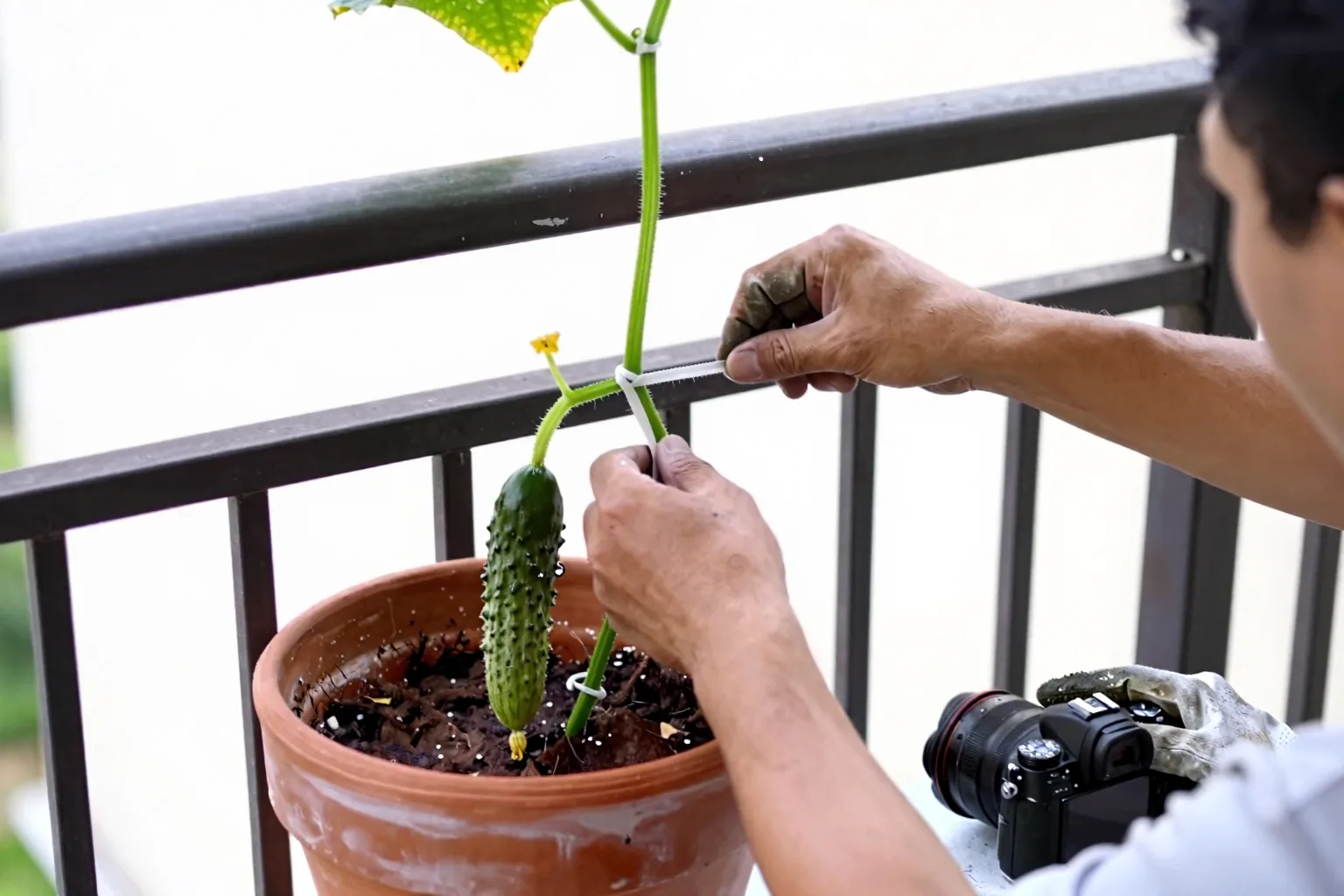
The trellis changes the physics again. A trellised cucumber in full leaf is a sail. Wind loads a 1.8 m frame at the top and levers against a base that may be only 35 cm wide, and the tipping moment does not care that the pot felt immovable when you lifted it. What I would do:
- Tie the top of the trellis to the railing, a wall hook or a stair rail. One zip tie removes most of the risk.
- Prefer a wide, straight-sided pot over a tall tapered one — a narrow foot is a lever arm.
- Angle an A-frame trellis so the plant leans against the railing rather than away from it.
- On an exposed high balcony, a mesh or netting panel takes less wind load than a solid-slat trellis.
A tipped pot in a gust snaps the main stem at the base, and a cucumber does not recover from that mid-season.
Matching Pot Material to Your Watering Habits
My genuinely unfashionable opinion: for cucumbers, choose the material around how often you will realistically water, not around what looks best or what has the healthiest root physics. A slightly imperfect root zone that never dries out will beat superb aeration that hits 35 °C on a Saturday you spent away from home.
- Plastic (including nursery pots): non-porous walls, so all evaporation is from the surface. The best value per litre and the most forgiving if you water every other day. Light-coloured plastic cooks the root ball less than black in direct sun.
- Glazed ceramic: behaves like plastic for moisture, adds thermal mass and stability against wind. Heavy, which is the point on an exposed balcony and the problem on a weight-limited one. A note rather than a scare: some decorative glazes are not certified food-safe, though the relevant question for a pot is the mix and the plant, not the glaze; if it matters to you, use it as a cachepot with a plastic liner inside.
- Unglazed terracotta: evaporates through the walls as well as the surface. Beautiful, and the wrong choice for a cucumber unless you are home twice a day in summer.
- Fabric grow bags: air-prunes roots, which prevents circling, and drains freely. It also dries fastest of the lot. Size up a step — a 30-litre bag behaves more like a 20-litre plastic pot in terms of how long it carries the plant.
- Self-watering pots: the reservoir decouples the plant from your schedule, which is exactly what a cucumber's stomata want. The trade-off is that the wicking chamber eats some of the labelled volume, so read the mix capacity rather than the overall size. It is worth reading how self-watering pots compare for vegetables before paying the premium.
Copy this into your phone before you go shopping:
- Volume 19 L / 5 gal or more, measured as mix capacity
- Depth 30 cm / 12 in or more
- Four to six drainage holes, 10 mm+, plus feet
- Straight-sided rather than tapered if trellising
- One plant per pot
- Variety habit checked on the packet before the pot is chosen
Three Questions People Ask in the Aisle
Can you grow cucumbers in a 5-gallon bucket?
Yes, for a bush or compact variety, provided you drill four to six holes in the base and a few in the lower sides. A standard bucket holds around 17 litres of mix once filled sensibly, which is at the low end. For a vining variety it is borderline: the plant will fruit, but it will be root-restricted by midsummer and you will be watering daily. Go one or two sizes up if the choice is available.
How many cucumber plants can you fit in one pot?
One, at the sizes above. Two plants in a 24-litre pot halve the mix available to each and double the transpiration, which is the exact combination that triggers flower drop. If you want two plants, use a trough of 50 litres or more and space them 45 cm (18 in) apart. Crowding also cuts airflow between the leaves, and a damp, still canopy is where powdery mildew starts.
Do container cucumbers need a trellis?
Vining varieties, yes, and for two reasons: fruit hanging in air grows straighter than fruit resting on the mix surface, and lifting the leaves off the pot improves airflow enough to slow foliar disease. Bush and patio types bred for containers generally do not need one, though a short 60 cm support hoop keeps them tidy and stops the heaviest fruit dragging the stems down.
What to Do This Week
Go and measure the pot you already own. Diameter across the top, depth from base to the fill line you would actually use, then π × r² × depth ÷ 1000 for litres. If that number starts with a 1 and the second digit is under 9, you have your answer before you have spent anything, and you know exactly what to look for on the shelf.
If it clears 19 litres, do the second job now rather than in June: drill the drainage, set it on feet, and decide where the trellis anchors. Fixing drainage or moving an anchor point once a cucumber is two metres up a frame is a job nobody enjoys.
Frequently Asked Questions
Can you grow cucumbers in a 5-gallon bucket?
Yes for compact bush varieties with drilled drainage holes; borderline and root-restricted for vining types, which do better a size or two up.
How many cucumber plants can you fit in one pot?
One plant per pot at the sizes recommended in this article; crowding two into one container usually means smaller fruit and more disease risk, not double the harvest.
Do container cucumbers need a trellis?
Vining varieties generally do, both for airflow and to keep fruit off the wet mix surface; bush/compact varieties bred for containers usually don't need one.