Container Gardening 101: What Changes When You Grow in Pots
The pot most people carry home from a hardware store holds somewhere around 8 litres of mix, roughly 2 US gallons. A tomato plant wants closer to 20 litres before it stops behaving like a shrunken version of itself. That gap, repeated across a balcony full of pots, is behind most of what goes wrong in a first container season: the plants aren't weak, they're housed too small.
Growing in pots isn't garden growing at reduced scale. Four things change physically the moment soil sits inside a wall with a hole in the bottom. Roots hit a ceiling. Water leaves faster. Nutrients leave with the water. And the whole assembly gets heavy enough to matter if it's sitting on a fifth-floor slab. Understand those four and every crop-specific guide you read afterwards suddenly makes sense, because they're all downstream of the same physics.
Root Volume Has a Hard Ceiling, and That Ceiling Sets Everything Else
In open ground, a tomato's roots will happily travel a metre or more sideways and most of that again downward, foraging through a soil volume you'd struggle to fit in a wheelie bin. In a 25 cm (10 inch) pot, the same plant meets a plastic wall within a couple of weeks of transplanting, turns, and starts circling. It doesn't stop growing roots. It just stops finding anything new.
Here's the causal chain that matters. Total root surface area sets how much water and dissolved nutrient the plant can absorb per day. That daily uptake sets how much leaf area the plant can keep turgid and fed. Leaf area sets photosynthesis. Photosynthesis sets how much sugar is available to fill fruit. So the litres in your pot don't just limit the roots, they quietly cap the harvest at the far end of that chain. You cannot fertilise your way past it, and you cannot water your way past it. A small pot with a big plant in it simply needs watering more often to stay alive, which is not the same thing as producing more.
Rough working depths, before you look up the specifics for your crop:
| Crop type | Minimum working depth | Comfortable pot volume |
|---|---|---|
| Cut-and-come-again salad, most soft herbs | 15–20 cm (6–8 in) | 5–10 L (1.3–2.6 gal) |
| Strawberries, bush beans, chard, spring onions | 20–30 cm (8–12 in) | 10–15 L (2.6–4 gal) |
| Chillies, aubergine, compact bush tomatoes | 30–40 cm (12–16 in) | 15–25 L (4–6.5 gal) |
| Indeterminate tomatoes, courgette, potatoes | 40 cm+ (16 in+) | 30–45 L (8–12 gal) |
Treat those as floors rather than targets. Depth and volume aren't interchangeable either: carrots and parsnips will fork or stub in a shallow trough no matter how wide it is, while lettuce is perfectly happy in a broad, shallow tray that would strangle a tomato.
The judgement call I'd make, and it's the one that saves people a whole wasted season: buy the largest pot you can still lift when it's soaking wet, and let that lift test decide your crop list rather than the picture on the seed packet. If the biggest thing you can move is 20 litres, you're a chilli and salad grower this year, and you'll get more food out of that honest choice than out of four undersized tomatoes. If you want to run the numbers for a specific fruiting crop, how many litres of potting mix a tomato actually needs is the maths worth doing before you buy anything.
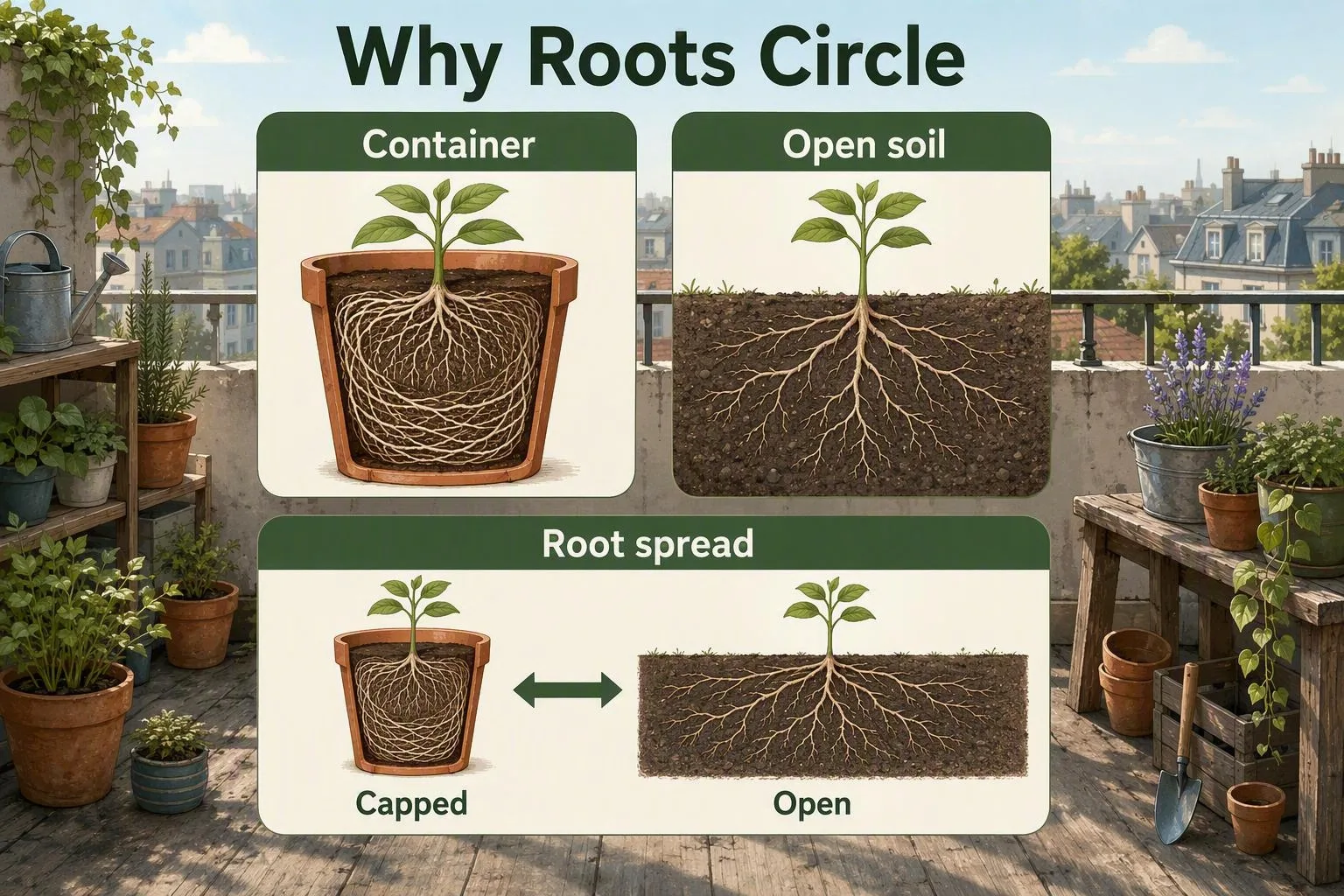
Root-bound is easy to spot once you know the signature. Water poured on top runs out of the drainage holes almost immediately instead of soaking in, because there's more root than mix left. The plant wilts by early afternoon even though you watered that morning. New growth gets smaller and paler while the plant keeps flowering desperately, which is a stress response rather than a good sign. Tip it out and you'll see a dense white mat of roots taking the shape of the pot. At that point potting up is the only real fix; trimming the leaves to match won't restore the harvest.
Potting Mix Dries Out Faster Than You'd Expect
A garden bed loses moisture from one surface: the top. A pot loses it from the top, through the drainage holes, and in many cases straight through the sides. It also has a terrible surface-area-to-volume ratio compared with the ground, and unlike a bed it has no deep, cool reservoir underneath to wick from. Whatever water is in there is all there is.
Potting mix makes this sharper. It's built to be light and free-draining, typically from peat or coir, bark and perlite, which means it holds air where garden soil would hold a slug of water. That's deliberate, because roots in a sealed container drown easily, but the trade-off is that the reserve empties quickly. It's also why the physics of drainage in a pot surprises people, and why drainage holes aren't enough on their own to guarantee a well-drained root zone.
Material changes the answer more than most people expect:
- Unglazed terracotta is porous. Water evaporates through the clay itself, so the mix dries from the sides inward as well as the top down. Beautiful, breathable, thirsty.
- Glazed ceramic and plastic seal the sides, so water leaves mainly from the surface and the holes. These are the forgiving ones.
- Fabric pots breathe hardest of all. They give excellent root structure and are close to impossible to overwater, and in a hot, windy spot they'll have you watering daily.
Colour and exposure stack on top. A dark plastic pot in unbroken afternoon sun gets uncomfortably hot to the touch on its sunny side, and the roots pressed against that wall are the ones that brown first while the middle of the root ball looks fine. Shading the pot itself, even by parking another pot in front of it, is a cheap fix that people skip because it feels too simple to matter.
Wind is the driver that catches people out. Moving air strips away the thin layer of humid, still air that sits against leaf surfaces and the soil top, so evaporation keeps running at full tilt instead of slowing as the air immediately around the plant saturates. On an exposed balcony, a breezy mild day can dry a pot faster than you'd guess from the temperature alone. If your watering routine works in the garden and fails on the balcony, wind exposure is where I'd look before anything else.
As a starting range in warm weather: expect every one to three days for a mid-sized pot in decent sun, daily or twice daily for anything small, terracotta or fabric in a heatwave, and something closer to weekly for the same crop in an in-ground bed. Then stop using the range. The reliable test is weight: lift the pot when you've just watered, lift it again two days later, and learn the difference in your hands. A finger pushed 5 cm (2 in) into the mix is the backup when the pot's too heavy to lift.
Every Watering Washes Nutrients Out the Bottom
Plants don't eat solids. They take up nutrients as ions dissolved in soil water, which means anything dissolved can travel with that water. In a bed, water that drains below the roots carries nutrients into subsoil that deeper roots may still reach. In a pot, it carries them onto your balcony floor and out of the plant's life permanently.
Nitrogen goes first. In its usual available form, nitrate, it carries a negative charge and isn't held onto by the growing medium the way positively charged ions are, so it moves with the water almost as freely as a dye. Potassium travels more slowly. Phosphorus tends to stay put longest. That's exactly why the classic hungry-container look is uniform yellowing of the oldest, lowest leaves while new growth stays green: the plant is stripping mobile nitrogen out of its old leaves to build new ones.
Two practical consequences. First, the standard bed advice of feeding at label strength every few weeks tends to leave gaps in a container that's being watered daily. Half-strength liquid feed at twice the frequency delivers the same total but keeps a steadier supply in the root zone, and it's much harder to burn roots that way. Second, bagged mixes usually come with some starter fertiliser blended in, and my working assumption is that it's a head start rather than a feeding plan. With a hungry crop in warm weather and regular watering, I'd plan to begin feeding within the first month or two rather than waiting for the leaves to tell me. If the bag states a duration, believe the bag over me.
Here's the part that gets left out of the usual telling: that same leaching is also protecting you. Fertiliser salts and the minerals in tap water build up in a container that never drains freely, and you'll see it as a white or pale crust on the mix surface and around the rim. Watering generously enough that a little runs out the bottom flushes those salts through. So the goal isn't to stop the drainage, it's to feed little and often against it. A pot that never drains has a different, worse problem.
The One Advantage a Ground Bed Doesn't Have: You Can Move the Plant
Everything above is a constraint. This is the compensation, and it's genuinely large.
The sun does not stay where it was in April. On a balcony the sun's arc climbs and shifts through spring and summer, and the shadows thrown by your own railing, the wall above, the neighbour's screen and the building opposite all move with it. A spot that gave five hours in May can be down to two by August, or the reverse. A bed can't respond to that. A pot can be walked three metres to the left in ninety seconds. Before you commit anything to a permanent corner, it's worth taking an afternoon to run a sunlight audit on your balcony and mark where the light actually falls at 9am, noon and 3pm, because guessing from memory is reliably wrong.
Mobility also buys you weather insurance. A tender plant can come indoors or under an eave the night a late frost is forecast. A wind-battered pepper can go behind a heavier pot for a week. Dwarf citrus can spend summer outside and winter by a bright window, which is the entire reason people can grow it at all in cold climates.
The trade-off is uncomfortable, though, and worth being honest about: weight and mobility pull in opposite directions, and pot size is where the tension lands. The 45-litre pot that makes a tomato happy is the one you will never move again once it's full. My call is to stop pretending the whole collection is mobile. Pick the two or three plants whose season genuinely depends on being relocated, put those on a wheeled plant caddy, and let everything else sit where it's well placed from day one.
Weight, Wind and What a Balcony Can Actually Hold
Dry potting mix is astonishingly light, which is how a 50-litre bag gets carried home under one arm. Saturated, it's a different object. Wet peat- or coir-based mixes sit broadly in the range of 600 to 900 kg per cubic metre depending on the blend and how much water they're holding, so a 50-litre pot filled and just watered plausibly lands somewhere around 30 to 45 kg (roughly 65 to 100 lb) before you add the pot itself, the saucer, or a two-metre tomato plant. Line four of those along a railing and you're looking at a load worth thinking about rather than assuming.
I'm not going to tell you what your balcony holds, because nobody writing an article can. Design loads vary by country, by building age, by construction type, and by whether the slab is cantilevered. What I'd do instead: keep the heaviest containers close to the building wall rather than out at the balcony edge, where the structure is generally best supported; spread rather than cluster; and if you're planning anything genuinely heavy, such as a row of large pots or a raised trough, check your building's rules or ask the managing agent or a structural engineer for the actual figure for your unit. Rented flats often have specific lease terms on this too. Weight limits for balcony and rooftop container gardens is the piece to read before ordering half a pallet of mix.
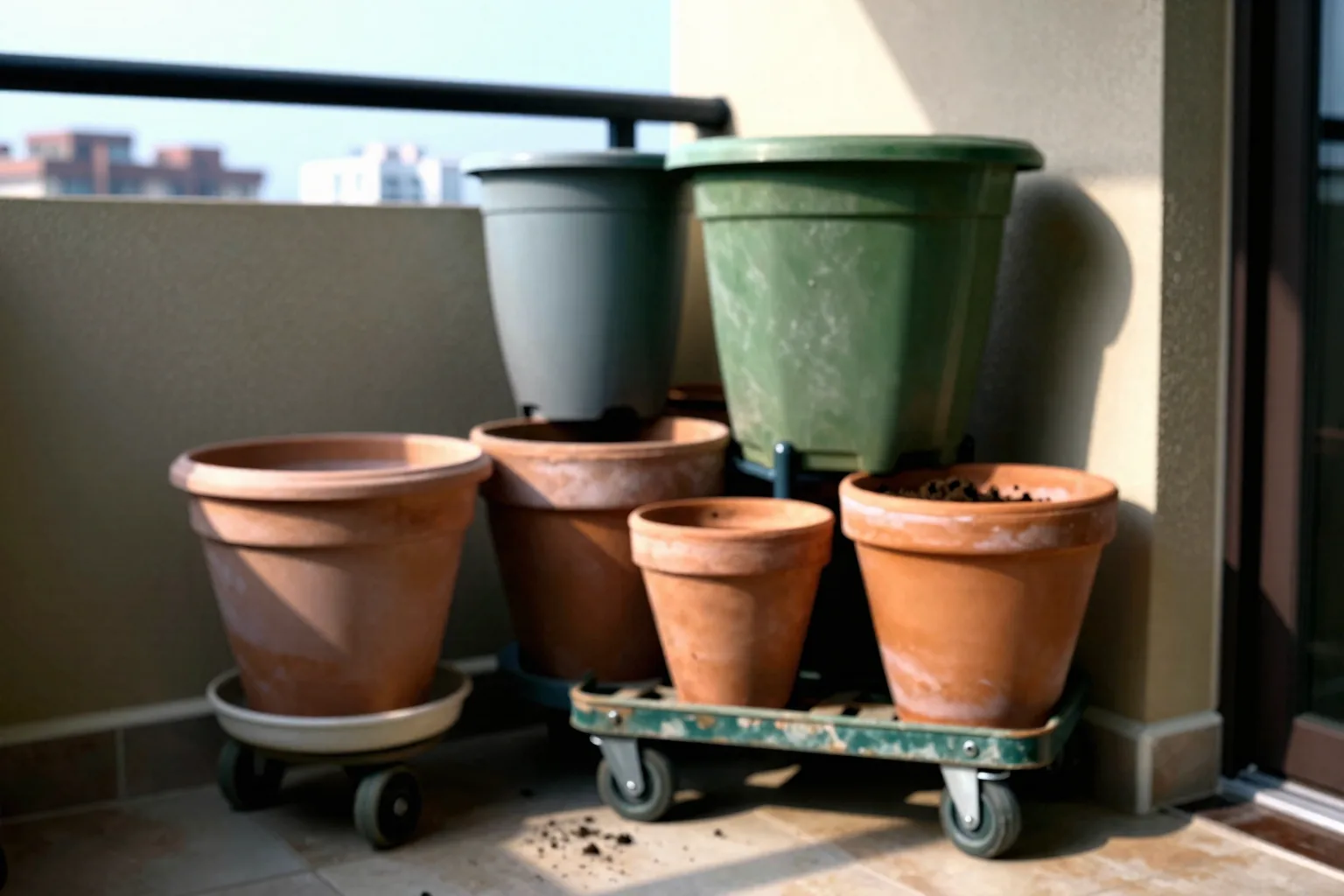
Wind does two separate jobs, and only one of them is obvious. The dramatic one is leverage: a tall plant in a light pot is a sail on a narrow base, and a gust that a garden plant would shrug off will lay a container flat and snap the stem at soil level. Heavy, wide-based pots, grouping containers so they shelter each other, and tying tall crops to a stake set close to the stem all help. Never balance a pot on the top rail of a railing, and never hang one on the outside face of a balcony where it can fall into a public space below.
The quiet job is the drying already described. Wind exposure is why two identical pots on the same balcony can need water on different days. The corner one, catching the flow that accelerates around the building, will be first.
So What's Actually Worth Growing First?
Run every candidate crop through the four constraints above and the shortlist writes itself. The question isn't which vegetable you like most. It's which one delivers something you'd actually eat, per litre of mix, per hour of sun you have, with the smallest penalty when you miss a watering.
The crops that forgive a container:
- Soft herbs (basil, parsley, coriander, chives, thyme). Shallow-rooted, harvested young, and expensive to buy in supermarket sprigs, which is where the real value sits. In a shared container, mint's rhizomes, the horizontal underground stems it spreads by, will typically outcompete whatever it's planted with within a season, so give mint a pot of its own. If you want a starting line-up, best herbs for a first-season container garden is the natural companion to this article.
- Cut-and-come-again salad. Sow, cut leaves at 10 cm, let it regrow, cut again. Tolerates part shade, which matters if your balcony is short of sun.
- Strawberries. Genuinely suited to pots, tolerate a small root volume, and hanging or tiered planting uses vertical space nothing else will.
- Chillies and compact peppers. Small plants relative to their yield, and they take heat and a hot pot wall better than most.
- Spring onions, radish, bush beans. Quick, shallow, and useful for filling gaps between slower crops.
The crops that ask for a lot: full-size indeterminate tomatoes, courgette, sweetcorn, pumpkins, brassicas. Not impossible, and a well-fed tomato in a 40-litre pot is a real pleasure. But each one wants a big container, near-daily watering in summer, staking, and consistent feeding, and one missed weekend in July can cost you the crop.
My contrarian pick for the "fun rather than food" pile is potatoes. Container potato growing is enormously satisfying, the harvest moment is genuinely great, and the return per litre of mix is poor compared with almost anything green. Grow them because tipping the sack out is a good day, not because you're going to stop buying potatoes.
Which leads to the spending advice nobody gives: three good pots beat ten cheap ones. A first season with three well-sized containers, one bag of decent mix and a watering can that's actually big enough will teach you more, and feed you better, than a balcony packed with 15 cm pots that all dry out by lunchtime.
The five-minute checklist for the shop aisle
- Find the litre or gallon capacity printed on the pot. If it isn't printed, the diameter alone tells you very little. Ask, or pick another pot.
- Check the drainage holes. Multiple holes, and not sealed by a flat saucer pressed against them.
- Lift the empty pot, then imagine it plus 30 kg. That's your mobility answer.
- Buy potting mix, not topsoil, not "garden soil", not "planting soil" meant for beds.
- Buy a liquid feed at the same time. You will need it sooner than you think, and the trip back is the reason people don't feed.
Worth screenshotting before you go, if you're reading this standing in the aisle.
Three Questions That Come Up Before the First Pot
Is container gardening more expensive than a bed in the ground?
Upfront, usually yes. You're buying the container and the growing medium, which a bed gets free from the ground under it, plus saucers and possibly a stand. Against that, there's no digging, no bed edging, no soil testing and no amending a difficult clay or sand. Ongoing, containers cost a bit more: fertiliser, because it leaches, and refreshing or replacing the mix every couple of seasons as it compacts and the organic fraction breaks down. Over three or four years, the pot itself is usually the cheapest part of the whole exercise if you buy it once and buy it decent.
Can I use garden soil in a container instead of potting mix?
I'd advise against it. Garden soil relies on structure built by roots, worms and weather, and that structure collapses in a pot. It compacts, waterlogs, then sets hard when it dries, and the fine particles cut off the air that container roots need more urgently than bed roots do. It can also bring weed seed, fungus gnat larvae and soil pathogens onto your balcony. A commercial potting mix is engineered to keep air-filled porosity in a shallow, contained profile, which is a different design brief from bed soil. Mixing a shovel of garden soil into a large container for a bit of mineral bulk is a defensible middle ground; filling a pot with it is not.
Is a raised bed the same as a container?
Only partly, and the difference is the bottom. A raised bed sitting open to the earth beneath drains into that earth and lets roots travel down into it, so it behaves largely like in-ground growing with better drainage and a comfier working height. The root ceiling and the leaching pressure described here barely apply. A raised bed built on a solid balcony floor or lined so it can't reach soil is a container, just a big one, and everything in this article applies to it in full. Volume being what it is, though, a large sealed bed is a very forgiving container: more litres means slower drying and more nutrient buffer.
Next step, before you buy anything else: go and look at the pots you already own and find their capacity, either printed on the base or by filling one with water from a measuring jug and counting. Then check where the sun actually falls at midday this week. Those two numbers, litres and hours, decide what you can grow far more than any advice about technique. Get them written down and the rest of this site's crop guides will tell you exactly what fits.
Frequently Asked Questions
Is container gardening more expensive than planting a bed in the ground?
Upfront costs are usually higher (pots, bagged mix, possibly a stand or saucers), but there's no bed prep or soil amendment; ongoing cost is mainly replacing mix every couple of seasons and more frequent fertilizer, since nutrients leach out with drainage.
Can I just use garden soil in a container instead of buying potting mix?
Not recommended: garden soil compacts in a pot, drains poorly, and can carry pests or weed seed; potting mixes are formulated to stay light and free-draining under the different physics of a contained root zone.
How is container gardening different from a raised bed?
A raised bed is usually open to the ground below (or holds a much larger, less restricted soil volume) so it behaves more like in-ground growing, while a true container has a fixed, sealed volume and drains only through its holes — the root-ceiling and leaching issues in this article apply fully to containers but only partly to raised beds.