Container Gardening Flowers: 10 Best Blooms for Small Pots
A 15 cm (6 in) pot holds roughly 2–3 litres (0.5–0.8 US gal) of mix; a 20–25 cm (8–10 in) pot usually holds roughly 4–12 litres (1–3 US gal), depending on its shape. That is why sweet alyssum, lobelia and viola are better bets for the smallest pots than a full-sized petunia or pelargonium: they can look finished before the container becomes a daily watering chore.
At the garden-centre shelf, the largest flowers often get the best photographs. On a balcony, the better question is less glamorous: can this plant’s roots, mature width and water demand fit the pot and the light you actually have? A flower that stays compact and productive in 2 litres is a better buy than a spectacular variety that needs three times the root volume.
My rule for container gardening flowers is simple: buy for the conditions you can maintain, not the display you hope to create. The right small-pot flower gives you colour without forcing you to compensate for a poor match with constant pruning, emergency watering or a larger container than your balcony can safely carry.
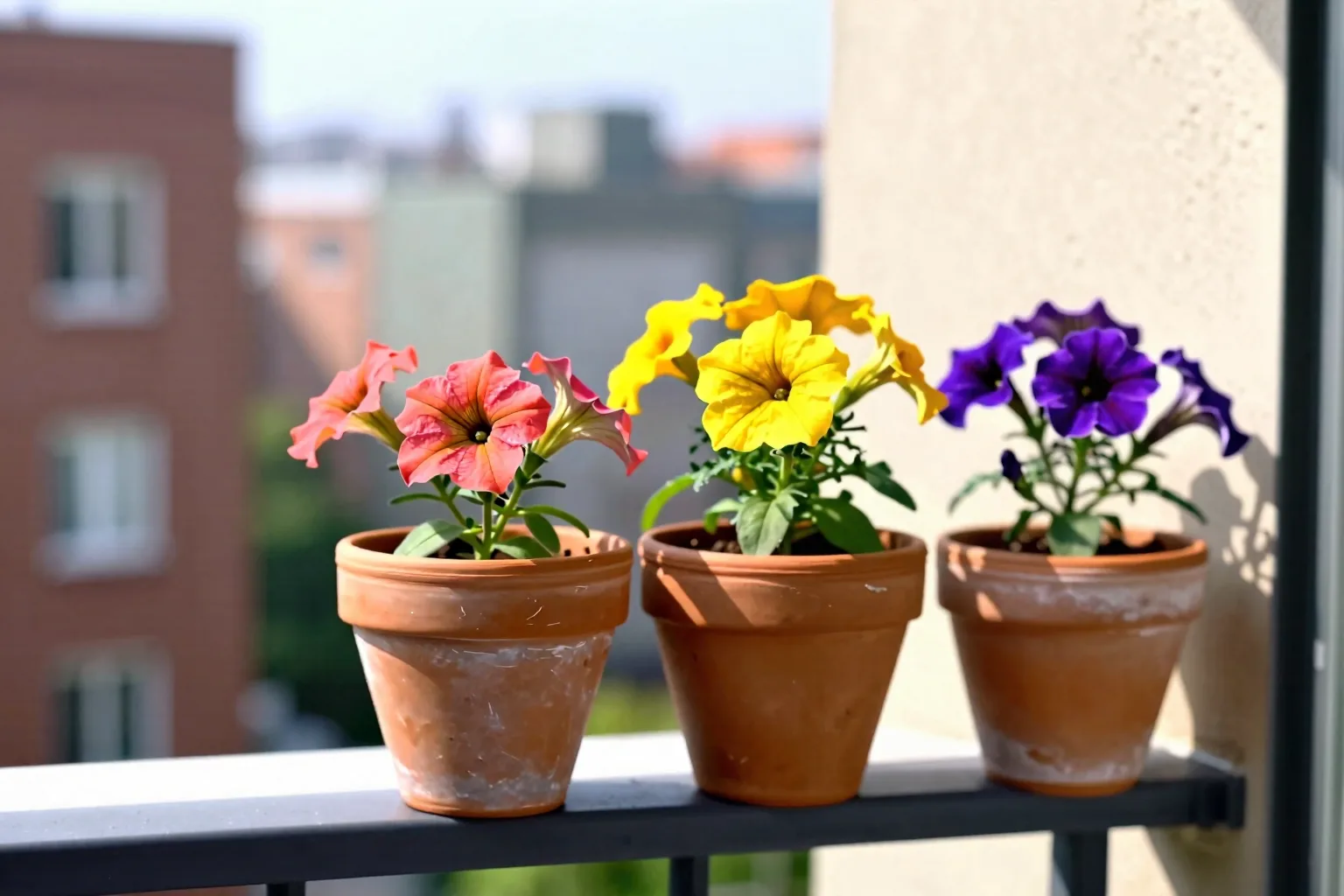
Start with the balcony, not the flower colour
A pot is a small root environment, not a miniature flower bed. The mix has a limited water reserve, nutrients can leave through the drainage holes, and roots cannot travel sideways to find a cooler or wetter patch. The benefit is mobility: you can move a container toward morning light, away from harsh afternoon sun or under cover before a frost.
Before buying, I’d run through five tests:
- Usable sunlight. Count direct sun where the pot will sit, but also notice reflected light from a pale wall and the heat from glass or masonry. A plant tag that says full sun describes its preferred condition, not a promise that one hour of winter sun will produce the same flowering as a long summer exposure. Use How to measure balcony sunlight before buying plants if you need a repeatable way to check the spot.
- Mature spread. The width on the label is the plant’s expected finished footprint. It tells you whether the foliage will overhang the pot, shade a neighbour or leave wet leaves packed together.
- Root volume. Match the pot to the plant’s root mass, not just the height of the nursery plant. A small plug can look happy for a fortnight while already using most of its available root space.
- Watering capacity. Ask how often you can inspect the pot in warm weather. A thirsty trailing plant may be a fine choice beside your kitchen door and a poor one on a windy top-floor balcony.
- Growth habit. Upright, mounding and trailing plants use space differently. A trailer needs room over the rim; an upright plant needs enough width to stay stable and enough light to avoid leaning.
If you are uncertain about the container itself, compare the dimensions with How to choose the right pot size for container flowers. Diameter alone can mislead: a shallow, wide bowl and a tall, narrow pot may measure the same across the top but hold very different amounts of mix.
The shop-aisle shortlist: 10 flowers matched to pot size, light and thirst
The table assumes one established plant per pot. It gives a practical starting point rather than a hard minimum; a compact cultivar’s label overrides the general figure, especially if its mature spread is smaller than the standard type.
| Flower | Starting pot per plant | Light | Habit | Water demand | Main small-pot risk |
|---|---|---|---|---|---|
| Petunia | 20–25 cm (8–10 in), 4–8 L (1–2 US gal) | Full sun | Mounding or trailing | High | Dry root ball, sparse flowering |
| Calibrachoa | 20–25 cm (8–10 in), 4–8 L (1–2 US gal) | Full sun | Trailing | High | Rapid wilt after drying |
| Dwarf zinnia | 15–20 cm (6–8 in), 2–5 L (0.5–1.3 US gal) | Direct sun | Upright or branching | Medium | Leggy growth in weak light |
| French marigold | 15–20 cm (6–8 in), 2–5 L (0.5–1.3 US gal) | Direct sun | Compact upright | Medium | Wet, crowded foliage |
| Impatiens | 15–20 cm (6–8 in), 2–5 L (0.5–1.3 US gal) | Bright shade or morning sun | Mounding | Medium | Scorch or permanently wet mix |
| Wax begonia | 15–20 cm (6–8 in), 2–5 L (0.5–1.3 US gal) | Bright shade to gentle sun | Compact upright | Low to medium | Leaf scorch or root rot |
| Lobelia | 15–20 cm (6–8 in), 2–3 L (0.5–0.8 US gal) | Bright light, morning sun | Trailing or mounding | Medium | Heat pause and dry-out |
| Viola | 15–20 cm (6–8 in), 2–4 L (0.5–1 US gal) | Cool sun or bright part shade | Compact | Medium | Summer heat and stretching |
| Sweet alyssum | 15 cm (6 in), 2–3 L (0.5–0.8 US gal) | Sun to part shade | Low and spilling | Medium | Dry root ball in heat |
| Pelargonium | 20–25 cm (8–10 in), 4–8 L (1–2 US gal) | Full sun | Upright or trailing | Low to medium | Cool, wet roots |
One plant per small pot is not a rule against combinations; it is a way to give each root system a fair share of the mix. Three nursery plants crowded into a 15 cm container can look impressive for ten days, then compete for water and air before they have made enough root mass to support the top growth. I prefer one well-matched plant with room to fill out over three mismatched seedlings that look impressive for ten days.
There is one useful exception: a container sold as a hanging basket may be designed for several small plugs, but treat its stated capacity as the limit. Do not count the empty space between plants as extra root volume.
The sun-loving spillers: petunia and calibrachoa
Petunia and calibrachoa look interchangeable on a plant bench because both can tumble over a rim. Their care is not identical in practice. A petunia generally makes a broader mound and carries more leaf area, so one plant is more dependable in a 20–25 cm (8–10 in) pot with about 4–8 litres (1–2 US gal) of mix. Calibrachoa can make a dense spill from a similar pot, but its fine, trailing growth does not make it safe to let the root ball dry.
Give both a bright, open position and a potting mix that drains freely while still holding some moisture. Full sun supplies the energy for flowering; a dim position gives you stretched stems and fewer blooms even if the plant stays green. Once the plant has settled into fresh mix and begun active growth, regular liquid feeding can replace nutrients that leave with repeated watering. Begin according to the fertiliser label and the condition of the plant rather than feeding a wilted plant immediately.
Many modern calibrachoa types are described as self-cleaning, meaning old petals drop without much hand removal. Petunias still benefit from removing faded flowers and the developing seed capsule behind them, especially if the plant has started to look tired. Pinch or cut just above a healthy leaf joint; a long bare stem cut at its tip may produce another bare stem.
The failure sequence is easy to miss: leaves soften, buds drop, stems become sparse, and the centre of the root ball may be dry even though the outer surface looks slightly damp. Rehydrate slowly, allowing water to soak in rather than running straight down the pot wall. If the mix has become water-repellent, two or three slow passes are more useful than one flood.
Here is the condition that flips my recommendation. On a hot, windy balcony where you cannot check moisture most days, I would choose a less thirsty flower instead of trying to rescue either of these with a tiny daily splash. Their generous top growth increases the demand while the small pot limits the supply.
Upright colour in heat: dwarf zinnia and French marigold
Dwarf zinnias and French marigolds earn their place on a sunny patio because they provide upright colour without requiring a long trail over the edge. The word dwarf matters. A compact zinnia or French marigold can work in a 15–20 cm (6–8 in) pot with roughly 2–5 litres (0.5–1.3 US gal) of mix; a standard, tall cultivar can outgrow that footprint and become top-heavy.
Give them several hours of direct light and enough space around the foliage for air to move after watering. This is not just tidiness. A dense canopy that stays wet for long periods creates a better setting for mildew and soft, damaged leaves than a plant whose stems can dry between wettings.
You can sow zinnias and marigolds directly into the final pot once the weather and mix are warm enough, or transplant a young plant carefully after cold nights have eased. Starting in a small cell and leaving it there too long creates a root-bound plug that takes longer to fill the new container. Plant at the same depth as the nursery root ball, then remove faded flower heads to redirect the plant toward new growth.
Leggy stems point me first toward weak light or crowding. A white powder on leaves suggests persistently damp foliage and poor airflow. A plant that barely grows after planting may simply be meeting cold roots; moving it to a warmer, brighter position is more useful than adding fertiliser to inactive roots.
Viola is the cool-weather exception to the summer list
Viola and pansy types are excellent small-container flowers, but they should not be judged by the same calendar as petunia. One plant can start in a 15–20 cm (6–8 in) pot containing about 2–4 litres (0.5–1 US gal) of mix. In cool weather it can take sun; in warmer conditions, bright part shade can extend the display.
Plant in spring or autumn where your local climate gives those seasons enough cool weather. Keep the mix evenly moist without leaving the pot standing in water. A viola stressed by heat may droop during the afternoon while the mix is still damp, and its flowers can look faded or papery. An underwatered plant usually has a dry upper layer and a noticeably light pot, then begins to recover after a thorough drink.
Trim stretched stems back to a leafy joint rather than shearing the whole plant flat. Viola is a strong choice for a windowsill or balcony with limited direct sun during a cool season, not a promise of uninterrupted bloom through the hottest part of summer.
When the balcony gets little direct sun: impatiens, wax begonia and lobelia
For the one-to-two-hour-sun reader, impatiens and wax begonia are the safer starting points among this list. They can flower in bright shade or gentle morning sun, while petunia and zinnia usually need more direct light to keep their stems compact and their flowering strong. Wax begonia is especially useful where the light is bright but the pot does not receive harsh afternoon rays.
Use a 15–20 cm (6–8 in) pot with about 2–5 litres (0.5–1.3 US gal) of mix for one compact plant. Lobelia also fits this range, but I would place it where it receives bright ambient light, morning sun or cooler temperatures. Deep shade can keep the foliage alive while giving you a thin, weakly flowering plant. Its fine stems also show heat and drought stress quickly.
Shade slows evaporation; it does not cancel the need for drainage. A shaded pot can stay wet because the surface dries slowly, and roots still need air spaces in the mix. Keep all three away from a permanently wet saucer. Yellowing leaves, a sour smell and collapse at the stem base point toward waterlogged roots rather than simple thirst.
Match the flower to the physical light pattern, not just the total light. A pale wall can throw useful reflected light into a darker corner. The balcony edge may receive a short band of morning sun, while the area behind a solid screen may remain the darkest position all day. Put lobelia and impatiens in the bright-but-sheltered zones, reserve gentle morning light for wax begonia, and avoid placing a sun-loving zinnia where the wall blocks its direct exposure.
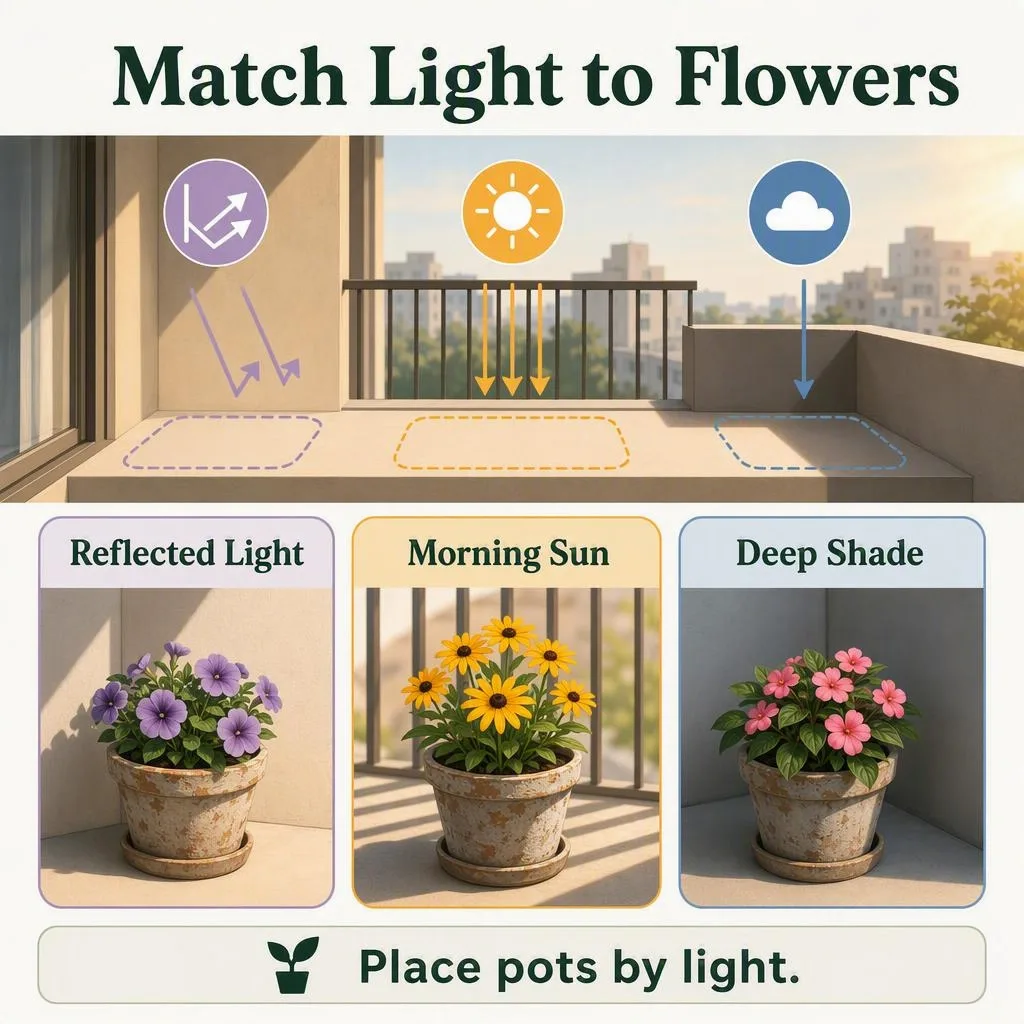
The other low-light failure is sudden exposure. A plant moved from a shaded shop bench straight into strong afternoon sun can develop bleached or brown leaf patches even when the mix is moist. Acclimatise it over several days by increasing the brighter exposure gradually. If growth is pale and stretched rather than scorched, increase light first; do not respond by adding more feed to a plant that cannot use the extra energy.
Sweet alyssum: the small, fragrant filler that does not need a large root zone
Sweet alyssum is one of the most convincing choices for a genuinely small pot. One plant can start in about 15 cm (6 in) and 2–3 litres (0.5–0.8 US gal) of mix, provided the container has usable drainage and the pot is not exposed to relentless drying wind.
It gives you a low, spilling shape and a noticeable sweet fragrance in sun to part shade. After a heavy flush of bloom, trim the spent growth back modestly to encourage a fresh cushion rather than leaving long, exhausted stems. The plant may pause during extreme heat, and a dry root ball can turn a full-looking mound into sparse stems surprisingly quickly.
Use alyssum as a single small-pot specimen, a soft edge on a larger planter or a filler around an upright plant. I would not choose it to occupy the entire depth of a large container; its value is that it can finish attractively without demanding one.
Pelargonium earns its larger pot by coping with a drier routine
Pelargonium, commonly sold under the garden-centre name zonal geranium, is my pick among these ten for a sunny grower who is more likely to overwater than to feed constantly. That is a preference, not a claim that it can be neglected. Its thicker stems and larger root mass still need a 20–25 cm (8–10 in) pot with roughly 4–8 litres (1–2 US gal) of mix for one mature plant.
Let the upper mix dry slightly before watering again, then soak the whole root zone. Slight dry-down is different from drought tolerance: a plant left limp repeatedly will shed leaves and reduce flowering. Compact zonal types suit upright pots; trailing types are better over a rim or in a hanging container. Remove faded flower clusters at the stem joint and feed during active growth once the fresh mix’s initial nutrient charge has begun to diminish.
Cold, wet mix is the classic mismatch. Soft stems, yellow lower leaves and poor flowering can follow a pot that stays damp for too long, particularly in cool weather. If frost is possible, move a prized plant under cover before the first frost rather than waiting for visible damage. A bright, cool indoor position and reduced watering can preserve it, but indoor light is often weaker than the plant wants, so expect some leaf drop or stretching and prune it back when active growth returns.
For plant-specific cross-checking, RHS plant profiles for petunia, calibrachoa, begonias, impatiens and pelargoniums are useful alongside the label supplied with the cultivar. Labels vary in how they describe mature size, so the plant’s stated spread is the detail I would use to overrule a generic pot recommendation.
Plant once, then manage the root zone rather than a calendar
The first watering is part of planting, not a separate chore. Put the pot in its final position before filling it if it is heavy or exposed to wind, and check that the drainage holes are open. Fill with purpose-made potting mix rather than garden soil. If you want the mechanism in plain language, Potting mix versus garden soil for container flowers explains why a mix designed for pots gives roots more usable air space and a more predictable water path.
The cautious answer on last year’s potting mix is no: I would not fill a fresh small pot entirely with mix that has already supported a full season of flowers. Its structure may have collapsed, soluble nutrients have been carried out through watering, and old roots or disease residue can remain. If reuse is unavoidable for an ornamental crop, blend a modest amount of old mix into mostly fresh mix only when the old material smells clean, drains normally and came from healthy plants; discard it if it stayed sour, waterlogged or diseased. This is a risk-reduction choice, not a guarantee that reused mix will fail.
Set the plant at the same depth as it sat in the nursery container. Fill around the root ball, firm the mix lightly, and leave about two fingers, or 3–4 cm (1–1.5 in), below the rim. That gap gives you room to water slowly without washing mix over the edge. Do not bury the crown or lower stems simply to make a short plant look taller in the pot.
Water in two or three slow passes until a little water runs from the drainage holes. The runoff confirms that water has travelled through the root zone; it does not prove that every dry pocket has been rewetted, which is why a very dry pot may need a pause between passes. The plain-language explanation in Container drainage holes: how many you need and why gravel fails covers the wet band that can sit above a drainage opening, called a perched water table. A layer of gravel under the mix does not create extra root volume or automatically remove that wet band.
After planting, judge the next watering by the plant and the pot. Push a finger 2–3 cm (about 1 in) into the surface, lift the container if you can, and notice whether the mix feels cool and holds together or feels dry and loose. In a plastic pot in full sun and wind, check close to daily. In a glazed pot in part shade, the same plant may need checking every third day rather than every day. Those are checking intervals, not a watering timetable; rain, pot depth, foliage size and a heatwave can change them quickly.
With fresh, pre-fed mix, I would normally wait about 2–3 weeks before beginning a dilute liquid feed, unless the mix label says it contains little or no starter fertiliser. Feed an actively growing plant with moist roots, not a plant wilting in dry mix or sitting in cold water. If leaves are green but the plant is making foliage and no flowers, check light and crowding before increasing nitrogen-rich feed.
Deadhead with a purpose. Remove a faded flower and its developing seed pod while leaving nearby buds and healthy leaves. On petunia, calibrachoa and alyssum, a light trim can restore a matted or tired shape; on viola, cut back only the stretched section to a leafy joint. Avoid stripping a plant bare during a heatwave, because the remaining leaves are still its working surface.
During a heatwave, water thoroughly in the morning and inspect again later if the pot is small, exposed or full of trailing growth. Move heat-sensitive plants into temporary afternoon shade, but do not solve every wilt by adding water: a wilted plant in saturated mix needs root inspection and better drainage. For a holiday absence, group pots out of the strongest wind, test a capillary mat or reservoir system at least a week beforehand, and make sure the setup wets the mix without leaving the pot submerged. How to water balcony plants during hot, windy weather is the practical follow-up for that situation.
Before the first frost, bring tender pelargoniums under cover and move other frost-sensitive annuals to protection if you want to extend their display. Do not carry a cold, soaking pot indoors and place it beside a hot radiator; let excess water drain and choose the brightest cool position available.
Use the symptom before reaching for the fertiliser
- Wilted leaves, dry mix: water slowly until the root zone is wet, then check again later. If water runs straight down the sides, rewet in several passes or stand the pot in a shallow amount of water briefly before allowing it to drain fully.
- Wilted leaves, wet mix: suspect airless roots, blocked holes or a full saucer before adding water. Lift the pot, clear the holes and remove damaged roots only if the plant is already being repotted.
- Yellow leaves: check moisture and drainage first. Yellowing in a cold, wet pot is not a reliable signal to fertilise, and extra feed can add stress to roots that are not taking it up.
- No flowers: check direct light, mature crowding, recent transplant shock and excessive nitrogen in that order. Petunia, zinnia and marigold usually need more direct light than impatiens or wax begonia.
- Leggy growth: increase usable light and remove the longest weak stems. If the plant is naturally trailing, redirect it over the rim rather than forcing it into an upright shape.
Before the weekend, put the empty pots in their intended positions and mark which side receives morning sun, reflected light or the darkest shade. Buy one plant whose mature spread fits the pot, fill it with fresh mix, and water until runoff appears. In a week, check the upper mix and the newest growth; firm leaves and compact new shoots mean the match is sensible, while repeated midday wilt or stretched stems tells you to change the position before buying another flower.